Zhou Wen-Ya, Zheng Hong, Du Xiao-Ling, Yang Ji-Long
Department of Bone and Soft Tissue Tumor.
Department of Epidemiology and Biostatistics, Tianjin Medical University Cancer Institute & Hospital, National Clinical Research Center for Cancer, Tianjin 300060, China.
Cancer Biol Med. 2016 Jun;13(2):260-8. doi: 10.20892/j.issn.2095-3941.2015.0102.
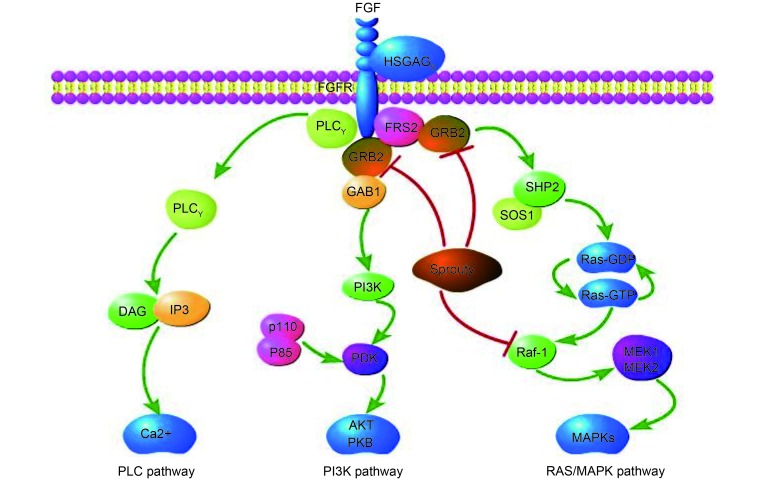
The fibroblast growth factor receptor (FGFR) family plays important roles in regulating cell growth, proliferation, survival, differentiation and angiogenesis. Deregulation of the FGF/FGFR signaling pathway has been associated with multiple development syndromes and cancers, and thus therapeutic strategies targeting FGFs and FGFR in human cancer are currently being explored. However, few studies on the FGF/FGFR pathway have been conducted in sarcoma, which has a poor outcome with traditional treatments such as surgery, chemotherapy, and radiotherapy. Hence, in the present review, we provide an overview of the role of the FGF/FGFR pathway signal in sarcoma and FGFR inhibitors, which might be new targets for the treatment of sarcomas according to recent research.
成纤维细胞生长因子受体(FGFR)家族在调节细胞生长、增殖、存活、分化和血管生成中发挥着重要作用。FGF/FGFR信号通路失调与多种发育综合征和癌症相关,因此目前正在探索针对人类癌症中FGFs和FGFR的治疗策略。然而,在肉瘤中针对FGF/FGFR通路的研究较少,肉瘤采用手术、化疗和放疗等传统治疗方法的效果较差。因此,在本综述中,我们概述了FGF/FGFR通路信号在肉瘤中的作用以及FGFR抑制剂,根据最近的研究,FGFR抑制剂可能是治疗肉瘤的新靶点。