Gharib Sina A, Malur Anagha, Huizar Isham, Barna Barbara P, Kavuru Mani S, Schnapp Lynn M, Thomassen Mary Jane
Division of Pulmonary and Critical Care Medicine, Department of Medicine, University of Washington, Seattle, WA, USA.
Computational Medicine Core, Center for Lung Biology, Department of Medicine, University of Washington, Seattle, WA, USA.
Respir Res. 2016 Jul 26;17(1):93. doi: 10.1186/s12931-016-0411-y.
Sarcoidosis is a multisystem immuno-inflammatory disorder of unknown etiology that most commonly involves the lungs. We hypothesized that an unbiased approach to identify pathways activated in bronchoalveolar lavage (BAL) cells can shed light on the pathogenesis of this complex disease.
We recruited 15 patients with various stages of sarcoidosis and 12 healthy controls. All subjects underwent bronchoscopy with lavage. For each subject, total RNA was extracted from BAL cells and hybridized to an Affymetrix U133A microarray. Rigorous statistical methods were applied to identify differential gene expression between subjects with sarcoidosis vs.
To better elucidate pathways differentially activated between these groups, we integrated network and gene set enrichment analyses of BAL cell transcriptional profiles.
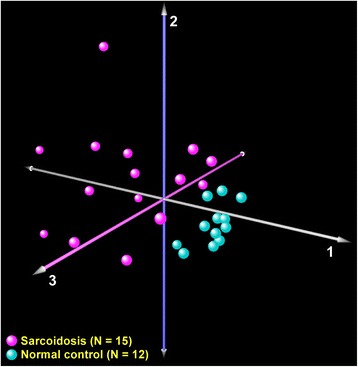
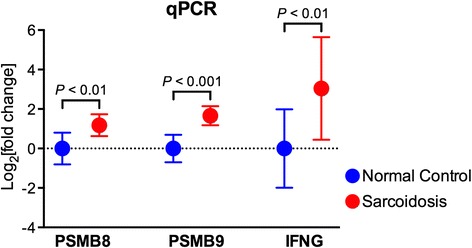
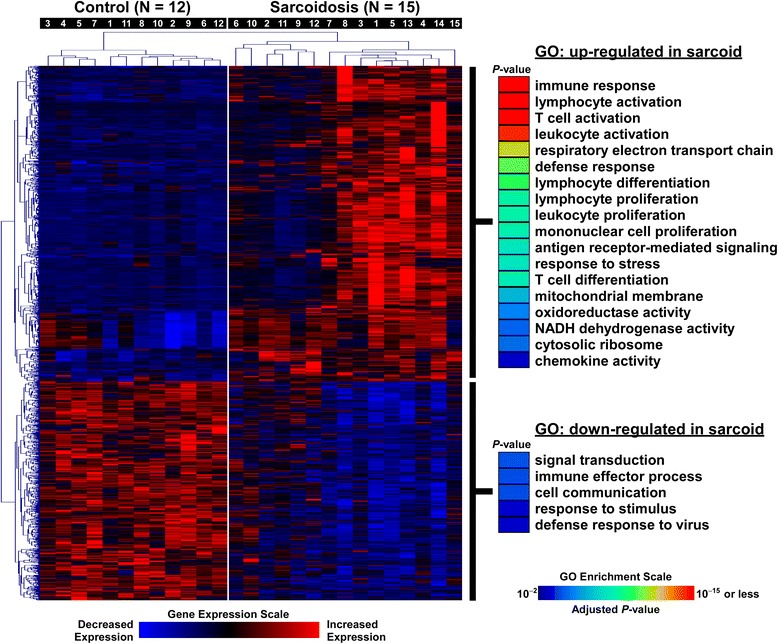
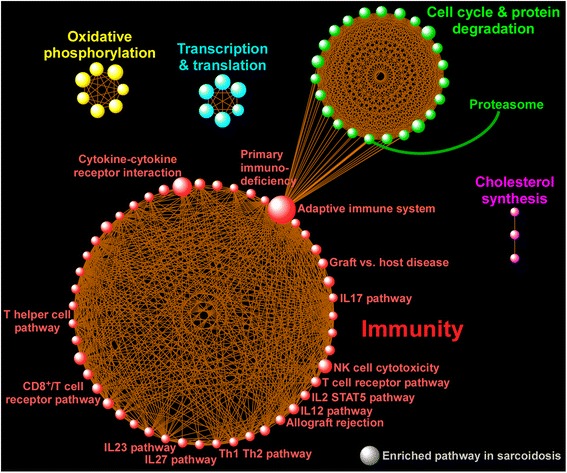
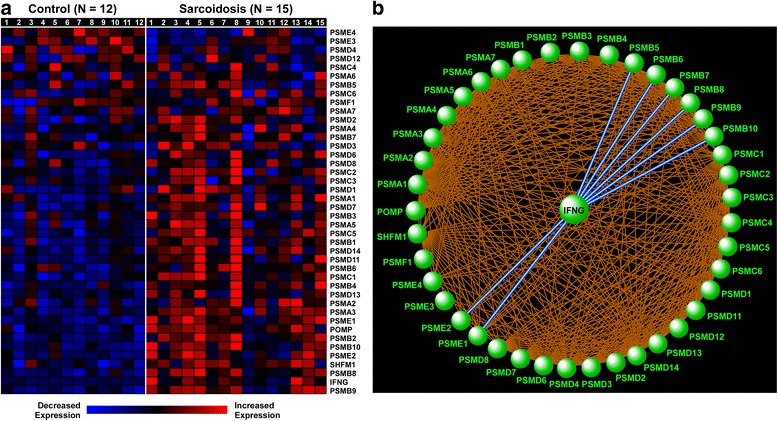
Sarcoidosis patients were either non-smokers or former smokers, all had lung involvement and only two were on systemic prednisone. Healthy controls were all non-smokers. Comparison of BAL cell gene expression between sarcoidosis and healthy subjects revealed over 1500 differentially expressed genes. Several previously described immune mediators, such as interferon gamma, were upregulated in the sarcoidosis subjects. Using an integrative computational approach we constructed a modular network of over 80 gene sets that were highly enriched in patients with sarcoidosis. Many of these pathways mapped to inflammatory and immune-related processes including adaptive immunity, T-cell signaling, graft vs. host disease, interleukin 12, 23 and 17 signaling. Additionally, we uncovered a close association between the proteasome machinery and adaptive immunity, highlighting a potentially important and targetable relationship in the pathobiology of sarcoidosis.
BAL cells in sarcoidosis are characterized by enrichment of distinct transcriptional programs involved in immunity and proteasomal processes. Our findings add to the growing evidence implicating alveolar resident immune effector cells in the pathogenesis of sarcoidosis and identify specific pathways whose activation may modulate disease progression.
结节病是一种病因不明的多系统免疫炎症性疾病,最常累及肺部。我们推测,采用无偏倚方法鉴定支气管肺泡灌洗(BAL)细胞中激活的信号通路,有助于揭示这种复杂疾病的发病机制。
我们招募了15例不同阶段结节病患者和12名健康对照者。所有受试者均接受支气管镜灌洗。对于每个受试者,从BAL细胞中提取总RNA,并与Affymetrix U133A微阵列杂交。应用严格的统计方法鉴定结节病患者与对照者之间的差异基因表达。
为了更好地阐明这些组之间差异激活的信号通路,我们对BAL细胞转录谱进行了网络和基因集富集分析。
结节病患者均为非吸烟者或既往吸烟者,均有肺部受累,仅2例使用全身性泼尼松。健康对照者均为非吸烟者。比较结节病患者与健康受试者的BAL细胞基因表达,发现超过1500个差异表达基因。结节病患者中,一些先前描述的免疫介质,如干扰素γ,表达上调。我们采用综合计算方法构建了一个由80多个基因集组成的模块化网络,这些基因集在结节病患者中高度富集。其中许多信号通路与炎症和免疫相关过程有关,包括适应性免疫、T细胞信号传导、移植物抗宿主病、白细胞介素12、23和17信号传导。此外,我们发现蛋白酶体机制与适应性免疫之间存在密切关联,突出了其在结节病病理生物学中潜在的重要且可靶向的关系。
结节病中的BAL细胞特征在于参与免疫和蛋白酶体过程的独特转录程序富集。我们的研究结果进一步证明肺泡驻留免疫效应细胞参与结节病发病机制,并鉴定出其激活可能调节疾病进展的特定信号通路。