Lee Ju Yup, Kim Nayoung, Kim Yong Sung, Nam Ryoung Hee, Ham Min Hee, Lee Hye Seung, Jo Wonjun, Shim Youngkwang, Choi Yoon Jin, Yoon Hyuk, Shin Cheol Min, Lee Dong Ho
Department of Internal Medicine, Seoul National University Bundang Hospital, Seongnam, Gyeonggi-do, Korea.
Department of Internal Medicine, Keimyung University School of Medicine, Daegu, Korea.
J Neurogastroenterol Motil. 2016 Oct 30;22(4):694-704. doi: 10.5056/jnm16007.
BACKGROUND/AIMS: This study was aimed at evaluating differences in the effects of repeated water avoidance stress (rWAS) on colonic movement, mucosal mast cell counts, cytokine levels, and visceromotor response (VMR) to colorectal distension (CRD) in rats of both sexes.
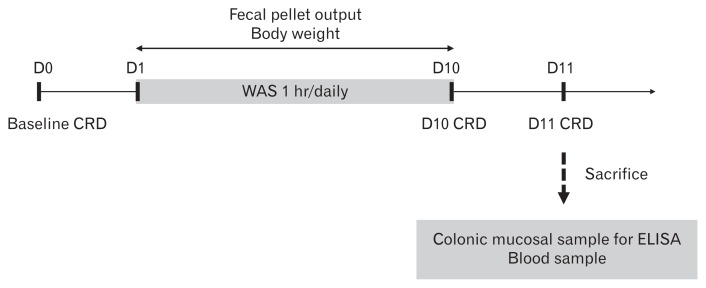
Wistar rats were divided into stress and no-stress groups. Rats in the stress group were exposed to rWAS (1 hr/day) for 10 days. Mucosal mast cells were immunohistochemically stained with anti-mast cell tryptase antibody and counted. The colonic mucosal cytokine levels were measured with enzyme-linked immunosorbent assay. The VMR to CRD (visceral analgesia) was assessed by using a barostat and noninvasive manometry.
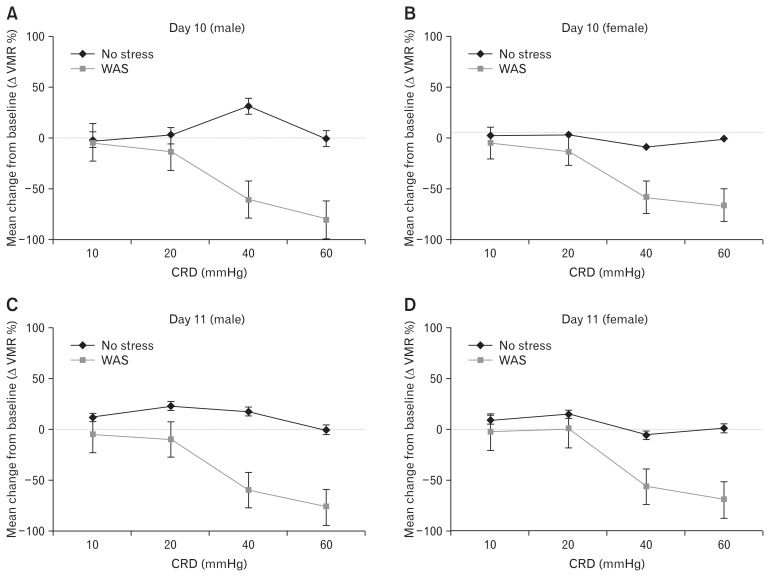
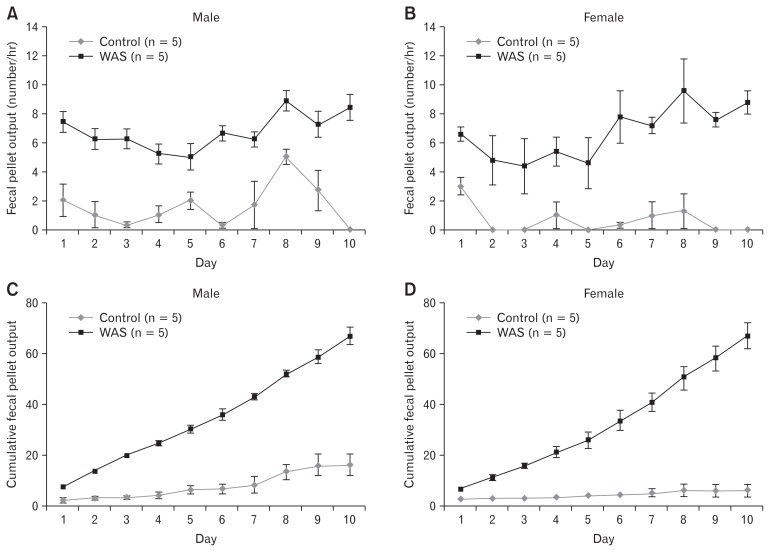
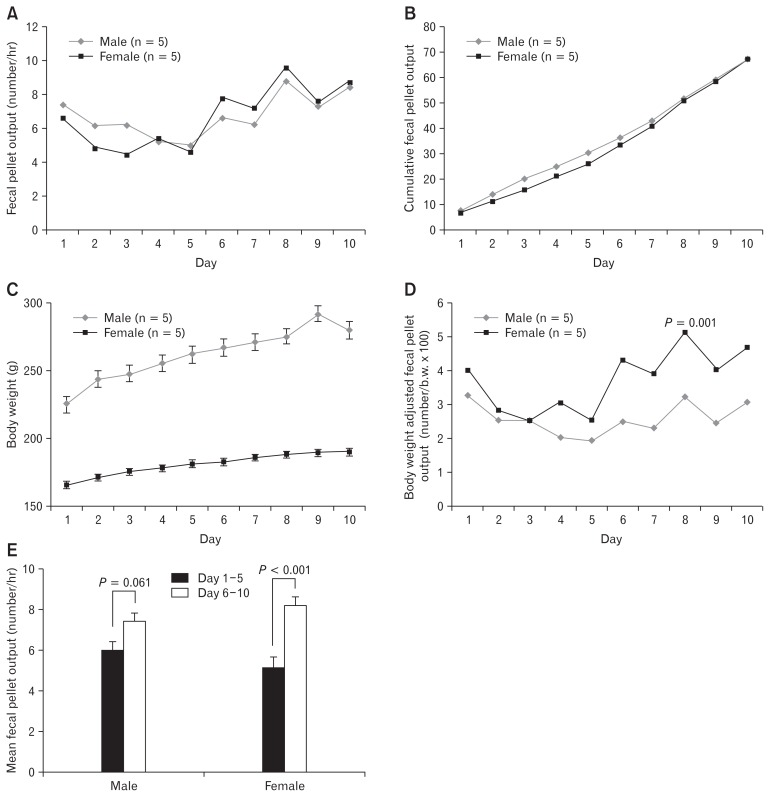
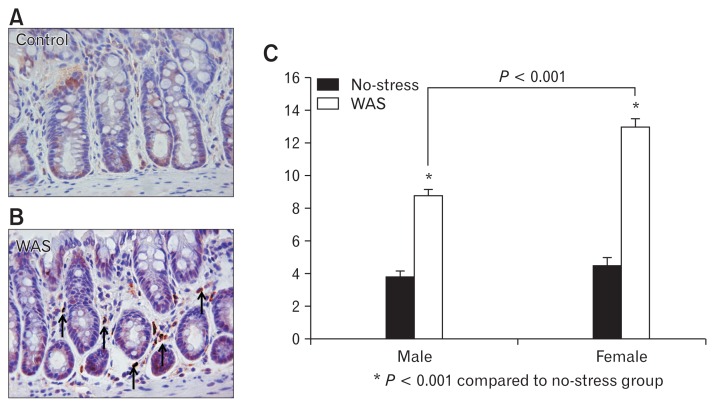
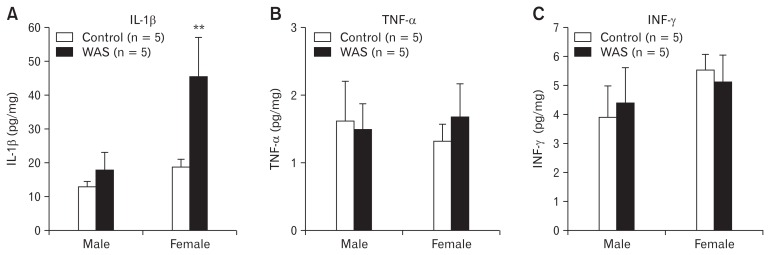
The mean number of fecal pellets in the rWAS group increased significantly as compared with that in the no-stress group in both sexes. After adjustment for body weight, the female rats had a significantly higher pellet output than the male rats. The mucosal mast cell count of the female rWAS group was higher than that of the male rWAS group (13.0 ± 0.9 vs 8.8 ± 0.6; < 0.001). The colonic mucosal interleukin-1β level was also higher only in the female rats of the rWAS group than in those of the no-stress group. On days 10 and 11, a decrease in VMR to CRD was observed at 40 and 60 mmHg in both sexes of the rWAS group, without a sex-based difference.
The colonic response to stress appeared to be more sensitive in the female rats than in the male rats. However, stress-induced visceral analgesia had no sex-related difference and the underlying mechanism needs to be further evaluated.
背景/目的:本研究旨在评估反复水回避应激(rWAS)对两性大鼠结肠运动、黏膜肥大细胞计数、细胞因子水平以及对结直肠扩张(CRD)的内脏运动反应(VMR)的影响差异。
将Wistar大鼠分为应激组和非应激组。应激组大鼠每天接受1小时的rWAS处理,持续10天。用抗肥大细胞类胰蛋白酶抗体对黏膜肥大细胞进行免疫组织化学染色并计数。采用酶联免疫吸附测定法测量结肠黏膜细胞因子水平。通过压力传感器和无创测压法评估对CRD的VMR(内脏镇痛)。
与非应激组相比,rWAS组两性大鼠的平均粪便颗粒数均显著增加。在调整体重后,雌性大鼠的粪便排出量显著高于雄性大鼠。雌性rWAS组的黏膜肥大细胞计数高于雄性rWAS组(13.0±0.9对8.8±0.6;<0.001)。仅rWAS组的雌性大鼠结肠黏膜白细胞介素-1β水平也高于非应激组。在第10天和第11天,rWAS组两性大鼠在40和60 mmHg时对CRD的VMR均降低,且无性别差异。
雌性大鼠对压力的结肠反应似乎比雄性大鼠更敏感。然而,应激诱导的内脏镇痛无性别差异,其潜在机制有待进一步评估。