Department of Biomedical Sciences, Colorado State University, Fort Collins, Colorado, USA.
School of Biomedical Engineering, Colorado State University, Fort Collins, Colorado, USA.
Physiol Rep. 2021 Oct;9(19):e15066. doi: 10.14814/phy2.15066.
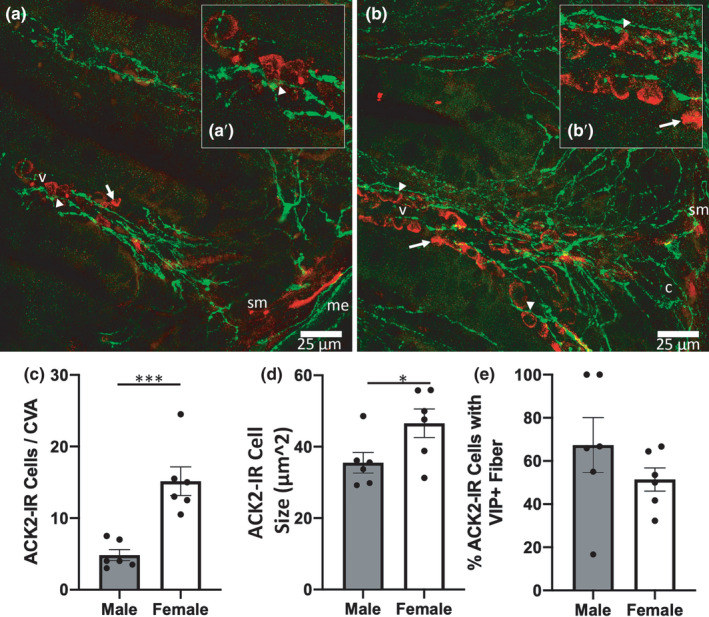
The gut wall houses mast cells that are anatomically situated near enteric neuronal fibers. Roles of specific neuropeptides in modulating function of immune components like mast cells in response to challenge with bacterial components are relatively unknown. Investigating such interactions requires models that include diverse cellular elements in native anatomic arrangements. Using an organotypic slice model that maintains gut wall cellular diversity ex vivo, the present study compared responses between tissues derived from male and female mice to examine neural-immune signaling in the gut wall after selected treatments. Ileum slices were treated with pharmacological reagents that block neuronal function (e.g., tetrodotoxin) or vasoactive intestinal peptide (VIP) receptors prior to challenge with lipopolysaccharide (LPS) to assess their influence on anatomic plasticity of VIP fibers and activation of mast cells. Sex differences were observed in the number of mucosal mast cells (c-kit/ACK2 immunoreactive) at baseline, regardless of treatment, with female ileum tissue having 46% more ACK2-IR mast cells than males. After challenge with LPS, male mast cell counts rose to female levels. Furthermore, sex differences were observed in the percentage of ACK2-IR cells within 1 µm of a VIP+ neuronal fiber, and mast cell size, a metric previously tied to activation, with females having larger cells at baseline. Male mast cell sizes reached female levels after LPS challenge. This study suggests sex differences in neural-immune plasticity and in mast cell activation both basally and in response to challenge with LPS. These sex differences could potentially impact functional neuroimmune response to pathogens.
肠壁内有肥大细胞,这些细胞在解剖学上位于肠神经元纤维附近。特定神经肽在调节免疫成分(如肥大细胞)功能方面的作用,以应对细菌成分的挑战,这方面的了解相对较少。研究这种相互作用需要包括天然解剖排列中多种细胞成分的模型。本研究使用一种保持肠壁细胞多样性的器官型切片模型,比较了来自雄性和雌性小鼠的组织对特定处理后肠壁中神经-免疫信号的反应,以检查神经-免疫信号。在用脂多糖 (LPS) 进行挑战之前,先用药理学试剂(如河豚毒素)阻断神经元功能或血管活性肠肽 (VIP) 受体处理回肠切片,以评估它们对 VIP 纤维解剖可塑性和肥大细胞激活的影响。无论治疗如何,在基线时,观察到黏膜肥大细胞(c-kit/ACK2 免疫反应性)数量存在性别差异,女性回肠组织中的 ACK2-IR 肥大细胞比男性多 46%。用 LPS 挑战后,雄性肥大细胞计数上升到与雌性相同的水平。此外,在 VIP+神经元纤维 1 µm 内的 ACK2-IR 细胞百分比和肥大细胞大小(以前与激活有关的指标)方面也观察到性别差异,基线时女性的细胞较大。用 LPS 挑战后,雄性肥大细胞大小达到女性水平。本研究表明,在神经-免疫可塑性和肥大细胞激活方面存在性别差异,无论是在基线还是在 LPS 挑战后。这些性别差异可能会对针对病原体的功能性神经免疫反应产生影响。