Lin Tingting, Liu Ergang, He Huining, Shin Meong Cheol, Moon Cheol, Yang Victor C, Huang Yongzhuo
Tianjin Key Laboratory on Technologies Enabling Development of Clinical Therapeutics and Diagnosis, School of Pharmacy, Tianjin Medical University, Tianjin 300070, China; Shanghai Institute of Materia Medica, Chinese Academy of Sciences, Shanghai 201203, China.
Tianjin Key Laboratory on Technologies Enabling Development of Clinical Therapeutics and Diagnosis, School of Pharmacy, Tianjin Medical University, Tianjin 300070, China.
Acta Pharm Sin B. 2016 Jul;6(4):352-8. doi: 10.1016/j.apsb.2016.04.001. Epub 2016 May 26.
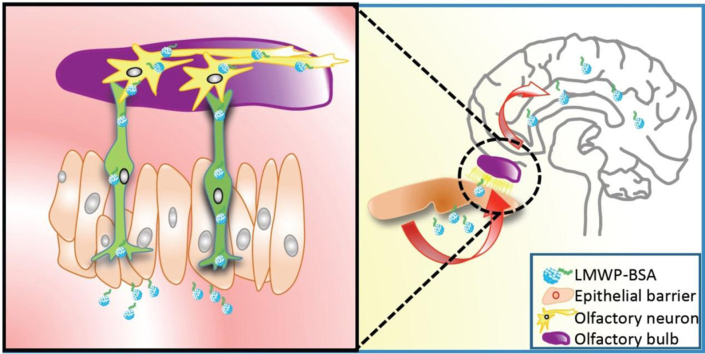
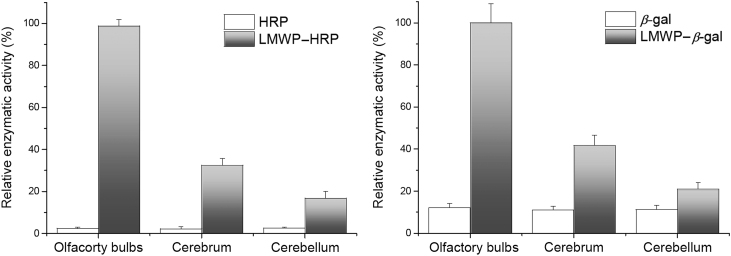
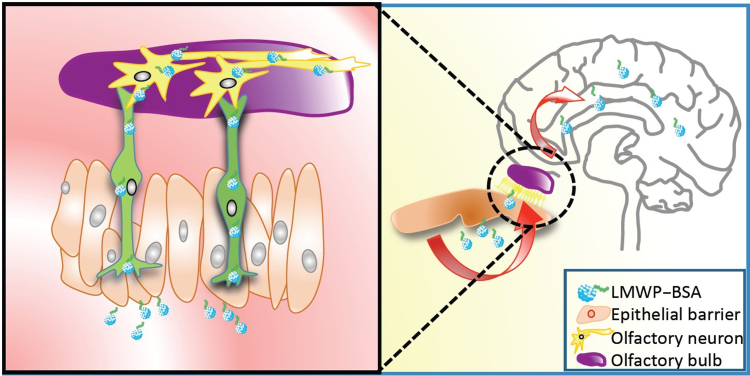
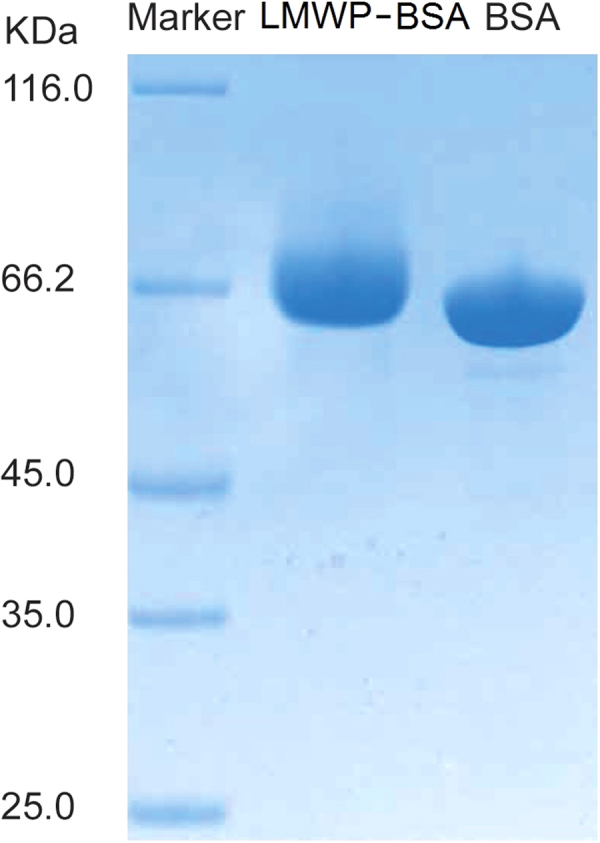
Brain delivery of macromolecular therapeutics (e.g., proteins) remains an unsolved problem because of the formidable blood-brain barrier (BBB). Although a direct pathway of nose-to-brain transfer provides an answer to circumventing the BBB and has already been intensively investigated for brain delivery of small drugs, new challenges arise for intranasal delivery of proteins because of their larger size and hydrophilicity. In order to overcome the barriers and take advantage of available pathways (e.g., epithelial tight junctions, uptake by olfactory neurons, transport into brain tissues, and intra-brain diffusion), a low molecular weight protamine (LMWP) cell-penetrating peptide was utilized to facilitate nose-to-brain transport. Cell-penetrating peptides (CPP) have been widely used to mediate macromolecular delivery through many kinds of biobarriers. Our results show that conjugates of LMWP-proteins are able to effectively penetrate into the brain after intranasal administration. The CPP-based intranasal method highlights a promising solution for protein therapy of brain diseases.
由于存在难以逾越的血脑屏障(BBB),大分子治疗药物(如蛋白质)的脑内递送仍是一个未解决的问题。尽管鼻脑直接转运途径为绕过血脑屏障提供了一种解决方案,并且已经针对小分子药物的脑内递送进行了深入研究,但由于蛋白质尺寸较大且具有亲水性,其鼻内递送出现了新的挑战。为了克服这些障碍并利用现有的途径(如上皮紧密连接、嗅觉神经元摄取、转运至脑组织以及脑内扩散),一种低分子量鱼精蛋白(LMWP)细胞穿透肽被用于促进鼻脑转运。细胞穿透肽(CPP)已被广泛用于介导大分子通过多种生物屏障的递送。我们的结果表明,LMWP-蛋白质缀合物在鼻内给药后能够有效穿透进入脑内。基于CPP的鼻内给药方法为脑部疾病的蛋白质治疗突出了一种有前景的解决方案。