Dirkes Jessica, Hughes Tonda, Ramirez-Valles Jesus, Johnson Tim, Bostwick Wendy
Master of Public Health Program, DePaul University, Chicago, IL, USA.
College of Nursing, University of Illinois at Chicago, Chicago, IL, USA.
J Clin Nurs. 2016 Dec;25(23-24):3545-3556. doi: 10.1111/jocn.13313. Epub 2016 Aug 1.
This study draws on a life course perspective to evaluate in a sample of sexual minority women: (1) the relationship between age at reaching sexual identity milestones and risk of suicidal ideation, (2) developmental stages or stages of sexual identity development that represent greatest risk and (3) the relationship between age of reaching milestones and parental support.
Research shows higher rates of suicidal ideation among sexual minority women than heterosexual women. Evidence suggests this is partly accounted for by risk factors including sexual identity development and parental support. However, it remains unclear whether there are stages of particularly high risk.
This is a cross-sectional study. Data come from a prospective study of sexual minority women that used convenience and respondent-driven sampling methods.
Using logistic regression, we examined associations among age at sexual identity developmental milestones, parental support and suicidal ideation in a large (N = 820), ethnically diverse sample of sexual minority women.
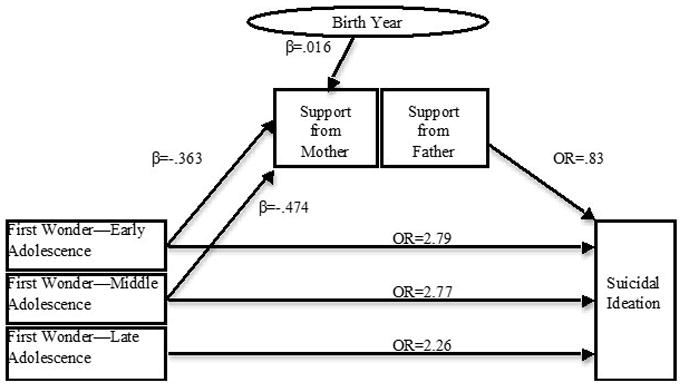
Compared with women who first wondered about their sexual identity in adulthood, those who first wondered in early, middle or late adolescence had greater odds of lifetime suicidal ideation. Younger age at subsequent milestones (first decided or first disclosed) was not associated with heightened risk of suicidal ideation. Parental support was independently associated with suicidal ideation.
Findings suggest that where one is in the process of identifying as a sexual minority may be more important than age in understanding risk of suicidal ideation in this population. As individuals come to accept and integrate their sexual minority identity risks associated with younger age diminish.
Nurses and other healthcare providers who work with youth should routinely ask about sexual orientation and suicidal ideation and be aware that youth in the earliest stages of coming out as sexual minority may be at particularly high risk of suicide.
本研究从生命历程的角度对性少数群体女性样本进行评估:(1)达到性身份认同里程碑的年龄与自杀意念风险之间的关系;(2)性身份认同发展中代表最大风险的发展阶段;(3)达到里程碑的年龄与父母支持之间的关系。
研究表明,性少数群体女性的自杀意念发生率高于异性恋女性。有证据表明,这部分是由包括性身份认同发展和父母支持在内的风险因素导致的。然而,尚不清楚是否存在特别高风险的阶段。
这是一项横断面研究。数据来自一项对性少数群体女性的前瞻性研究,该研究采用了便利抽样和应答者驱动抽样方法。
我们使用逻辑回归,在一个规模较大(N = 820)、种族多样的性少数群体女性样本中,研究性身份认同发展里程碑的年龄、父母支持与自杀意念之间的关联。
与成年后才首次对自己的性身份产生疑问的女性相比,那些在青春期早期、中期或晚期首次产生疑问的女性,终生有自杀意念的几率更高。在随后的里程碑(首次确定或首次公开)时年龄较小与自杀意念风险增加无关。父母支持与自杀意念独立相关。
研究结果表明,在理解该人群的自杀意念风险方面,处于性少数群体身份认同过程中的阶段可能比年龄更重要。随着个体开始接受并整合其性少数群体身份,与较年轻年龄相关的风险会降低。
与青少年打交道的护士和其他医疗保健提供者应常规询问性取向和自杀意念,并意识到处于公开自己为性少数群体最早阶段的青少年可能自杀风险特别高。