Cheon Eun-Jin, Lee Jun-Yeob, Choi Joong-Hyeon, Lee Young-Ji, Koo Bon-Hoon
Department of Psychiatry, Yeungnam University College of Medicine, Yeungnam University Medical Center, Daegu, Republic of Korea.
Department of Psychiatry, Saebits Hospital, Gyeongju, Republic of Korea.
Psychiatry Investig. 2016 Jul;13(4):447-52. doi: 10.4306/pi.2016.13.4.447. Epub 2016 Jul 25.
The purpose of this study was to compare duloxetine monotherapy to combination therapy with other antidepressants in patients with major depressive disorder in a clinical, real world setting.
An eight-week, retrospective, multi-center study of outpatients with major depressive disorder was undertaken. After screening 415 patients, enrolled in this study from July 2009 to June 2014 were 82 patients from among three centers who had been taking duloxetine with or without other antidepressant and not administered with atypical antipsychotics. We compared the mean changes of the Clinical Global Impression-Severity Scale (CGI-S) as a primary measure and the discontinuation rate as a secondary measure between the duloxetine monotherapy group (n=36, 43.9%) and the combination therapy with other antidepressants group (n=46, 56.1%) at baseline, one, two, four and eight weeks.
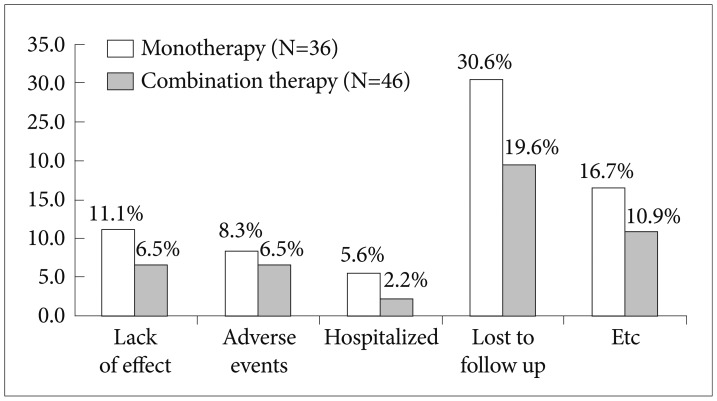
There were no significant differences across the demographic characteristics between two groups. There was, however, a statistically greater improvement on the CGI-S at weeks 2, 4 and 8 in the combination group compared with the monotherapy group. There were no significant differences in discontinuation rate and adverse events between two groups. No serious adverse events were reported in both groups during the study period.
This result suggests that the duloxetine combination therapy with other antidepressants could improve effectiveness and have comparable tolerability with the monotherapy in the treatment of outpatients with major depressive disorders in a naturalistic setting. Adequately powered, well-controlled clinical trials are strongly warranted to confirm our findings due to methodological shortcomings.
本研究旨在在临床实际环境中比较度洛西汀单药治疗与度洛西汀联合其他抗抑郁药治疗重度抑郁症患者的效果。
开展了一项针对重度抑郁症门诊患者的为期八周的回顾性多中心研究。在筛查了415例患者后,2009年7月至2014年6月期间,来自三个中心的82例患者纳入本研究,这些患者一直在服用度洛西汀,无论是否联用其他抗抑郁药,且未使用非典型抗精神病药。我们比较了度洛西汀单药治疗组(n = 36,43.9%)和度洛西汀联合其他抗抑郁药治疗组(n = 46,56.1%)在基线、第1、2、4和8周时作为主要指标的临床总体印象-严重程度量表(CGI-S)的平均变化以及作为次要指标的停药率。
两组患者的人口统计学特征无显著差异。然而,联合治疗组在第2、4和8周时的CGI-S评分在统计学上比单药治疗组有更大改善。两组的停药率和不良事件无显著差异。研究期间两组均未报告严重不良事件。
该结果表明,在自然环境中治疗重度抑郁症门诊患者时,度洛西汀联合其他抗抑郁药治疗可能会提高疗效,且耐受性与单药治疗相当。由于方法学上的缺陷,强烈需要开展有足够样本量且严格对照的临床试验来证实我们的研究结果。