She Qing-Bai, Gruvberger-Saal Sofia K, Maurer Matthew, Chen Yilun, Jumppanen Mervi, Su Tao, Dendy Meaghan, Lau Ying-Ka Ingar, Memeo Lorenzo, Horlings Hugo M, van de Vijver Marc J, Isola Jorma, Hibshoosh Hanina, Rosen Neal, Parsons Ramon, Saal Lao H
Program in Molecular Pharmacology and Chemistry and Department of Medicine, Memorial Sloan-Kettering Cancer Center, New York, NY, USA.
Markey Cancer Center, University of Kentucky College of Medicine, Lexington, KY, USA.
BMC Cancer. 2016 Aug 2;16:587. doi: 10.1186/s12885-016-2609-2.
The basal-like breast cancer (BLBC) subtype is characterized by positive staining for basal mammary epithelial cytokeratin markers, lack of hormone receptor and HER2 expression, and poor prognosis with currently no approved molecularly-targeted therapies. The oncogenic signaling pathways driving basal-like tumorigenesis are not fully elucidated.
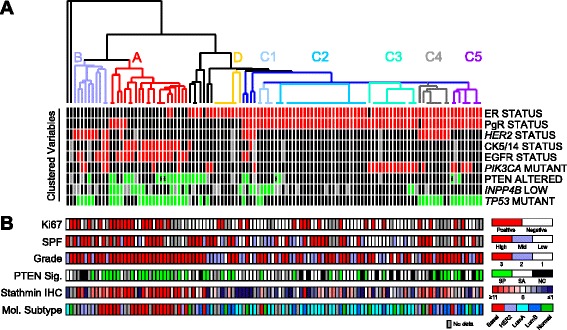
One hundred sixteen unselected breast tumors were subjected to integrated analysis of phosphoinositide 3-kinase (PI3K) pathway related molecular aberrations by immunohistochemistry, mutation analysis, and gene expression profiling. Incidence and relationships between molecular biomarkers were characterized. Findings for select biomarkers were validated in an independent series. Synergistic cell killing in vitro and in vivo tumor therapy was investigated in breast cancer cell lines and mouse xenograft models, respectively.
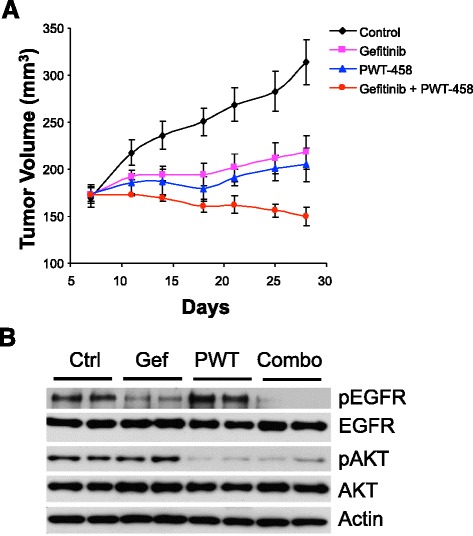
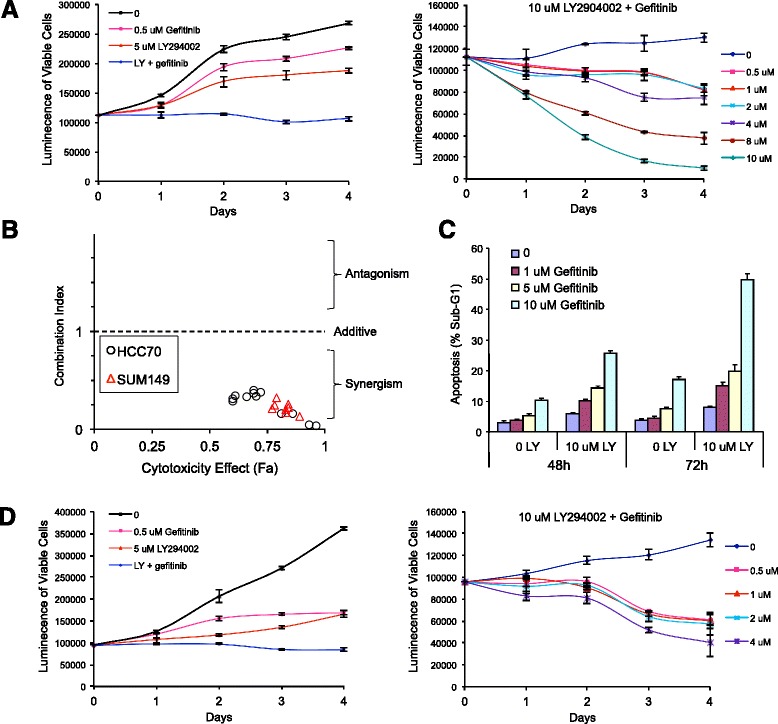
Sixty-four % of cases had an oncogenic alteration to PIK3CA, PTEN, or INPP4B; when including upstream kinases HER2 and EGFR, 75 % of cases had one or more aberration including 97 % of estrogen receptor (ER)-negative tumors. PTEN-loss was significantly associated to stathmin and EGFR overexpression, positivity for the BLBC markers cytokeratin 5/14, and the BLBC molecular subtype by gene expression profiling, informing a potential therapeutic combination targeting these pathways in BLBC. Combination treatment of BLBC cell lines with the EGFR-inhibitor gefitinib plus the PI3K pathway inhibitor LY294002 was synergistic, and correspondingly, in an in vivo BLBC xenograft mouse model, gefitinib plus PI3K-inhibitor PWT-458 was more effective than either monotherapy and caused tumor regression.
Our study emphasizes the importance of PI3K/PTEN pathway activity in ER-negative and basal-like breast cancer and supports the future clinical evaluation of combining EGFR and PI3K pathway inhibitors for the treatment of BLBC.
基底样乳腺癌(BLBC)亚型的特征是乳腺基底上皮细胞角蛋白标志物染色呈阳性,缺乏激素受体和HER2表达,且预后较差,目前尚无获批的分子靶向治疗方法。驱动基底样肿瘤发生的致癌信号通路尚未完全阐明。
对116例未经选择的乳腺肿瘤进行综合分析,通过免疫组织化学、突变分析和基因表达谱分析磷酸肌醇3-激酶(PI3K)通路相关分子异常。对分子生物标志物之间的发生率和关系进行了表征。在一个独立系列中对选定生物标志物的结果进行了验证。分别在乳腺癌细胞系和小鼠异种移植模型中研究了体外协同细胞杀伤和体内肿瘤治疗。
64%的病例存在PIK3CA、PTEN或INPP4B的致癌性改变;当包括上游激酶HER2和EGFR时,75%的病例有一个或多个异常,其中97%的雌激素受体(ER)阴性肿瘤。PTEN缺失与微管相关蛋白1和EGFR过表达、基底样乳腺癌标志物细胞角蛋白5/14阳性以及基因表达谱分析确定的基底样乳腺癌分子亚型显著相关,提示在基底样乳腺癌中针对这些通路的潜在治疗组合。用表皮生长因子受体(EGFR)抑制剂吉非替尼加PI3K通路抑制剂LY294002联合治疗基底样乳腺癌细胞系具有协同作用,相应地,在体内基底样乳腺癌异种移植小鼠模型中,吉非替尼加PI3K抑制剂PWT-458比单一疗法更有效,并导致肿瘤消退。
我们的研究强调了PI3K/PTEN通路活性在雌激素受体阴性和基底样乳腺癌中的重要性,并支持未来对联合EGFR和PI3K通路抑制剂治疗基底样乳腺癌进行临床评估。