Kliemann Nathalie, Beeken Rebecca J, Wardle Jane, Johnson Fiona
Health Behaviour Research Centre, Department of Epidemiology and Public Health, University College London, Gower Street, London, WC1E 6BT, UK.
Int J Behav Nutr Phys Act. 2016 Aug 2;13:87. doi: 10.1186/s12966-016-0414-6.
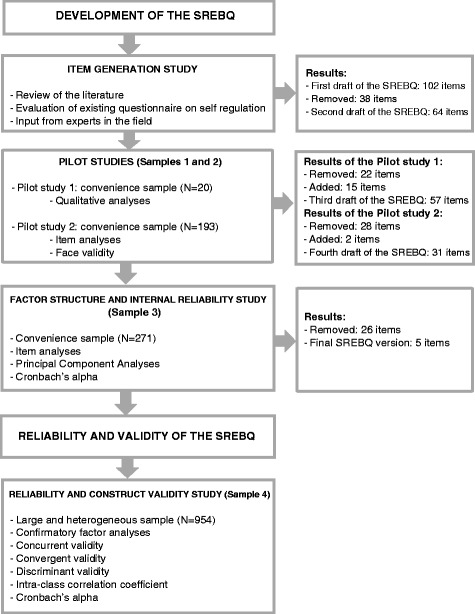
Eating self-regulatory capacity can help individuals to cope with the obesogenic environment and achieve, as well as maintain, a healthy weight and diet. At present, there is no comprehensive, reliable and valid questionnaire for assessing this capacity and measuring change in response to self-regulation interventions in adults. This paper reports the development of the Self-regulation of Eating Behaviour Questionnaire (SREBQ) for use in UK adults, and presents evidence for its reliability and construct validity. The development of the SREBQ involved generation of an item pool, followed by two pilot studies (Samples 1 and 2) and a test of the questionnaire's underlying factor structure (Sample 3). The final version of the SREBQ was then assessed for reliability and construct validity (Sample 4).
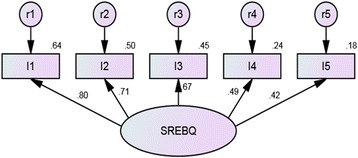
Development of the SREBQ resulted in a 5-item questionnaire. The face validity was satisfactory, as assessed by the pilot studies. The factor structure analysis (Sample 3) suggested that it has a single underlying factor, which was confirmed in a second sample (Sample 4). The SREBQ had strong construct validity, showing a positive correlation with general measures of self-regulation. It was also positively correlated with motivation and behavioural automaticity, and negatively correlated with food responsiveness and emotional over-eating (p < 0.001). It showed good discriminant validity, as it was only weakly associated with satiety responsiveness, food fussiness and slowness in eating.
The SREBQ is a reliable and valid measure for assessment of eating self-regulatory capacity in the general UK adult population.
饮食自我调节能力有助于个体应对致胖环境,实现并维持健康体重和饮食。目前,尚无全面、可靠且有效的问卷来评估成年人的这种能力以及衡量其对自我调节干预措施的反应变化。本文报告了用于英国成年人的饮食行为自我调节问卷(SREBQ)的编制情况,并提供了其信度和结构效度的证据。SREBQ的编制过程包括生成项目池,随后进行两项预试验(样本1和样本2)以及对问卷潜在因子结构的测试(样本3)。然后对SREBQ的最终版本进行信度和结构效度评估(样本4)。
SREBQ的编制形成了一份包含5个条目的问卷。通过预试验评估,其表面效度令人满意。因子结构分析(样本3)表明它有一个单一的潜在因子,这在第二个样本(样本4)中得到了证实。SREBQ具有很强的结构效度,与自我调节的总体测量指标呈正相关。它还与动机和行为自动化呈正相关,与食物反应性和情绪性暴饮暴食呈负相关(p < 0.001)。它显示出良好的区分效度,因为它与饱腹感反应性、食物挑剔和进食缓慢仅有微弱关联。
SREBQ是评估英国一般成年人群饮食自我调节能力的可靠且有效的测量工具。