Ma Ying-Yu, Wang Xiao-Jun, Han Yong, Li Gang, Wang Hui-Ju, Wang Shi-Bing, Chen Xiao-Yi, Liu Fan-Long, He Xiang-Lei, Tong Xiang-Min, Mou Xiao-Zhou
Clinical Research Institute, Zhejiang Provincial People's Hospital, Hangzhou, Zhejiang 310014, P.R. China.
Department of Anus, Rectum and Colon Surgery, First Affiliated Hospital, Zhejiang University School of Medicine, Hangzhou, Zhejiang 310014, P.R. China.
Mol Med Rep. 2016 Sep;14(3):2541-7. doi: 10.3892/mmr.2016.5536. Epub 2016 Jul 21.
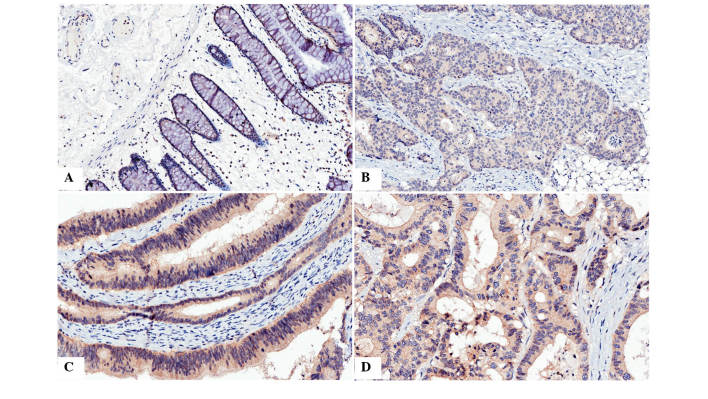
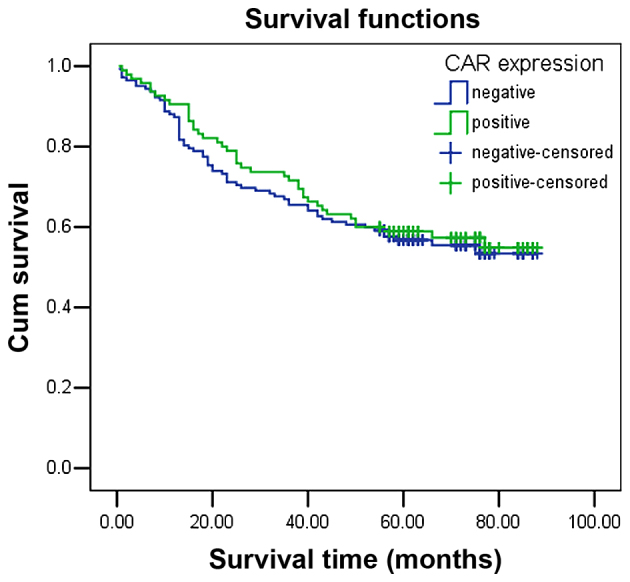
The coxsackie and adenovirus receptor (CAR) is considered a tumor suppressor and critical factor for the efficacy of therapeutic strategies that employ the adenovirus. However, data on CAR expression levels in colorectal cancer are conflicting and its clinical relevance remains to be elucidated. Immunohistochemistry was performed on tissue microarrays containing 251 pairs of colon cancer and adjacent normal tissue samples from Chinese Han patients to assess the expression levels of CAR. Compared with healthy mucosa, decreased CAR expression (40.6% vs. 95.6%; P<0.001) was observed in colorectal cancer samples. The CAR immunopositivity in tumor tissues was not significantly associated with gender, age, tumor size, differentiation, TNM stage, lymph node metastasis or distant metastasis in patients with colon cancer. However, expression of CAR is present in 83.3% of the tumor tissues from patient with colorectal liver metastasis, which was significantly higher than those without liver metastasis (39.6%; P=0.042). At the plasma membrane, CAR was observed in 29.5% normal mucosa samples, which was significantly higher than in colorectal cancer samples (4.0%; P<0.001). In addition, the survival analysis demonstrated that the expression level of CAR has no association with the prognosis of colorectal cancer. CAR expression was observed to be downregulated in colorectal cancer, and it exerts complex effects during colorectal carcinogenesis, potentially depending on the stage of the cancer development and progression. High CAR expression may promote liver metastasis. With regard to oncolytic therapy, CAR expression analysis should be performed prior to adenoviral oncolytic treatment to stratify Chinese Han patients for treatment.
柯萨奇病毒和腺病毒受体(CAR)被认为是一种肿瘤抑制因子,也是采用腺病毒的治疗策略疗效的关键因素。然而,关于结直肠癌中CAR表达水平的数据存在矛盾,其临床相关性仍有待阐明。对来自中国汉族患者的251对结肠癌及癌旁正常组织样本的组织芯片进行免疫组织化学检测,以评估CAR的表达水平。与健康黏膜相比,在结直肠癌样本中观察到CAR表达降低(40.6%对95.6%;P<0.001)。肿瘤组织中的CAR免疫阳性与结肠癌患者的性别、年龄、肿瘤大小、分化程度、TNM分期、淋巴结转移或远处转移均无显著相关性。然而,在结直肠癌肝转移患者的肿瘤组织中,83.3%存在CAR表达,这显著高于无肝转移的患者(39.6%;P=0.042)。在质膜上,29.5%的正常黏膜样本中观察到CAR,这显著高于结直肠癌样本(4.0%;P<0.001)。此外,生存分析表明,CAR的表达水平与结直肠癌的预后无关。观察到CAR在结直肠癌中表达下调,并且在结直肠癌发生过程中发挥复杂作用,这可能取决于癌症发展和进展的阶段。高CAR表达可能促进肝转移。关于溶瘤治疗,在腺病毒溶瘤治疗前应对中国汉族患者进行CAR表达分析,以便进行分层治疗。