Veerman Christiaan C, Mengarelli Isabella, Guan Kaomei, Stauske Michael, Barc Julien, Tan Hanno L, Wilde Arthur A M, Verkerk Arie O, Bezzina Connie R
Heart Centre, Department of Experimental and Clinical Cardiology, Academic Medical Center, University of Amsterdam, Amsterdam, The Netherlands.
Department of Cardiology and Pneumonology, Georg-August-University Göttingen, Göttingen, Germany.
Sci Rep. 2016 Aug 3;6:30967. doi: 10.1038/srep30967.
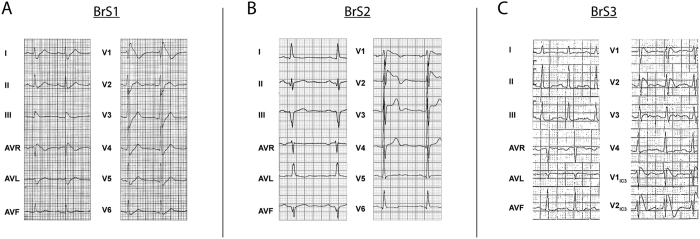
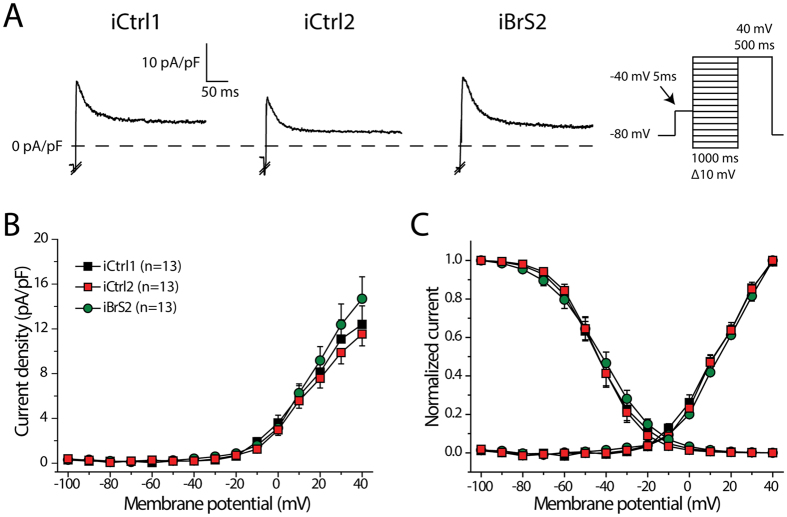
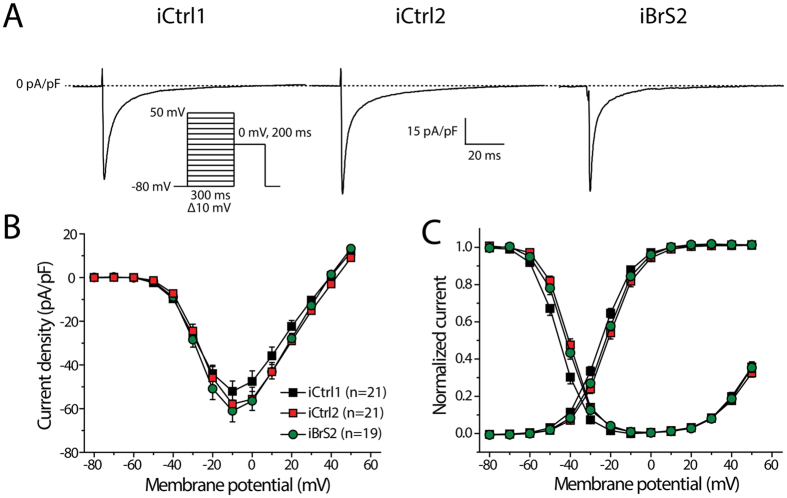
Brugada syndrome (BrS) is a rare cardiac rhythm disorder associated with sudden cardiac death. Mutations in the sodium channel gene SCN5A are found in ~20% of cases while mutations in other genes collectively account for <5%. In the remaining patients the genetic defect and the underlying pathogenic mechanism remain obscure. To provide insight into the mechanism of BrS in individuals without identified mutations, we here studied electrophysiological properties of cardiomyocytes (CMs) generated from human induced pluripotent stem cells (hiPSCs) from 3 BrS patients who tested negative for mutations in the known BrS-associated genes. Patch clamp studies revealed no differences in sodium current (INa) in hiPSC-CMs from the 3 BrS patients compared to 2 unrelated controls. Moreover, action potential upstroke velocity (Vmax), reflecting INa, was not different between hiPSC-CMs from the BrS patients and the controls. hiPSC-CMs harboring the BrS-associated SCN5A-1795insD mutation exhibited a reduction in both INa and Vmax, demonstrating our ability to detect reduced sodium channel function. hiPSC-CMs from one of the BrS lines demonstrated a mildly reduced action potential duration, however, the transient outward potassium current (Ito) and the L-type calcium current (ICa,L), both implicated in BrS, were not different compared to the controls. Our findings indicate that ion channel dysfunction, in particular in the cardiac sodium channel, may not be a prerequisite for BrS.
Brugada综合征(BrS)是一种与心源性猝死相关的罕见心律失常。约20%的病例中发现钠通道基因SCN5A存在突变,而其他基因的突变合计占比不到5%。在其余患者中,基因缺陷和潜在的致病机制仍不清楚。为了深入了解未发现突变的个体中BrS的发病机制,我们在此研究了3例已知与BrS相关基因检测为突变阴性的BrS患者的人诱导多能干细胞(hiPSC)所产生的心肌细胞(CM)的电生理特性。膜片钳研究显示,与2名无关对照相比,3例BrS患者的hiPSC-CM的钠电流(INa)没有差异。此外,反映INa的动作电位上升速度(Vmax)在BrS患者的hiPSC-CM和对照之间也没有差异。携带与BrS相关的SCN5A-1795insD突变的hiPSC-CM的INa和Vmax均降低,证明了我们检测钠通道功能降低的能力。来自其中一个BrS细胞系的hiPSC-CM的动作电位持续时间略有缩短,然而,与BrS都有关的瞬时外向钾电流(Ito)和L型钙电流(ICa,L)与对照相比没有差异。我们的研究结果表明,离子通道功能障碍,特别是心脏钠通道功能障碍,可能不是BrS的必要条件。