Skelton Dawn A, Bailey Cathy, Howel Denise, Cattan Mima, Deary Vincent, Coe Dot, de Jong Lex D, Gawler Sheena, Gray Joanne, Lampitt Rosy, Wilkinson Jennifer, Adams Nicola
Institute of Allied Health Research, School of Health and Life Sciences, Glasgow Caledonian University, Glasgow, UK.
Faculty of Health and Life Sciences, Department of Public Health and Well Being, International Ageing, Newcastle upon Tyne, UK.
BMJ Open. 2016 Aug 2;6(8):e011996. doi: 10.1136/bmjopen-2016-011996.
In the UK, 1 in 5 people aged 75 and over live with sight loss. Visually impaired older people (VIOP) have an above average incidence of falls and 1.3-1.9 times more likely to experience hip fractures, than the general population. Older people with eye diseases are ∼3 times more likely than those with good vision, to limit activities due to fear of falling. This feasibility study aims to adapt the group-based Falls Management Exercise (FaME) programme to the needs of VIOP and carry out an external pilot trial to inform the design of a future definitive randomised controlled trial.
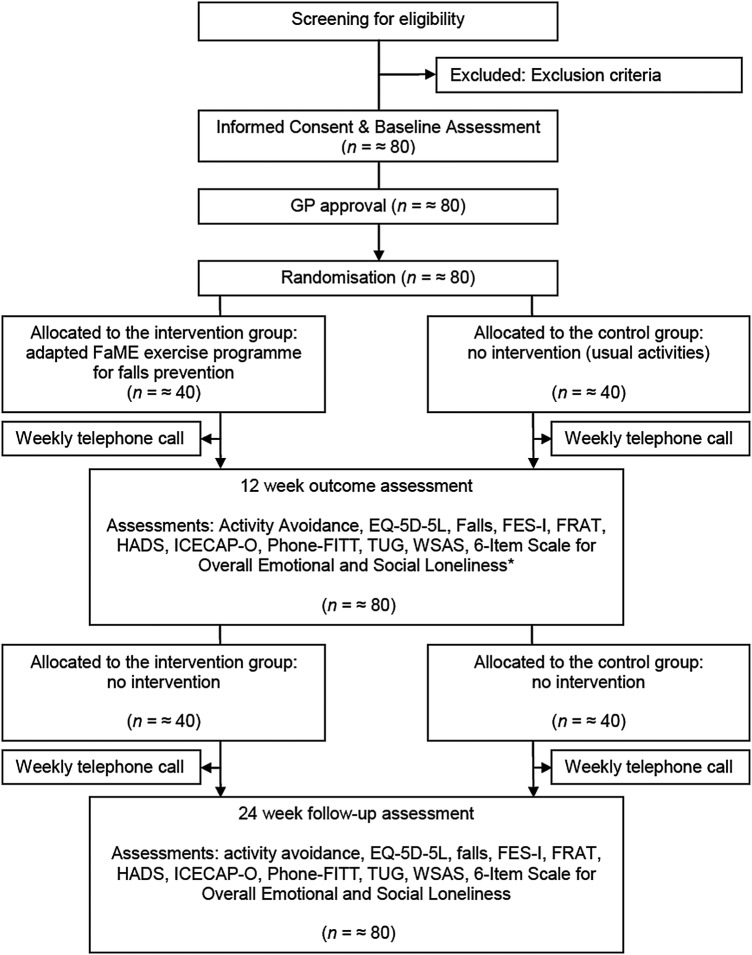
A UK based 2-centre mixed methods, randomised, feasibility study will be conducted over 28 months. Stakeholder panels, including VIOP, will make recommendations for adaptations to an existing exercise programme (FaME), to meet the needs of VIOP, promoting uptake and adherence, while retaining required effective components of the exercise programme. 80 VIOP aged 60 and over, living at home, ambulant with or without a walking aid, will be recruited in Newcastle (n=40) and Glasgow (n=40) through National Health Service (NHS) Trusts and third sector partners. Participants randomised into the intervention arm will receive the adapted FaME programme. Participants randomised into the control arm will continue with usual activity. Outcomes are, recruitment rate, adherence and validated measures including fear of falling and quality of life. Postintervention in-depth qualitative interviews will be conducted with a purposive sample of VIOP (N=10). Postural stability instructors will be interviewed, before trial-specific training and following the intervention.
Ethics approval was secured through the National Research Ethics Service (NRES) Committee North East, Newcastle and North Tyneside 2. Glasgow Caledonian University was approved as a non-NHS site with local ethics approval. Findings will be disseminated through peer-reviewed journals, national and international conferences.
ISRCTN16949845.
在英国,75岁及以上的人群中,五分之一的人有视力丧失问题。视力受损的老年人(VIOP)跌倒发生率高于平均水平,发生髋部骨折的可能性是普通人群的1.3至1.9倍。患有眼部疾病的老年人因害怕跌倒而限制活动的可能性是视力良好者的3倍左右。这项可行性研究旨在使基于小组的跌倒管理锻炼(FaME)计划适应视力受损老年人的需求,并进行外部试点试验,为未来确定性随机对照试验的设计提供依据。
一项基于英国的两中心混合方法随机可行性研究将在28个月内进行。包括视力受损老年人在内的利益相关者小组将对现有锻炼计划(FaME)提出调整建议,以满足视力受损老年人的需求,促进参与和坚持,同时保留锻炼计划所需的有效组成部分。将通过国民健康服务(NHS)信托机构和第三部门合作伙伴,在纽卡斯尔(n = 40)和格拉斯哥(n = 40)招募80名60岁及以上、居家、可独立行走或需借助助行器行走的视力受损老年人。随机分配到干预组的参与者将接受调整后的FaME计划。随机分配到对照组的参与者将继续其日常活动。观察指标包括招募率、依从性以及经过验证的指标,如跌倒恐惧和生活质量。干预后,将对10名有目的抽样的视力受损老年人进行深入定性访谈。在进行特定试验培训之前和干预之后将对姿势稳定性指导员进行访谈。
已通过国家研究伦理服务(NRES)委员会东北纽卡斯尔和北泰恩赛德2获得伦理批准。格拉斯哥卡利多尼亚大学经当地伦理批准被批准为非NHS研究地点。研究结果将通过同行评审期刊、国内和国际会议进行传播。
ISRCTN16949845。