Sukasem Chonlaphat, Jantararoungtong Thawinee, Kuntawong Parnrat, Puangpetch Apichaya, Koomdee Napatrupron, Satapornpong Patompong, Supapsophon Patcharin, Klaewsongkram Jettanong, Rerkpattanapipat Ticha
Division of Pharmacogenomics and Personalized Medicine, Department of Pathology, Faculty of Medicine Ramathibodi Hospital, Mahidol UniversityBangkok, Thailand; Laboratory for Pharmacogenomics, Somdech Phra Debaratana Medical Center, Ramathibodi HospitalBangkok, Thailand; The Thai Severe Cutaneous Adverse Drug Reaction Research GroupBangkok, Thailand.
Division of Pharmacogenomics and Personalized Medicine, Department of Pathology, Faculty of Medicine Ramathibodi Hospital, Mahidol UniversityBangkok, Thailand; Laboratory for Pharmacogenomics, Somdech Phra Debaratana Medical Center, Ramathibodi HospitalBangkok, Thailand.
Front Pharmacol. 2016 Jul 18;7:186. doi: 10.3389/fphar.2016.00186. eCollection 2016.
The aim of this study was to investigate the predisposition to different types of allopurinol-induced cutaneous adverse drug reactions (CADR), including Stevens-Johnson syndrome (SJS), toxic epidermal necrolysis (TEN; SJS-TEN, n = 13), drug reaction with eosinophilia and systemic symptoms (DRESS, n = 10) and Maculopapular eruption (MPE; n = 7), conferred by HLA-B (*) 58:01 in a Thai population.
This case-control association study compares 30 patients with allopurinol-induced CADR, allopurinol-tolerant control patients (n = 100), and a Thai general population (n = 1095). Patients' human leukocyte antigen type B (HLA-B) alleles were genotyped by using a two-stage sequence-specific oligonucleotide probe system.
Of a total 30 patients with CADR due to allopurinol, 29 (96.7%) patients were found to be at least heterozygous for HLA-B () 58:01, compared to only 4.0% in allopurinol-tolerant patients (p < 0.001). Odds ratio (OR) for the association of HLA-B () 58:01 with allopurinol-induced CADR in this population was 696.0 (95% CI: 74.8-6475.0). The HLA-B () 58:01 allele was present in all patients with allopurinol-induced SJS-TEN (OR = 579.0, 95%CI: 29.5-11362.7, p < 0.001) and DRESS (OR 430.3, 95%CI: 22.6-8958.9, p < 0.001). Additionally, OR of HLA-B () 58:01 was highly significant in the allopurinol-induced MPE patients (OR 144.0, 95%CI: 13.9-1497.0, p < 0.001).
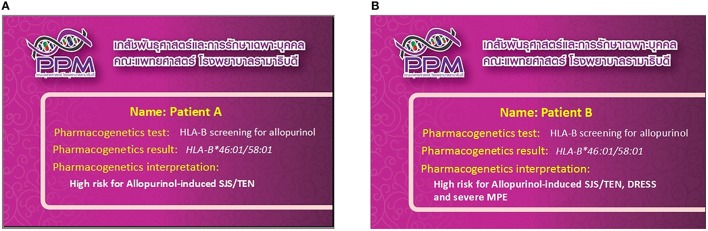
In this study we confirmed the association between HLAB () 58:01 and allopurinol-induced SJS-TEN in a Thai population. In addition, we identified an association between HLA-B () 58:01 and allopurinol-induced DRESS and MPE in this population. Therefore, HLA-B () 58:01 can be used as a pharmacogenetic marker for allopurinol-induced CADR including SJS-TEN, DRESS and MPE. These results suggest that screening for HLA-B () 58:01 alleles in patients who will be treated with allopurinol would be clinically helpful in preventing the risk of developing CARD in a Thai patients. Summary Regardless of phenotype, this is the first pharmacogenetic study of allopurinol-induced CADR in patients of Thai ancestry.In this study we confirmed the association between HLA-B (*) 58:01 and allopurinol-induced SJS-TEN, DRESS, and MPE in Thai population.Regarding to our findings, the pharmacogenetic interpretation could be generalized to drug hypersensitivity including DRESS, SJS-TEN, and MPE.
本研究旨在调查泰国人群中 HLA - B(*)58:01 基因对不同类型别嘌醇诱导的皮肤不良反应(CADR)的易感性,这些不良反应包括史蒂文斯 - 约翰逊综合征(SJS)、中毒性表皮坏死松解症(TEN;SJS - TEN,n = 13)、伴有嗜酸性粒细胞增多和全身症状的药物反应(DRESS,n = 10)以及斑丘疹(MPE;n = 7)。
本病例对照关联研究比较了 30 例别嘌醇诱导的 CADR 患者、别嘌醇耐受的对照患者(n = 100)以及泰国普通人群(n = 1095)。采用两阶段序列特异性寡核苷酸探针系统对患者的人类白细胞抗原 B 型(HLA - B)等位基因进行基因分型。
在总共 30 例因别嘌醇导致 CADR 的患者中,发现 29 例(96.7%)患者至少为 HLA - B()58:01 杂合子,而在别嘌醇耐受患者中这一比例仅为 4.0%(p < 0.001)。在该人群中,HLA - B()58:01 与别嘌醇诱导的 CADR 关联的优势比(OR)为 696.0(95%可信区间:74.8 - 6475.0)。HLA - B()58:01 等位基因在所有别嘌醇诱导的 SJS - TEN 患者(OR = 579.0,95%可信区间:29.5 - 11362.7,p < 0.001)和 DRESS 患者(OR 430.3,95%可信区间:22.6 - 8958.9,p < 0.001)中均存在。此外,HLA - B()58:01 在别嘌醇诱导的 MPE 患者中的 OR 也具有高度显著性(OR 144.0,95%可信区间:13.9 - 1497.0,p < 0.001)。
在本研究中,我们证实了泰国人群中 HLA - B()58:01 与别嘌醇诱导的 SJS - TEN 之间的关联。此外,我们还发现该人群中 HLA - B()58:01 与别嘌醇诱导的 DRESS 和 MPE 之间存在关联。因此,HLA - B()58:01 可作为别嘌醇诱导的包括 SJS - TEN、DRESS 和 MPE 在内的 CADR 的药物遗传学标志物。这些结果表明,对将接受别嘌醇治疗的患者进行 HLA - B()58:01 等位基因筛查,在预防泰国患者发生 CARD 的风险方面具有临床帮助。总结:无论表型如何,这是首例针对泰国裔患者别嘌醇诱导的 CADR 的药物遗传学研究。在本研究中,我们证实了泰国人群中 HLA - B(*)58:01 与别嘌醇诱导的 SJS - TEN、DRESS 和 MPE 之间的关联。基于我们的研究结果,药物遗传学解释可推广至包括 DRESS、SJS - TEN 和 MPE 在内的药物超敏反应。