Mishra Ameet K, Abrahamsson Annelie, Dabrosin Charlotta
Department of Oncology and Department of Clinical and Experimental Medicine, Linköping University, Linköping, Sweden.
Oncotarget. 2016 Aug 30;7(35):56876-56888. doi: 10.18632/oncotarget.10871.
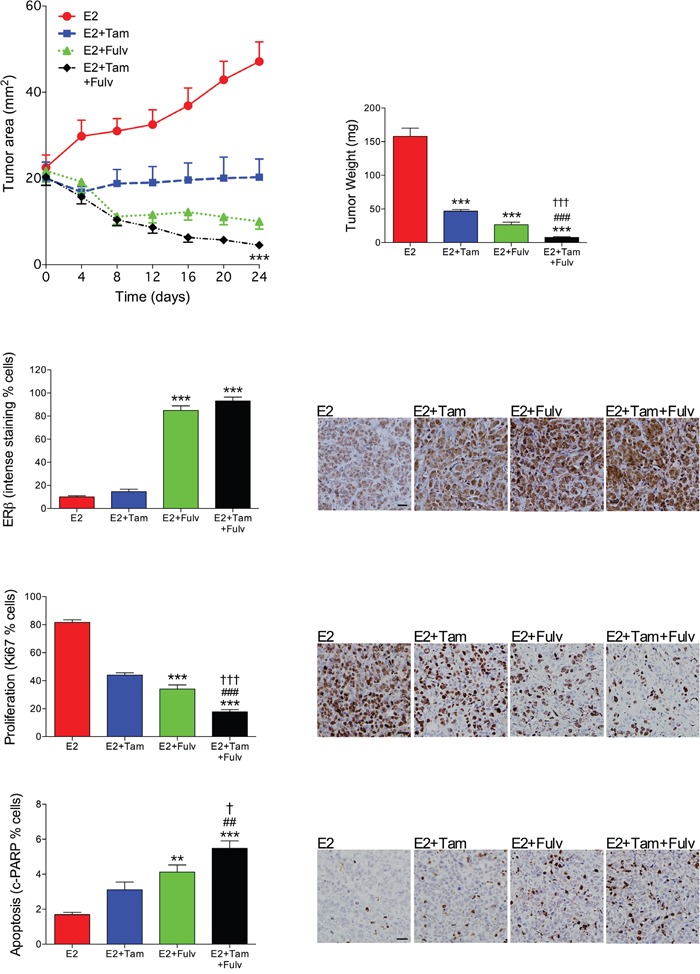
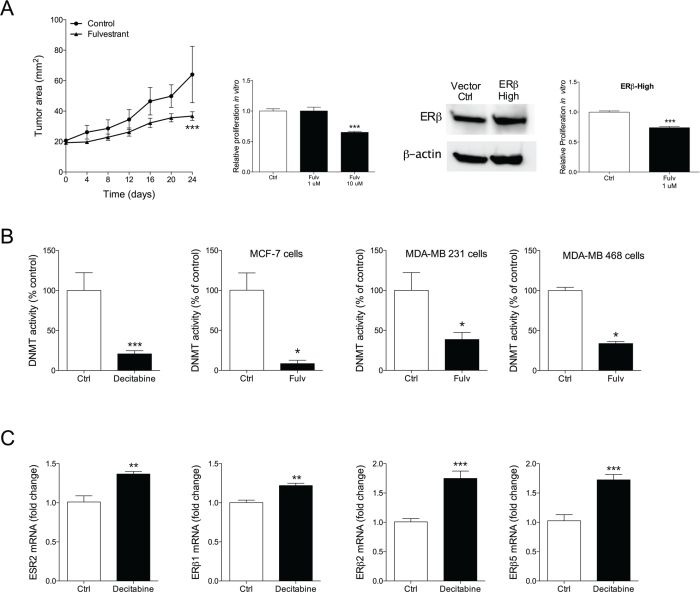
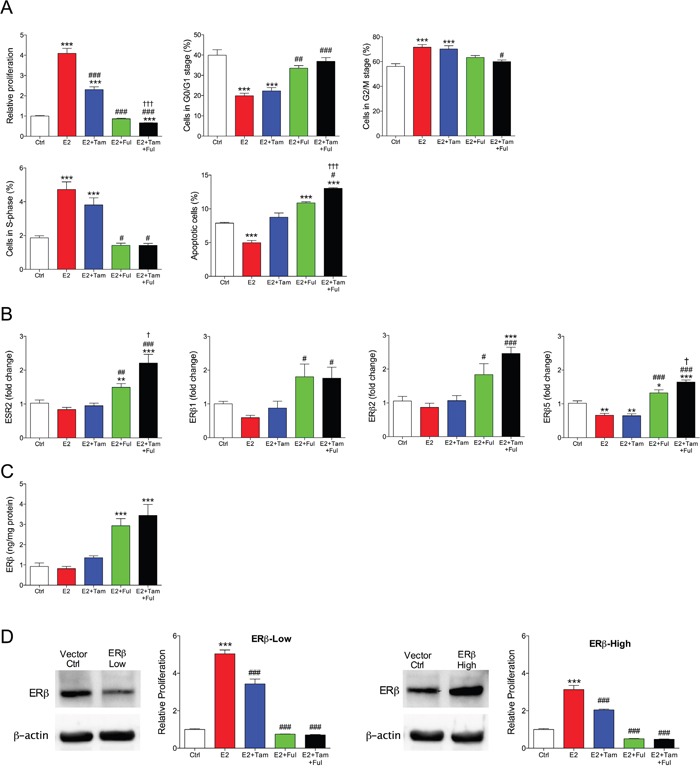
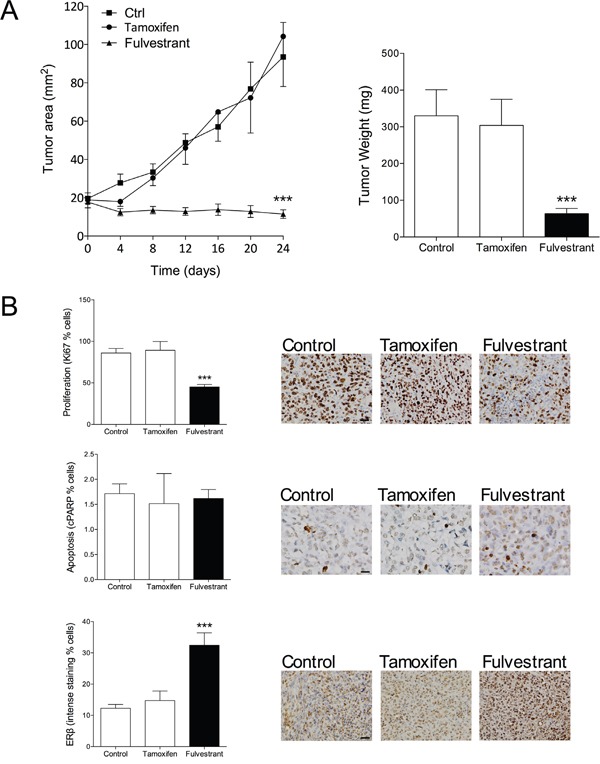
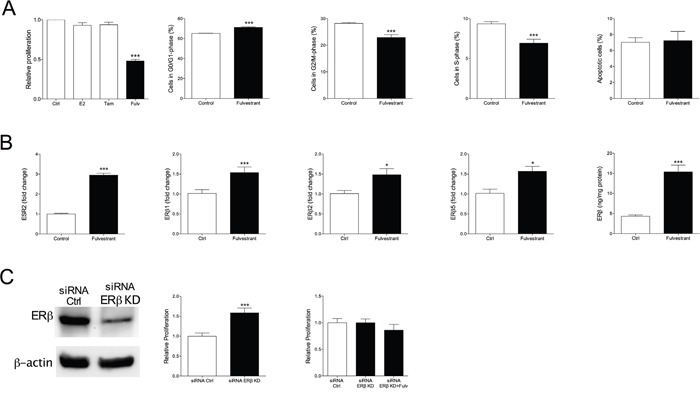
The estrogen receptor-alpha (ERα) is used as a predictive marker for anti-estrogen therapy in breast cancer patients. In addition to aromatase inhibitors, ERα can be targeted at the receptor level using the receptor modulator tamoxifen or by the pure anti-estrogen fulvestrant. The role of the second ER, ER-beta (ERβ), as a therapeutic target or prognostic marker in breast cancer is still elusive. Hitherto, it is not known if ERα+/ERβ+ breast cancers would benefit from a treatment strategy combining tamoxifen and fulvestrant or if fulvestrant exert any therapeutic effects in ERα-/ERβ+ breast cancer. Here, we report that fulvestrant up-regulated ERβ in ERα+/ERβ+ breast cancer and in triple negative ERβ+ breast cancers (ERα-/ERβ+). In ERα+/ERβ+ breast cancer, a combination therapy of tamoxifen and fulvestrant significantly reduced tumor growth compared to either treatment alone both in vivo and in vitro. In ERα-/ERβ+ breast cancer fulvestrant had potent effects on cancer growth, in vivo as well as in vitro, and this effect was dependent on intrinsically expressed levels of ERβ. The role of ERβ was further confirmed in cells where ERβ was knocked-in or knocked-down. Inhibition of DNA methyltransferase (DNMT) increased the levels of ERβ and fulvestrant exerted similar potency on DNMT activity as the DNMT inhibitor decitabine. We conclude that fulvestrant may have therapeutic potential in additional groups of breast cancer patients; i) in ERα+/ERβ+ breast cancer where fulvestrant synergizes with tamoxifen and ii) in triple negative/ERβ+ breast cancer patients, a subgroup of breast cancer patients with poor prognosis.
雌激素受体α(ERα)被用作乳腺癌患者抗雌激素治疗的预测标志物。除芳香化酶抑制剂外,ERα还可在受体水平上通过受体调节剂他莫昔芬或纯抗雌激素药物氟维司群进行靶向治疗。第二种雌激素受体,即雌激素受体β(ERβ),作为乳腺癌的治疗靶点或预后标志物,其作用仍不明确。迄今为止,尚不清楚ERα+/ERβ+乳腺癌患者是否能从他莫昔芬和氟维司群联合治疗策略中获益,也不清楚氟维司群在ERα-/ERβ+乳腺癌中是否具有任何治疗效果。在此,我们报告氟维司群可上调ERα+/ERβ+乳腺癌和三阴性ERβ+乳腺癌(ERα-/ERβ+)中的ERβ表达。在ERα+/ERβ+乳腺癌中,他莫昔芬和氟维司群联合治疗在体内和体外均比单独使用任何一种治疗方法能显著降低肿瘤生长。在ERα-/ERβ+乳腺癌中,氟维司群在体内和体外对癌症生长均有显著作用,且这种作用依赖于ERβ的内在表达水平。ERβ的作用在ERβ基因敲入或敲除的细胞中得到进一步证实。抑制DNA甲基转移酶(DNMT)可增加ERβ的水平,且氟维司群对DNMT活性的影响与DNMT抑制剂地西他滨相似。我们得出结论,氟维司群可能在其他乳腺癌患者群体中具有治疗潜力:i)在ERα+/ERβ+乳腺癌中,氟维司群与他莫昔芬具有协同作用;ii)在三阴性/ERβ+乳腺癌患者中,这是一类预后较差的乳腺癌患者亚群。