Zeigler-Johnson Charnita, Morales Knashawn H, Lal Priti, Feldman Michael
Division of Population Science, Department of Medical Oncology, Thomas Jefferson University, Philadelphia, Pennsylvania, United States of America.
Center for Clinical Epidemiology and Biostatistics, University of Pennsylvania, Philadelphia, Pennsylvania, United States of America.
PLoS One. 2016 Aug 3;11(8):e0159109. doi: 10.1371/journal.pone.0159109. eCollection 2016.
Obesity reflects a chronic inflammatory environment that may contribute to prostate cancer progression and poor treatment outcomes. However, it is not clear which mechanisms drive this association within the tumor microenvironment. The aim of this pilot study was to examine prostatic inflammation via tumor infiltrating lymphocytes and macrophages characterized by obesity and cancer severity.
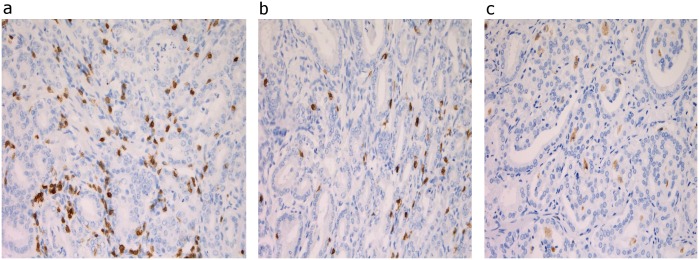
We studied paraffin-embedded prostatectomy tissue from 99 participants (63 non-obese and 36 obese) from the Study of Clinical Outcomes, Risk and Ethnicity (University of Pennsylvania). Pathologists analyzed the tissue for type and count of lymphocytes and macrophages, including CD3, CD8, FOXP3, and CD68. Pathology data were linked to clinical and demographic variables. Statistical analyses included frequency tables, Kruskal-Wallis tests, Spearman correlations, and multivariable models.
We observed positive univariate associations between the number of CD68 cells and tumor grade (p = 0.019). In multivariable analysis, CD8 counts were associated with time to biochemical failure (HR = 1.09, 95% CI = 1.004-1.192, p-value = 0.041.) There were no differences in lymphocytes or macrophages by obesity status or BMI.
The number of lymphocytes and macrophages in the tumor microenvironment did not differ by obesity status. However, these inflammation markers were associated with poor prostate cancer outcomes. Further examination of underlying mechanisms that influence obesity-related effects on prostate cancer outcomes is warranted. Such research will guide immunotherapy protocols and weight management as they apply to diverse patient populations and phenotypes.
肥胖反映了一种慢性炎症环境,可能导致前列腺癌进展及治疗效果不佳。然而,尚不清楚在肿瘤微环境中是哪些机制驱动了这种关联。这项初步研究的目的是通过以肥胖和癌症严重程度为特征的肿瘤浸润淋巴细胞和巨噬细胞来检查前列腺炎症。
我们研究了来自宾夕法尼亚大学临床结果、风险与种族研究的99名参与者(63名非肥胖者和36名肥胖者)的石蜡包埋前列腺切除组织。病理学家分析了组织中淋巴细胞和巨噬细胞的类型及数量,包括CD3、CD8、FOXP3和CD68。病理数据与临床和人口统计学变量相关联。统计分析包括频率表、Kruskal-Wallis检验、Spearman相关性分析和多变量模型。
我们观察到CD68细胞数量与肿瘤分级之间存在单变量正相关(p = 0.019)。在多变量分析中,CD8计数与生化失败时间相关(HR = 1.09,95%CI = 1.004 - 1.192,p值 = 0.041)。淋巴细胞或巨噬细胞在肥胖状态或BMI方面没有差异。
肿瘤微环境中淋巴细胞和巨噬细胞的数量在肥胖状态方面没有差异。然而,这些炎症标志物与前列腺癌不良预后相关。有必要进一步研究影响肥胖对前列腺癌预后相关作用的潜在机制。此类研究将指导免疫治疗方案和体重管理,因为它们适用于不同的患者群体和表型。