
热波动通过独立于平均温度的机制影响转录组。
Thermal fluctuations affect the transcriptome through mechanisms independent of average temperature.
作者信息
Sørensen Jesper Givskov, Schou Mads Fristrup, Kristensen Torsten Nygaard, Loeschcke Volker
机构信息
Department of Bioscience, Section for Genetics, Ecology and Evolution, Aarhus University, Ny Munkegade 114, 8000 Aarhus C, Denmark.
Department of Chemistry and Bioscience, Aalborg University, Fredrik Bajers Vej 7H, 9220 Aalborg E, Denmark.
出版信息
Sci Rep. 2016 Aug 4;6:30975. doi: 10.1038/srep30975.
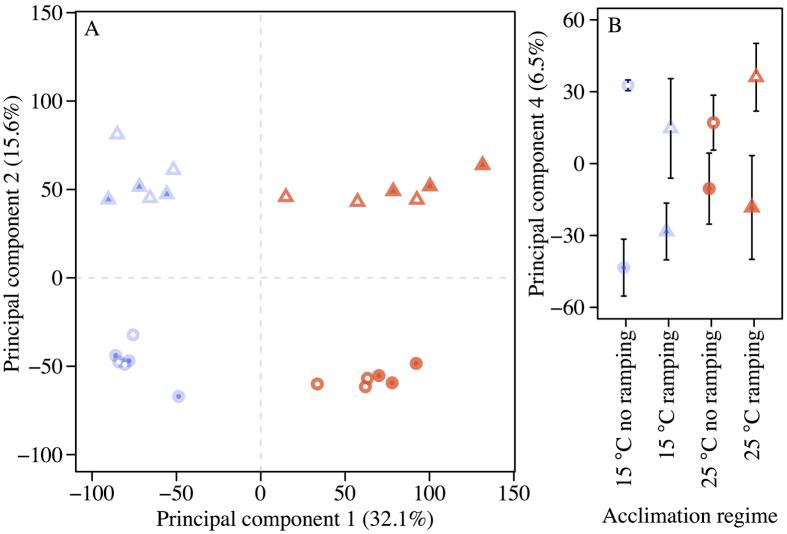
Terrestrial ectotherms are challenged by variation in both mean and variance of temperature. Phenotypic plasticity (thermal acclimation) might mitigate adverse effects, however, we lack a fundamental understanding of the molecular mechanisms of thermal acclimation and how they are affected by fluctuating temperature. Here we investigated the effect of thermal acclimation in Drosophila melanogaster on critical thermal maxima (CTmax) and associated global gene expression profiles as induced by two constant and two ecologically relevant (non-stressful) diurnally fluctuating temperature regimes. Both mean and fluctuation of temperature contributed to thermal acclimation and affected the transcriptome. The transcriptomic response to mean temperatures comprised modification of a major part of the transcriptome, while the response to fluctuations affected a much smaller set of genes, which was highly independent of both the response to a change in mean temperature and to the classic heat shock response. Although the independent transcriptional effects caused by fluctuations were relatively small, they are likely to contribute to our understanding of thermal adaptation. We provide evidence that environmental sensing, particularly phototransduction, is a central mechanism underlying the regulation of thermal acclimation to fluctuating temperatures. Thus, genes and pathways involved in phototransduction are likely of importance in fluctuating climates.
陆生变温动物面临着温度均值和方差变化的挑战。表型可塑性(热驯化)或许能减轻不利影响,然而,我们对热驯化的分子机制以及它们如何受到波动温度的影响仍缺乏基本认识。在此,我们研究了果蝇热驯化对临界热最大值(CTmax)以及由两种恒定温度和两种生态相关(无胁迫)的昼夜波动温度模式诱导的相关全基因组表达谱的影响。温度的均值和波动都对热驯化有作用,并影响转录组。对平均温度的转录组反应包括转录组大部分的修饰,而对波动的反应影响的基因集要小得多,且与对平均温度变化的反应和经典热休克反应高度独立。尽管波动引起的独立转录效应相对较小,但它们可能有助于我们理解热适应。我们提供的证据表明,环境感知,尤其是光转导,是调节对波动温度热驯化的核心机制。因此,参与光转导的基因和途径在波动气候中可能很重要。


 Zotero 插件