Carreras-Torres Robert, Haycock Philip C, Relton Caroline L, Martin Richard M, Smith George Davey, Kraft Peter, Gao Chi, Tworoger Shelley, Le Marchand Loïc, Wilkens Lynne R, Park Sungshim L, Haiman Christopher, Field John K, Davies Michael, Marcus Michael, Liu Geoffrey, Caporaso Neil E, Christiani David C, Wei Yongyue, Chen Chu, Doherty Jennifer A, Severi Gianluca, Goodman Gary E, Hung Rayjean J, Amos Christopher I, McKay James, Johansson Mattias, Brennan Paul
Section of Genetics, International Agency for Research on Cancer (IARC), Lyon, France.
MRC Integrative Epidemiology Unit, School of Social and Community Medicine, University of Bristol, Bristol, UK.
Sci Rep. 2016 Aug 4;6:31121. doi: 10.1038/srep31121.
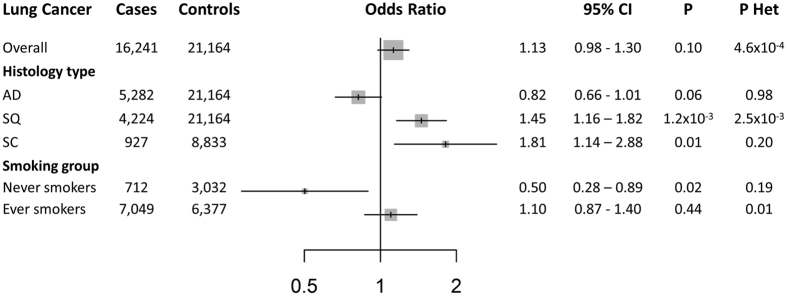
Body mass index (BMI) is inversely associated with lung cancer risk in observational studies, even though it increases the risk of several other cancers, which could indicate confounding by tobacco smoking or reverse causality. We used the two-sample Mendelian randomization (MR) approach to circumvent these limitations of observational epidemiology by constructing a genetic instrument for BMI, based on results from the GIANT consortium, which was evaluated in relation to lung cancer risk using GWAS results on 16,572 lung cancer cases and 21,480 controls. Results were stratified by histological subtype, smoking status and sex. An increase of one standard deviation (SD) in BMI (4.65 Kg/m(2)) raised the risk for lung cancer overall (OR = 1.13; P = 0.10). This was driven by associations with squamous cell (SQ) carcinoma (OR = 1.45; P = 1.2 × 10(-3)) and small cell (SC) carcinoma (OR = 1.81; P = 0.01). An inverse trend was seen for adenocarcinoma (AD) (OR = 0.82; P = 0.06). In stratified analyses, a 1 SD increase in BMI was inversely associated with overall lung cancer in never smokers (OR = 0.50; P = 0.02). These results indicate that higher BMI may increase the risk of certain types of lung cancer, in particular SQ and SC carcinoma.
在观察性研究中,体重指数(BMI)与肺癌风险呈负相关,尽管它会增加其他几种癌症的风险,这可能表明存在吸烟导致的混杂因素或反向因果关系。我们采用两样本孟德尔随机化(MR)方法,通过构建基于GIANT联盟结果的BMI基因工具,来规避观察性流行病学的这些局限性,该基因工具利用16572例肺癌病例和21480例对照的全基因组关联研究(GWAS)结果评估其与肺癌风险的关系。结果按组织学亚型、吸烟状况和性别进行分层。BMI增加一个标准差(SD)(4.65 Kg/m²)会使总体肺癌风险升高(比值比[OR]=1.13;P=0.10)。这是由与鳞状细胞(SQ)癌(OR=1.45;P=1.2×10⁻³)和小细胞(SC)癌(OR=1.81;P=0.01)的关联驱动的。腺癌(AD)呈现相反趋势(OR=0.82;P=0.06)。在分层分析中,BMI增加1个SD与从不吸烟者的总体肺癌呈负相关(OR=0.50;P=0.02)。这些结果表明,较高的BMI可能会增加某些类型肺癌的风险,尤其是SQ和SC癌。