Ding Ding, Zhao Qianhua, Guo Qihao, Liang Xiaoniu, Luo Jianfeng, Yu Lirong, Zheng Li, Hong Zhen
Institute of Neurology, Huashan Hospital, Fudan University, WHO Collaborating Center for Research and Training in Neurosciences, Shanghai, China.
Department of Health Statistics, School of Public Health, Fudan University, Shanghai, China; The Key Laboratory of Public Health Safety, Fudan University, Shanghai, China.
Alzheimers Dement (Amst). 2016 Apr 9;4:28-36. doi: 10.1016/j.dadm.2016.03.004. eCollection 2016.
The Shanghai Aging Study is a community-based study aiming to investigate the incidence and progression of cognitive decline in Chinese elderly, with the operational procedures and diagnostic criteria similar to cohort studies in developed countries.
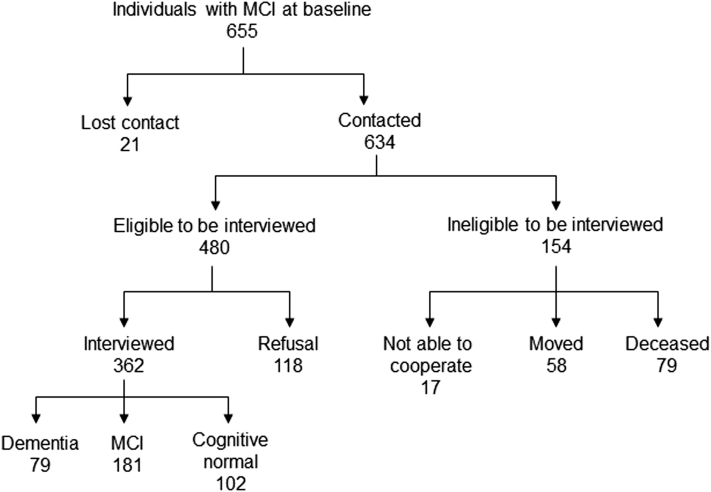
We prospectively evaluated 362 individuals with mild cognitive impairment (MCI) diagnosed at baseline through a clinical and neuropsychological interview. Diagnoses of dementia and MCI were made using standard criteria via consensus diagnosis.
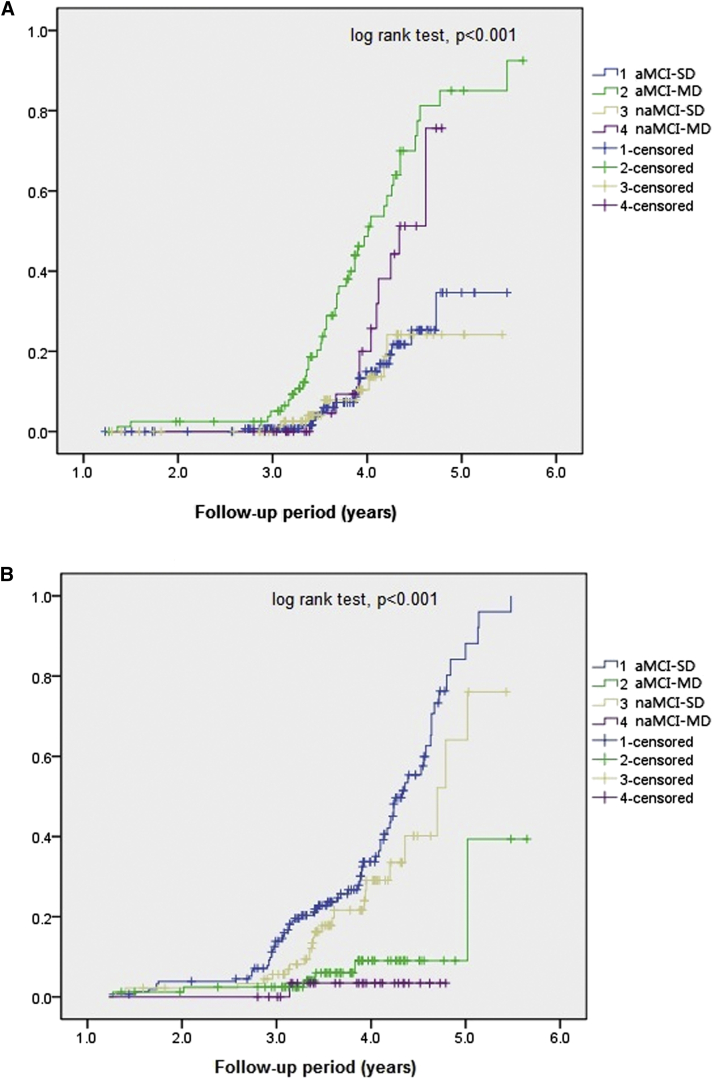
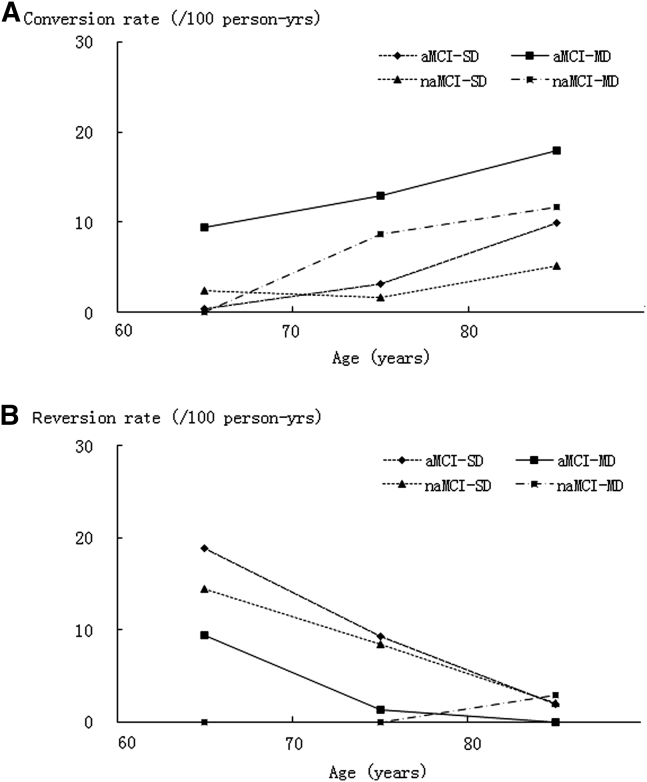
The conversion rate to dementia was 6.0 per 100 person-years, while the reversion rate to cognitive normal was 7.8 per 100 person-years. Amnestic MCI multiple domains was the most risky type for dementia (conversion rate: 14.2 per 100 person-years). Older age (hazard ratio [HR] = 1.09), apolipoprotein E (APOE ε4) (HR = 2.15), and low MMSE score (HR = 1.18) were predictors for dementia.
Approximately 6% of elderly with MCI progress to dementia annually. Prospective studies are needed to further examine risk and protective predictors and to seek proper interventions for cognitive decline.
上海老龄化研究是一项基于社区的研究,旨在调查中国老年人认知功能衰退的发病率和进展情况,其操作程序和诊断标准与发达国家的队列研究相似。
我们通过临床和神经心理学访谈对362名在基线时被诊断为轻度认知障碍(MCI)的个体进行了前瞻性评估。痴呆和MCI的诊断采用标准标准并通过共识诊断得出。
痴呆转化率为每100人年6.0例,认知恢复正常的逆转率为每100人年7.8例。遗忘型多领域MCI是痴呆最危险的类型(转化率:每100人年14.2例)。年龄较大(风险比[HR]=1.09)、载脂蛋白E(APOEε4)(HR=2.15)和低MMSE评分(HR=1.18)是痴呆的预测因素。
每年约6%的MCI老年人会进展为痴呆。需要进行前瞻性研究以进一步检查风险和保护性预测因素,并寻求针对认知衰退的适当干预措施。