Bauder Javan M, Breininger David R, Bolt M Rebecca, Legare Michael L, Jenkins Christopher L, Rothermel Betsie B, McGarigal Kevin
Department of Environmental Conservation, University of Massachusetts, Amherst, Massachusetts, United States of America.
NASA Ecological Programs, Integrated Mission Support Services, Kennedy Space Center, Florida, United States of America.
PLoS One. 2016 Aug 4;11(8):e0160033. doi: 10.1371/journal.pone.0160033. eCollection 2016.
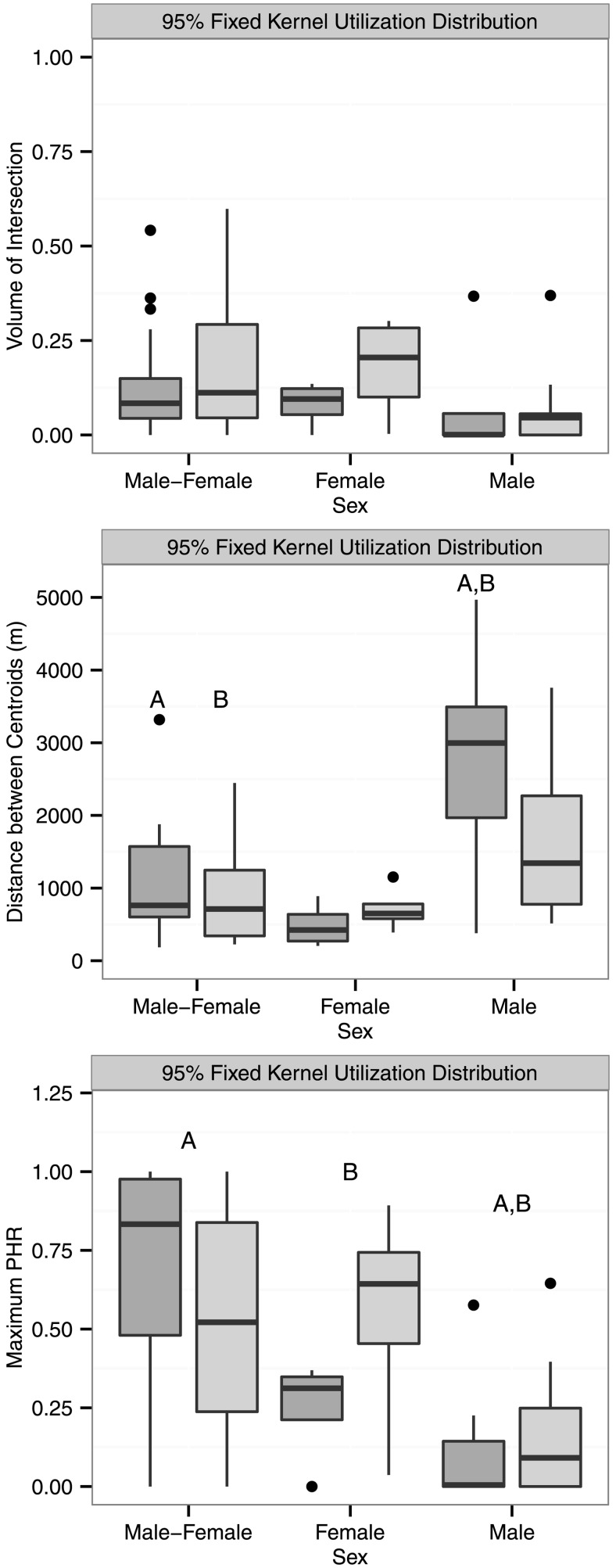
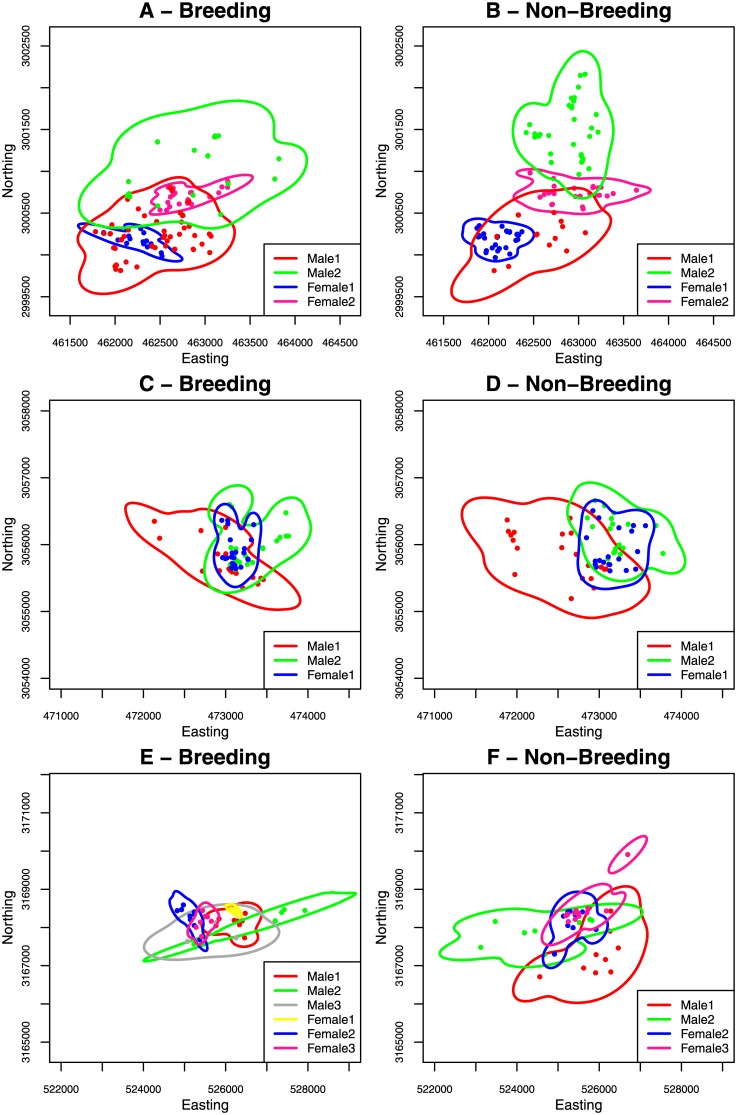
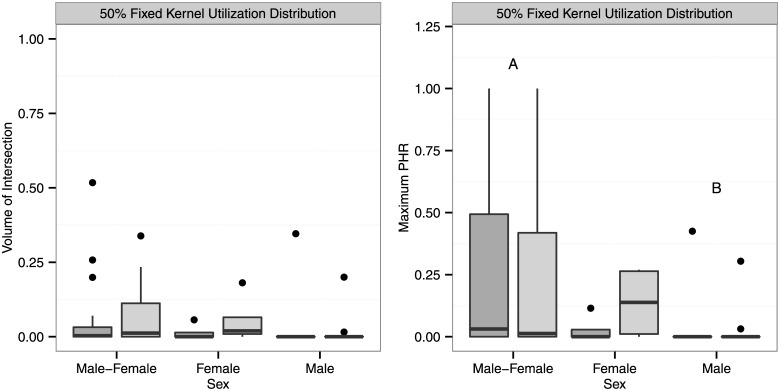
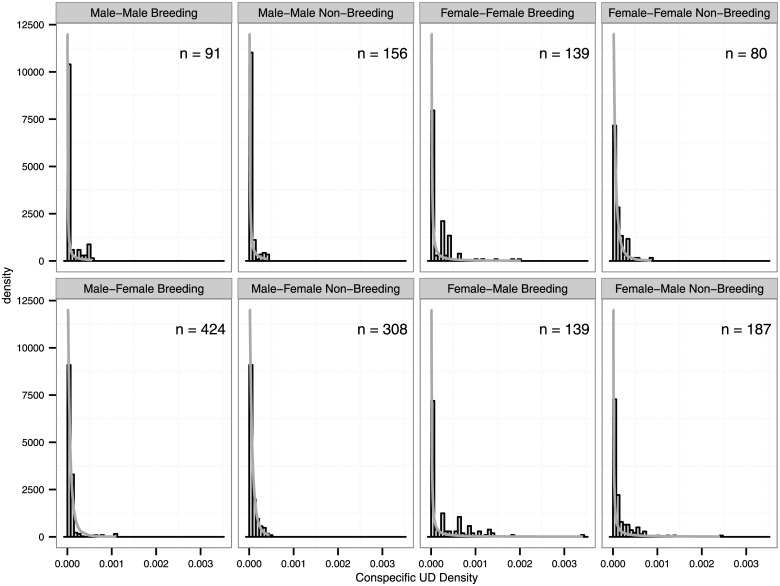
Understanding the factors influencing the degree of spatial overlap among conspecifics is important for understanding multiple ecological processes. Compared to terrestrial carnivores, relatively little is known about the factors influencing conspecific spatial overlap in snakes, although across snake taxa there appears to be substantial variation in conspecific spatial overlap. In this study, we described conspecific spatial overlap of eastern indigo snakes (Drymarchon couperi) in peninsular Florida and examined how conspecific spatial overlap varied by sex and season (breeding season vs. non-breeding season). We calculated multiple indices of spatial overlap using 6- and 3-month utilization distributions (UD) of dyads of simultaneously adjacent telemetered snakes. We also measured conspecific UD density values at each telemetry fix and modeled the distribution of those values as a function of overlap type, sex, and season using generalized Pareto distributions. Home range overlap between males and females was significantly greater than overlap between individuals of the same sex and male home ranges often completely contained female home ranges. Male home ranges overlapped little during both seasons, whereas females had higher levels of overlap during the non-breeding season. The spatial patterns observed in our study are consistent with those seen in many mammalian carnivores, in which low male-male overlap and high inter-sexual overlap provides males with greater access to females. We encourage additional research on the influence of prey availability on conspecific spatial overlap in snakes as well as the behavioral mechanisms responsible for maintaining the low levels of overlap we observed.
了解影响同种个体间空间重叠程度的因素对于理解多种生态过程至关重要。与陆生食肉动物相比,我们对影响蛇类同种个体空间重叠的因素了解相对较少,尽管在整个蛇类分类群中,同种个体的空间重叠似乎存在很大差异。在本研究中,我们描述了佛罗里达半岛东部靛青蛇(Drymarchon couperi)的同种个体空间重叠情况,并研究了同种个体空间重叠如何因性别和季节(繁殖季节与非繁殖季节)而变化。我们使用同时相邻的遥测蛇对的6个月和3个月利用分布(UD)计算了多个空间重叠指数。我们还在每次遥测定位时测量了同种个体的UD密度值,并使用广义帕累托分布将这些值的分布建模为重叠类型、性别和季节的函数。雄性和雌性之间的家域重叠显著大于同性个体之间的重叠,并且雄性家域通常完全包含雌性家域。在两个季节中,雄性家域之间的重叠都很少,而雌性在非繁殖季节的重叠水平较高。我们研究中观察到的空间模式与许多哺乳动物食肉动物中看到的模式一致——在这些动物中,低雄性 - 雄性重叠和高两性间重叠使雄性有更多机会接触雌性。我们鼓励进一步研究猎物可获得性对蛇类同种个体空间重叠的影响,以及负责维持我们观察到的低重叠水平的行为机制。