
为克服构象空间中的熵垒而引入的虚拟态。
Virtual states introduced for overcoming entropic barriers in conformational space.
作者信息
Higo Junichi, Nakamura Haruki
机构信息
Institute for Protein Research, Osaka University, 3-2 Yamadaoka, Suita, Osaka 565-0871, Japan.
出版信息
Biophysics (Nagoya-shi). 2012 Oct 10;8:139-44. doi: 10.2142/biophysics.8.139. eCollection 2012.
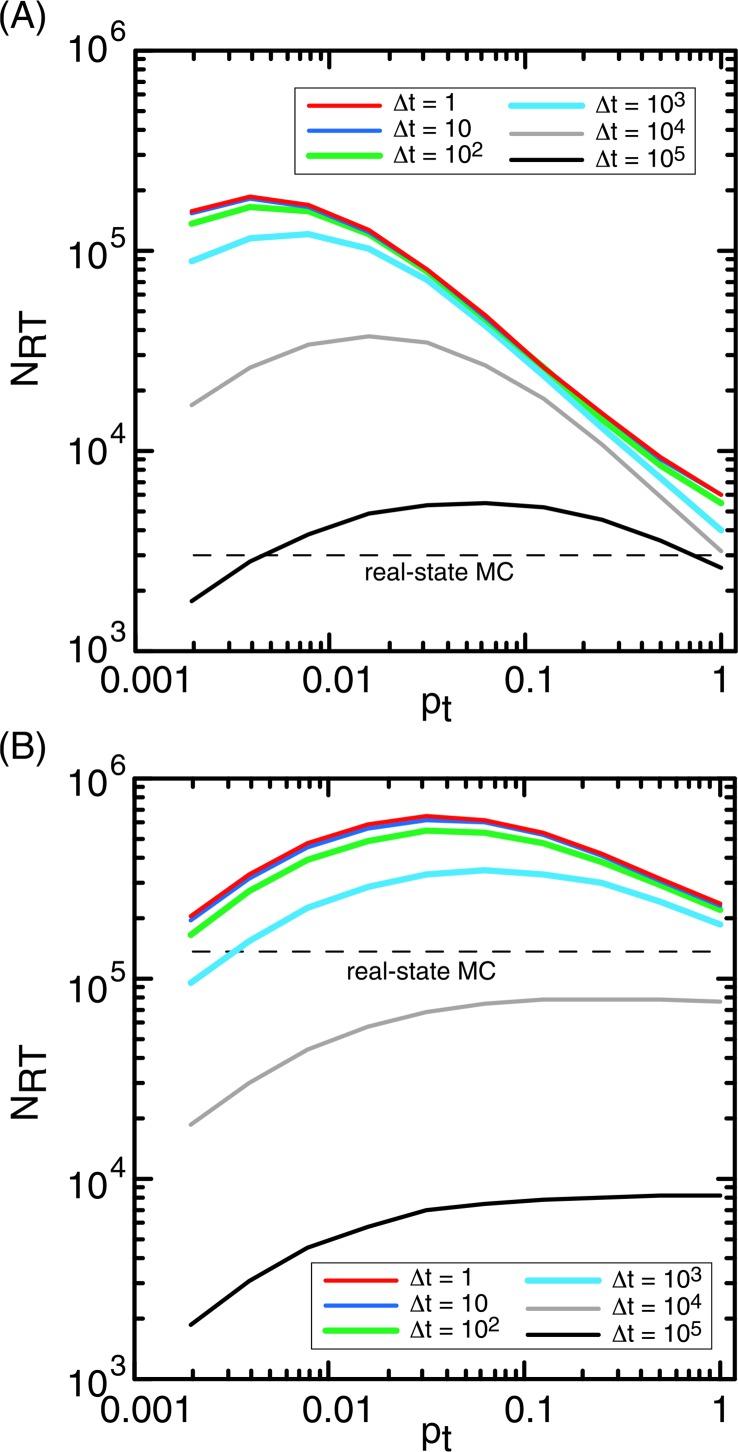
Free-energy landscape is an important quantity to study large-scale motions of a biomolecular system because it maps possible pathways for the motions. When the landscape consists of thermodynamically stable states (low-energy basins), which are connected by narrow conformational pathways (i.e., bottlenecks), the narrowness slows the inter-basin round trips in conformational sampling. This results in inaccuracy of free energies for the basins. This difficulty is not cleared out even when an enhanced conformational sampling is fairly performed along a reaction coordinate. In this study, to enhance the inter-basin round trips we introduced a virtual state that covers the narrow pathways. The probability distribution function for the virtual state was controlled based on detailed balance condition for the inter-state transitions (transitions between the real-state basins and the virtual state). To mimic the free-energy landscape of a real biological system, we introduced a simple model where a wall separates two basins and a narrow hole is pierced in the wall to connect the basins. The sampling was done based on Monte Carlo (MC). We examined several hole-sizes and inter-state transition probabilities. For a small hole-size, a small inter-state transition probability produced a sampling efficiency 100 times higher than a conventional MC does. This result goes against ones intuition, because one considers generally that the sampling efficiency increases with increasing the transition probability. The present method is readily applicable to enhanced conformational sampling such as multi-canonical or adaptive umbrella sampling, and extendable to molecular dynamics.
自由能景观是研究生物分子系统大规模运动的一个重要量,因为它描绘了运动的可能路径。当景观由热力学稳定状态(低能盆地)组成,这些状态由狭窄的构象路径(即瓶颈)相连时,狭窄会减缓构象采样中盆地间的往返。这导致盆地自由能的不准确。即使沿着反应坐标进行了相当程度的增强构象采样,这个困难也无法消除。在本研究中,为了增强盆地间的往返,我们引入了一个覆盖狭窄路径的虚拟状态。基于状态间跃迁(真实状态盆地与虚拟状态之间的跃迁)的细致平衡条件来控制虚拟状态的概率分布函数。为了模拟真实生物系统的自由能景观,我们引入了一个简单模型,其中一堵墙将两个盆地隔开,墙上有一个狭窄的洞将盆地连接起来。采样基于蒙特卡罗(MC)方法进行。我们研究了几种洞的大小和状态间跃迁概率。对于较小的洞尺寸,较小的状态间跃迁概率产生的采样效率比传统蒙特卡罗方法高100倍。这个结果与直觉相悖,因为人们通常认为采样效率会随着跃迁概率的增加而提高。本方法很容易应用于增强构象采样,如多正则或自适应伞形采样,并且可扩展到分子动力学。


 Zotero 插件