Chen Hulin, Wang Junling, Liu Zhongrong, Yang Huilan, Zhu Yingjie, Zhao Minling, Liu Yan, Yan Miaomiao
Department of Dermatology, Guangzhou General Hospital of Guangzhou Military Command (Liuhuaqiao Hospital), Guangzhou, Guangdong 510010, P.R. China.
Gynecologic Department of Guangzhou Hospital of Integrated Traditional and West Medicine, Guangzhou, Guangdong 510800, P.R. China.
Int J Mol Med. 2016 Oct;38(4):1039-46. doi: 10.3892/ijmm.2016.2697. Epub 2016 Aug 3.
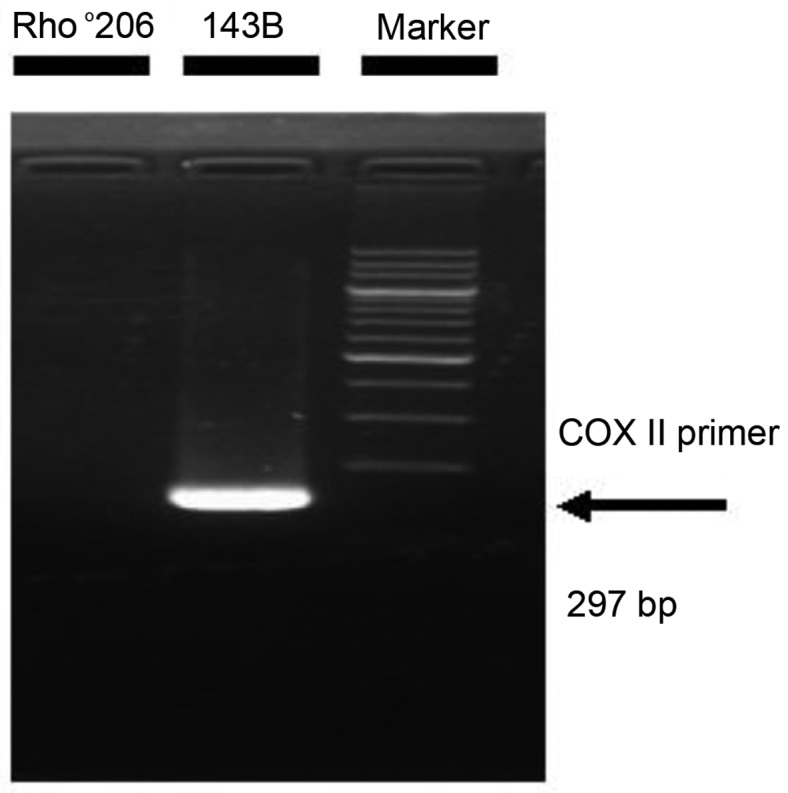
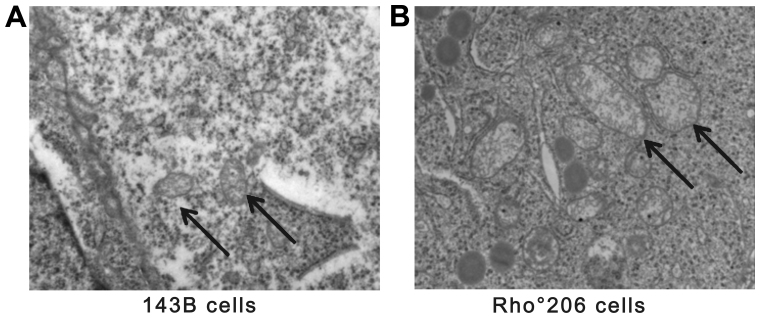
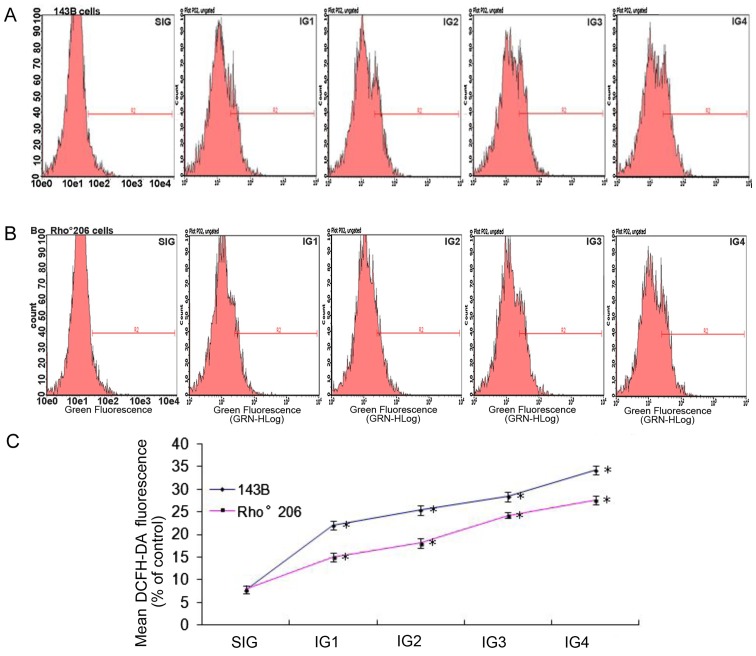
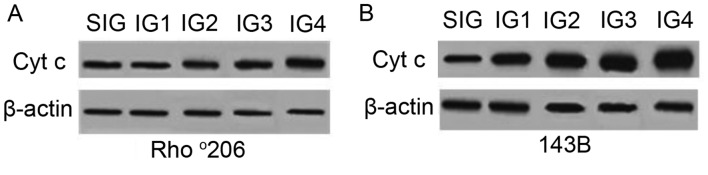
Mitochondrial DNA (mtDNA) depletion occurs frequently in many diseases including cancer. The present study was designed in order to examine the hypothesis that mtDNA‑depleted cells are resistant to apoptosis and to explore the possible mechanisms responsible for this effect. Parental human osteosarcoma 143B cells and mtDNA‑deficient (Rho˚ or ρ˚) 206 cells (derived from 143B cells) were exposed to different doses of solar-simulated ultraviolet (UV) radiation. The effects of solar irradiation on cell morphology were observed under both light and fluorescence microscopes. Furthermore, apoptosis, mitochondrial membrane potential (MMP) disruption and reactive oxygen species (ROS) production were detected and measured by flow cytometry. In both cell lines, apoptosis and ROS production were clearly increased, whereas MMP was slightly decreased. However, apoptosis and ROS production were reduced in the Rho˚206 cells compared with the 143B cells. We also performed western blot analysis and demonstrated the increased release of cytosolic Cyt c from mitochondria in the 143B cells compared with that in the Rho˚206 cells. Thus, we concluded that Rho˚206 cells exhibit more resistance to solar‑simulated UV radiation‑induced apoptosis at certain doses than 143B cells and this is possibly due to decreased ROS production.
线粒体DNA(mtDNA)耗竭在包括癌症在内的许多疾病中频繁发生。本研究旨在检验mtDNA耗竭细胞对凋亡具有抗性这一假说,并探索造成这种效应的可能机制。将亲本人骨肉瘤143B细胞和线粒体DNA缺陷型( Rho˚ 或ρ˚)206细胞(源自143B细胞)暴露于不同剂量的模拟太阳紫外线(UV)辐射下。在光学显微镜和荧光显微镜下观察太阳辐射对细胞形态的影响。此外,通过流式细胞术检测并测定凋亡、线粒体膜电位(MMP)破坏和活性氧(ROS)生成情况。在两种细胞系中,凋亡和ROS生成均明显增加,而MMP略有下降。然而,与143B细胞相比,Rho˚206细胞中的凋亡和ROS生成减少。我们还进行了蛋白质印迹分析,结果表明,与Rho˚206细胞相比,143B细胞中线粒体胞质细胞色素C的释放增加。因此,我们得出结论,在一定剂量下,Rho˚206细胞比143B细胞对模拟太阳UV辐射诱导的凋亡表现出更强的抗性,这可能是由于ROS生成减少所致。