Lenac Rovis Tihana, Kucan Brlic Paola, Kaynan Noa, Juranic Lisnic Vanda, Brizic Ilija, Jordan Stefan, Tomic Adriana, Kvestak Daria, Babic Marina, Tsukerman Pinchas, Colonna Marco, Koszinowski Ulrich, Messerle Martin, Mandelboim Ofer, Krmpotic Astrid, Jonjic Stipan
Center for Proteomics, Faculty of Medicine, University of Rijeka, Rijeka 51000, Croatia.
The Lautenberg Center for General and Tumor Immunology, The Hebrew University, The BioMedical Research Institute, Hadassah Medical School, Jerusalem 91120, Israel.
J Exp Med. 2016 Aug 22;213(9):1835-50. doi: 10.1084/jem.20151899. Epub 2016 Aug 8.
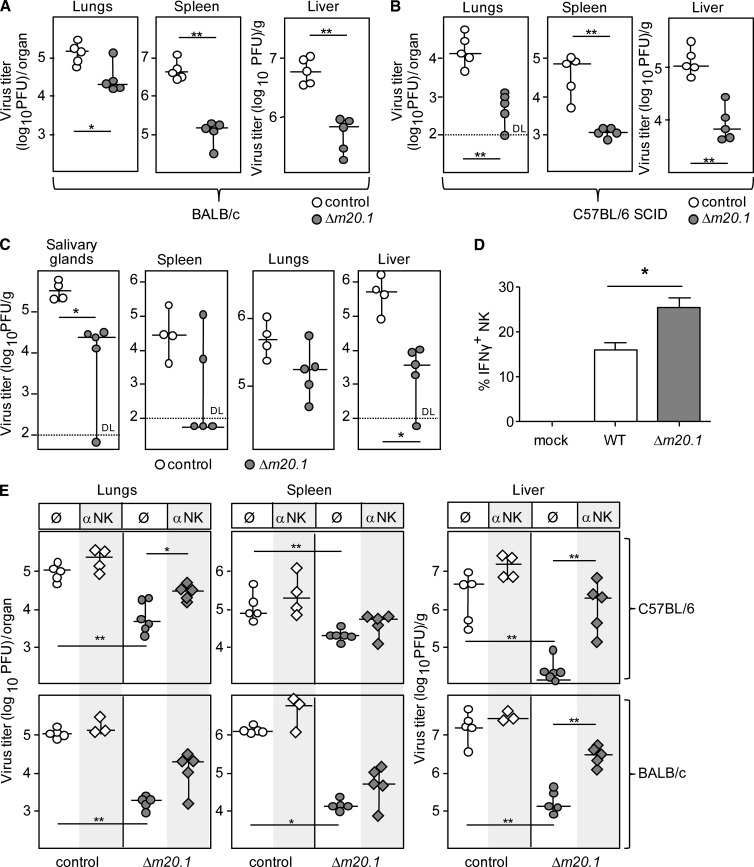
The poliovirus receptor (PVR) is a ubiquitously expressed glycoprotein involved in cellular adhesion and immune response. It engages the activating receptor DNAX accessory molecule (DNAM)-1, the inhibitory receptor TIGIT, and the CD96 receptor with both activating and inhibitory functions. Human cytomegalovirus (HCMV) down-regulates PVR expression, but the significance of this viral function in vivo remains unknown. Here, we demonstrate that mouse CMV (MCMV) also down-regulates the surface PVR. The m20.1 protein of MCMV retains PVR in the endoplasmic reticulum and promotes its degradation. A MCMV mutant lacking the PVR inhibitor was attenuated in normal mice but not in mice lacking DNAM-1. This attenuation was partially reversed by NK cell depletion, whereas the simultaneous depletion of mononuclear phagocytes abolished the virus control. This effect was associated with the increased expression of DNAM-1, whereas TIGIT and CD96 were absent on these cells. An increased level of proinflammatory cytokines in sera of mice infected with the virus lacking the m20.1 and an increased production of iNOS by inflammatory monocytes was observed. Blocking of CCL2 or the inhibition of iNOS significantly increased titer of the virus lacking m20.1. In this study, we have demonstrated that inflammatory monocytes, together with NK cells, are essential in the early control of CMV through the DNAM-1-PVR pathway.
脊髓灰质炎病毒受体(PVR)是一种广泛表达的糖蛋白,参与细胞黏附和免疫反应。它与具有激活功能的激活受体DNAX辅助分子(DNAM)-1、抑制性受体TIGIT以及兼具激活和抑制功能的CD96受体相互作用。人类巨细胞病毒(HCMV)会下调PVR的表达,但这种病毒功能在体内的意义仍不清楚。在此,我们证明小鼠巨细胞病毒(MCMV)也会下调PVR的表面表达。MCMV的m20.1蛋白将PVR保留在内质网中并促进其降解。缺乏PVR抑制剂的MCMV突变体在正常小鼠中减毒,但在缺乏DNAM-1的小鼠中则不然。这种减毒作用通过NK细胞耗竭部分逆转,而单核吞噬细胞的同时耗竭则消除了病毒的控制。这种效应与DNAM-1表达增加有关,而这些细胞上不存在TIGIT和CD96。观察到感染缺乏m20.1的病毒的小鼠血清中促炎细胞因子水平升高,且炎性单核细胞产生的诱导型一氧化氮合酶增加。阻断CCL2或抑制诱导型一氧化氮合酶会显著提高缺乏m20.1的病毒的滴度。在本研究中,我们证明炎性单核细胞与NK细胞一起,通过DNAM-1-PVR途径在CMV的早期控制中至关重要。