Jung Marianna E, Metzger Daniel B
Department of Pharmacology and Neuroscience, University of North Texas Health Science Center at Fort Worth, 3500 Camp Bowie Blvd., Fort Worth, TX 76107-2699, USA.
Department of Pharmacology and Neuroscience, University of North Texas Health Science Center at Fort Worth, 3500 Camp Bowie Blvd., Fort Worth, TX 76107-2699, USA.
Behav Brain Res. 2016 Nov 1;314:199-214. doi: 10.1016/j.bbr.2016.07.054. Epub 2016 Aug 5.
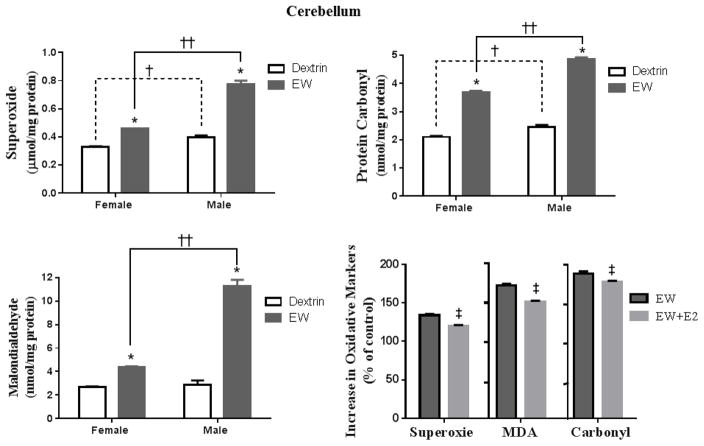
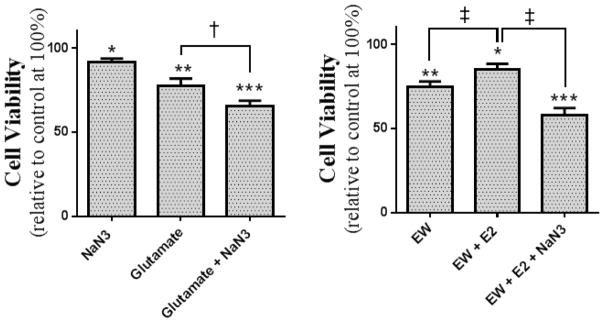
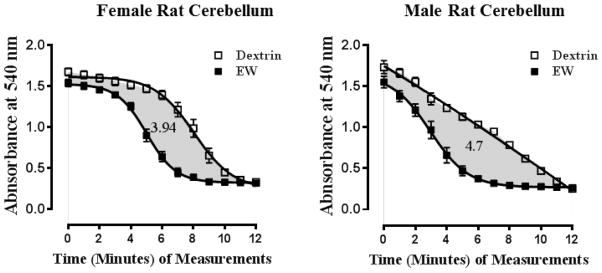
Ethanol withdrawal (EW) is referred to the abrupt termination of long-term heavy drinking, and provokes oxidative brain damage. Here, we investigated whether the cerebellum and hippocampus of female rats are less affected by prooxidant EW than male rats due to the antioxidant effect of 17β-estradiol (E2). Female and male rats received a four-week ethanol diet and three-week withdrawal per cycle for two cycles. Some female rats were ovariectomized with E2 or antioxidant (Vitamin E+Co-Q10) treatment. Measurements were cerebellum (Rotarod) and hippocampus (water-maze)-related behaviors, oxidative markers (O2(-), malondialdehyde, protein carbonyls), mitochondrial membrane swelling, and a key mitochondrial enzyme, cytochrome c oxidase (CcO). Separately, HT22 (hippocampal) cells were subjected to ethanol-exposure and withdrawal for two cycles to assess the effect of a CcO inhibitor on E2's protection for mitochondrial respiration and cell viability. Ethanol-withdrawn female rats showed a smaller increase in oxidative markers in cerebellum and hippocampus than male rats, and E2 treatment decreased the oxidative markers. Compared to male counterparts, ethanol-withdrawn female rats showed better Rotarod but poorer water-maze performance, accompanied by more severe mitochondrial membrane swelling and CcO suppression in hippocampus. E2 or antioxidant treatment improved Rotarod but not water-maze performance. In the presence of a CcO inhibitor, E2 treatment failed to protect mitochondrial respiration and cell viability from EW. These data suggest that antioxidant E2 contributes to smaller oxidative stress in ethanol-withdrawn female than male rats. They also suggest that EW-induced severe mitochondrial damage in hippocampus may blunt E2's antioxidant protection for hippocampus-related behavior.
乙醇戒断(EW)是指长期大量饮酒的突然终止,并引发脑氧化损伤。在此,我们研究了雌性大鼠的小脑和海马是否由于17β-雌二醇(E2)的抗氧化作用而比雄性大鼠受促氧化的乙醇戒断影响更小。雌性和雄性大鼠每周期接受四周乙醇饮食和三周戒断,共两个周期。一些雌性大鼠接受卵巢切除术并给予E2或抗氧化剂(维生素E+辅酶Q10)治疗。测量指标包括小脑(转棒试验)和海马(水迷宫试验)相关行为、氧化标志物(超氧阴离子、丙二醛、蛋白质羰基)、线粒体膜肿胀以及一种关键的线粒体酶细胞色素c氧化酶(CcO)。另外,将HT22(海马)细胞进行两个周期的乙醇暴露和戒断处理,以评估CcO抑制剂对E2保护线粒体呼吸和细胞活力的影响。乙醇戒断的雌性大鼠小脑和海马中氧化标志物的增加幅度小于雄性大鼠,且E2治疗可降低氧化标志物水平。与雄性大鼠相比,乙醇戒断的雌性大鼠转棒试验表现更好但水迷宫试验表现较差,同时海马中线粒体膜肿胀和CcO抑制更严重。E2或抗氧化剂治疗改善了转棒试验表现,但未改善水迷宫试验表现。在存在CcO抑制剂的情况下,E2治疗未能保护线粒体呼吸和细胞活力免受乙醇戒断的影响。这些数据表明,抗氧化剂E2使乙醇戒断的雌性大鼠比雄性大鼠产生更小的氧化应激。它们还表明,乙醇戒断诱导的海马严重线粒体损伤可能削弱E2对海马相关行为的抗氧化保护作用。