• 文献检索
  • 文档翻译
  • 深度研究
  • 学术资讯
  • Suppr Zotero 插件Zotero 插件
  • 邀请有礼
  • 套餐&价格
  • 历史记录
应用&插件
Suppr Zotero 插件Zotero 插件浏览器插件Mac 客户端Windows 客户端微信小程序
定价
高级版会员购买积分包购买API积分包
服务
文献检索文档翻译深度研究API 文档MCP 服务
关于我们
关于 Suppr公司介绍联系我们用户协议隐私条款
关注我们

Suppr 超能文献

核心技术专利:CN118964589B侵权必究
粤ICP备2023148730 号-1Suppr @ 2026

文献检索

告别复杂PubMed语法,用中文像聊天一样搜索,搜遍4000万医学文献。AI智能推荐,让科研检索更轻松。

立即免费搜索

文件翻译

保留排版,准确专业,支持PDF/Word/PPT等文件格式,支持 12+语言互译。

免费翻译文档

深度研究

AI帮你快速写综述,25分钟生成高质量综述,智能提取关键信息,辅助科研写作。

立即免费体验

犬类恐惧与攻击性的基因图谱绘制。

Genetic mapping of canine fear and aggression.

作者信息

Zapata Isain, Serpell James A, Alvarez Carlos E

机构信息

Center for Molecular and Human Genetics, The Research Institute at Nationwide Children's Hospital, Columbus, OH, 43205, USA.

Center for the Interaction of Animals and Society, School of Veterinary Medicine, University of Pennsylvania, Philadelphia, PA, 19104, USA.

出版信息

BMC Genomics. 2016 Aug 8;17:572. doi: 10.1186/s12864-016-2936-3.

DOI:10.1186/s12864-016-2936-3
PMID:27503363
原文链接:https://pmc.ncbi.nlm.nih.gov/articles/PMC4977763/
Abstract

BACKGROUND

Fear/anxiety and anger/aggression greatly influence health, quality of life and social interactions. They are a huge burden to wellbeing, and personal and public economics. However, while much is known about the physiology and neuroanatomy of such emotions, little is known about their genetics - most importantly, why some individuals are more susceptible to pathology under stress.

RESULTS

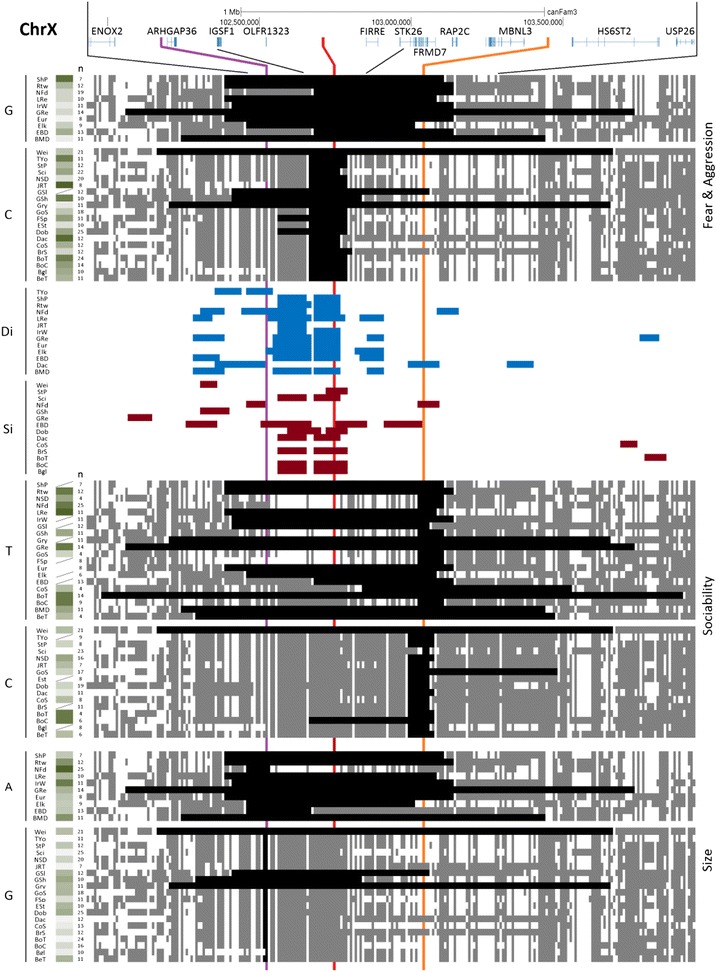
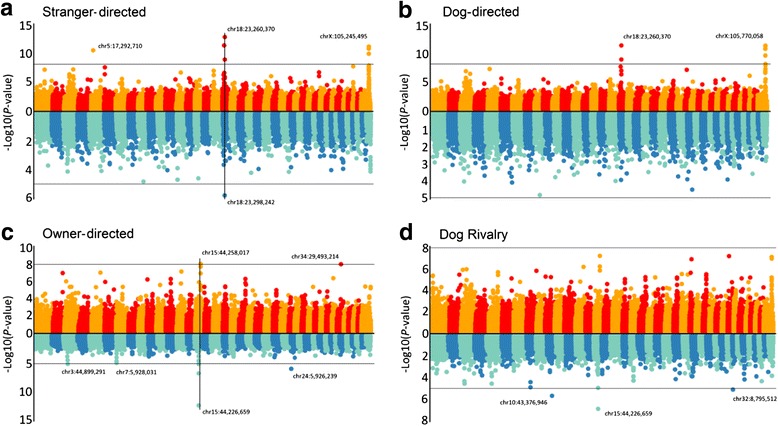
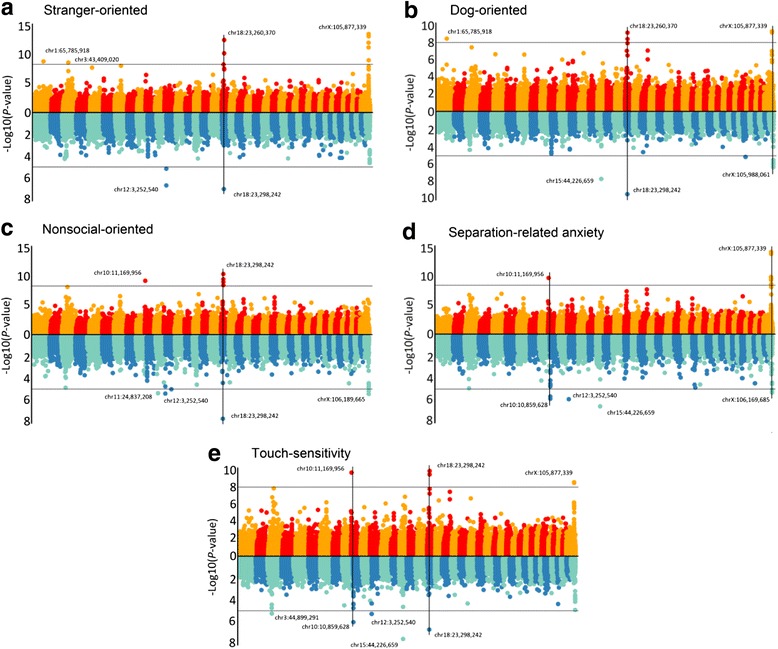
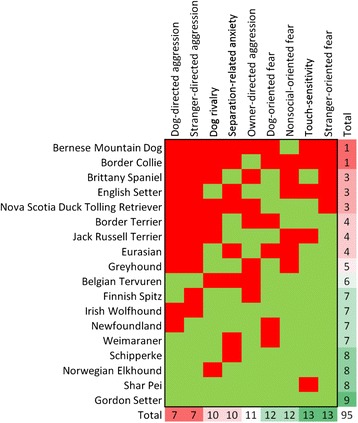
We conducted genomewide association (GWA) mapping of breed stereotypes for many fear and aggression traits across several hundred dogs from diverse breeds. We confirmed those findings using GWA in a second cohort of partially overlapping breeds. Lastly, we used the validated loci to create a model that effectively predicted fear and aggression stereotypes in a third group of dog breeds that were not involved in the mapping studies. We found that i) known IGF1 and HMGA2 loci variants for small body size are associated with separation anxiety, touch-sensitivity, owner directed aggression and dog rivalry; and ii) two loci, between GNAT3 and CD36 on chr18, and near IGSF1 on chrX, are associated with several traits, including touch-sensitivity, non-social fear, and fear and aggression that are directed toward unfamiliar dogs and humans. All four genome loci are among the most highly evolutionarily-selected in dogs, and each of those was previously shown to be associated with morphological traits. We propose that the IGF1 and HMGA2 loci are candidates for identical variation being associated with both behavior and morphology. In contrast, we show that the GNAT3-CD36 locus has distinct variants for behavior and morphology. The chrX region is a special case due to its extensive linkage disequilibrium (LD). Our evidence strongly suggests that sociability (which we propose is associated with HS6ST2) and fear/aggression are two distinct GWA loci within this LD block on chrX, but there is almost perfect LD between the peaks for fear/aggression and animal size.

CONCLUSIONS

We have mapped many canine fear and aggression traits to single haplotypes at the GNAT3-CD36 and IGSF1 loci. CD36 is widely expressed, but areas of the amygdala and hypothalamus are among the brain regions with highest enrichment; and CD36-knockout mice are known to have significantly increased anxiety and aggression. Both of the other genes have very high tissue-specificity and are very abundantly expressed in brain regions that comprise the core anatomy of fear and aggression - the amygdala to hypothalamic-pituitary-adrenal (HPA) axis. We propose that reduced-fear variants at these loci may have been involved in the domestication process.

摘要

背景

恐惧/焦虑和愤怒/攻击行为对健康、生活质量及社会交往有极大影响。它们给幸福安康以及个人和公共经济带来巨大负担。然而,尽管我们对这些情绪的生理学和神经解剖学了解颇多,但对其遗传学却知之甚少——最重要的是,为何有些人在压力下更容易出现病理状况。

结果

我们对数百只不同品种犬的多种恐惧和攻击行为特征进行了全基因组关联(GWA)图谱分析,以确定品种刻板印象。我们在第二批部分重叠品种的犬中通过GWA证实了这些发现。最后,我们利用已验证的基因座创建了一个模型,该模型能有效预测第三组未参与图谱研究的犬品种中的恐惧和攻击行为刻板印象。我们发现:i)已知与小体型相关的IGF1和HMGA2基因座变异与分离焦虑、触觉敏感性、对主人的攻击行为及犬之间的竞争有关;ii)位于18号染色体上GNAT3和CD36之间以及X染色体上IGSF1附近的两个基因座与多种特征相关,包括触觉敏感性、非社交性恐惧以及针对陌生犬和人类的恐惧和攻击行为。这四个基因组基因座都是犬类中进化选择程度最高的,并且之前已证明每个基因座都与形态特征相关。我们提出IGF1和HMGA2基因座可能是与行为和形态都相关的相同变异的候选基因座。相比之下,我们表明GNAT3 - CD36基因座在行为和形态方面具有不同的变异。X染色体区域由于其广泛的连锁不平衡(LD)而情况特殊。我们的证据有力地表明社交性(我们认为与HS6ST2相关)和恐惧/攻击行为是X染色体上这个LD区域内两个不同的GWA基因座,但恐惧/攻击行为峰值与动物体型之间几乎完全连锁不平衡。

结论

我们已将许多犬类的恐惧和攻击行为特征定位到GNAT3 - CD36和IGSF1基因座的单倍型上。CD36广泛表达,但杏仁核和下丘脑区域是大脑中表达最丰富的区域之一;已知CD36基因敲除小鼠的焦虑和攻击行为显著增加。另外两个基因都具有非常高的组织特异性,并且在构成恐惧和攻击行为核心解剖结构的大脑区域——从杏仁核到下丘脑 - 垂体 - 肾上腺(HPA)轴中大量表达。我们提出这些基因座上降低恐惧的变异可能参与了驯化过程。
https://cdn.ncbi.nlm.nih.gov/pmc/blobs/1e8c/4977763/18d2cc7886b6/12864_2016_2936_Fig8_HTML.jpg
https://cdn.ncbi.nlm.nih.gov/pmc/blobs/1e8c/4977763/116bbacbab00/12864_2016_2936_Fig1_HTML.jpg
https://cdn.ncbi.nlm.nih.gov/pmc/blobs/1e8c/4977763/c5ebeeddf994/12864_2016_2936_Fig2_HTML.jpg
https://cdn.ncbi.nlm.nih.gov/pmc/blobs/1e8c/4977763/c4c18c5e53ac/12864_2016_2936_Fig3_HTML.jpg
https://cdn.ncbi.nlm.nih.gov/pmc/blobs/1e8c/4977763/4e8b37c09b37/12864_2016_2936_Fig4_HTML.jpg
https://cdn.ncbi.nlm.nih.gov/pmc/blobs/1e8c/4977763/061654cc4945/12864_2016_2936_Fig5_HTML.jpg
https://cdn.ncbi.nlm.nih.gov/pmc/blobs/1e8c/4977763/7926e59234fa/12864_2016_2936_Fig6_HTML.jpg
https://cdn.ncbi.nlm.nih.gov/pmc/blobs/1e8c/4977763/161736490744/12864_2016_2936_Fig7_HTML.jpg
https://cdn.ncbi.nlm.nih.gov/pmc/blobs/1e8c/4977763/18d2cc7886b6/12864_2016_2936_Fig8_HTML.jpg
https://cdn.ncbi.nlm.nih.gov/pmc/blobs/1e8c/4977763/116bbacbab00/12864_2016_2936_Fig1_HTML.jpg
https://cdn.ncbi.nlm.nih.gov/pmc/blobs/1e8c/4977763/c5ebeeddf994/12864_2016_2936_Fig2_HTML.jpg
https://cdn.ncbi.nlm.nih.gov/pmc/blobs/1e8c/4977763/c4c18c5e53ac/12864_2016_2936_Fig3_HTML.jpg
https://cdn.ncbi.nlm.nih.gov/pmc/blobs/1e8c/4977763/4e8b37c09b37/12864_2016_2936_Fig4_HTML.jpg
https://cdn.ncbi.nlm.nih.gov/pmc/blobs/1e8c/4977763/061654cc4945/12864_2016_2936_Fig5_HTML.jpg
https://cdn.ncbi.nlm.nih.gov/pmc/blobs/1e8c/4977763/7926e59234fa/12864_2016_2936_Fig6_HTML.jpg
https://cdn.ncbi.nlm.nih.gov/pmc/blobs/1e8c/4977763/161736490744/12864_2016_2936_Fig7_HTML.jpg
https://cdn.ncbi.nlm.nih.gov/pmc/blobs/1e8c/4977763/18d2cc7886b6/12864_2016_2936_Fig8_HTML.jpg

相似文献

1
Genetic mapping of canine fear and aggression.犬类恐惧与攻击性的基因图谱绘制。
BMC Genomics. 2016 Aug 8;17:572. doi: 10.1186/s12864-016-2936-3.
2
Genetic testing of dogs predicts problem behaviors in clinical and nonclinical samples.犬种基因检测可预测临床和非临床样本中的行为问题。
BMC Genomics. 2022 Feb 7;23(1):102. doi: 10.1186/s12864-022-08351-9.
3
Assessment of the functionality of genome-wide canine SNP arrays and implications for canine disease association studies.全基因组犬单核苷酸多态性阵列的功能评估及其对犬疾病关联研究的意义。
Anim Genet. 2011 Apr;42(2):181-90. doi: 10.1111/j.1365-2052.2010.02132.x. Epub 2010 Nov 11.
4
Analysis of large versus small dogs reveals three genes on the canine X chromosome associated with body weight, muscling and back fat thickness.对大型犬与小型犬的分析揭示,犬类X染色体上有三个基因与体重、肌肉量和背部脂肪厚度有关。
PLoS Genet. 2017 Mar 3;13(3):e1006661. doi: 10.1371/journal.pgen.1006661. eCollection 2017 Mar.
5
Expression of Behavioural Traits in Goldendoodles and Labradoodles.金毛寻回犬与拉布拉多寻回犬混种后代行为特征的表现
Animals (Basel). 2019 Dec 17;9(12):1162. doi: 10.3390/ani9121162.
6
Two novel genomic regions associated with fearfulness in dogs overlap human neuropsychiatric loci.两个与犬类恐惧相关的新型基因组区域与人类神经精神疾病相关区域重叠。
Transl Psychiatry. 2019 Jan 17;9(1):18. doi: 10.1038/s41398-018-0361-x.
7
Shelter dog behavior after adoption: Using the C-BARQ to track dog behavior changes through the first six months after adoption.领养后 shelter 犬的行为:使用 C-BARQ 在领养后最初的六个月跟踪犬只的行为变化。
PLoS One. 2023 Aug 16;18(8):e0289356. doi: 10.1371/journal.pone.0289356. eCollection 2023.
8
Linked genetic variants on chromosome 10 control ear morphology and body mass among dog breeds.10号染色体上的连锁遗传变异控制着犬种的耳部形态和体重。
BMC Genomics. 2015 Jun 23;16(1):474. doi: 10.1186/s12864-015-1702-2.
9
Dog behavior co-varies with height, bodyweight and skull shape.狗的行为与身高、体重和头骨形状共同变化。
PLoS One. 2013 Dec 16;8(12):e80529. doi: 10.1371/journal.pone.0080529. eCollection 2013.
10
Identification of genomic regions associated with phenotypic variation between dog breeds using selection mapping.利用选择映射识别与犬种间表型变异相关的基因组区域。
PLoS Genet. 2011 Oct;7(10):e1002316. doi: 10.1371/journal.pgen.1002316. Epub 2011 Oct 13.

引用本文的文献

1
A Quantitative Exploration of Australian Dog Breeders' Breeding Goals, Puppy Rearing Practices and Approaches to Socialisation.澳大利亚犬类繁殖者的繁殖目标、幼犬饲养实践及社会化方法的定量探索
Animals (Basel). 2025 Aug 6;15(15):2302. doi: 10.3390/ani15152302.
2
Association between androgen receptor gene and behavioral traits in cats (Felis catus).猫(家猫)雄激素受体基因与行为特征之间的关联。
PLoS One. 2025 May 28;20(5):e0324055. doi: 10.1371/journal.pone.0324055. eCollection 2025.
3
Potential Adaptive Introgression From Dogs in Iberian Grey Wolves (Canis lupus).

本文引用的文献

1
Out of southern East Asia: the natural history of domestic dogs across the world.走出东亚南部:世界各地家犬的自然史。
Cell Res. 2016 Jan;26(1):21-33. doi: 10.1038/cr.2015.147. Epub 2015 Dec 15.
2
Behavioral characterization of CD36 knockout mice with SHIRPA primary screen.通过SHIRPA初级筛选对CD36基因敲除小鼠进行行为特征分析。
Behav Brain Res. 2016 Feb 15;299:90-6. doi: 10.1016/j.bbr.2015.11.027. Epub 2015 Nov 25.
3
Evidence of long-term gene flow and selection during domestication from analyses of Eurasian wild and domestic pig genomes.
伊比利亚灰狼(Canis lupus)中可能存在来自狗的适应性基因渗入。
Mol Ecol. 2025 Jun;34(12):e17639. doi: 10.1111/mec.17639. Epub 2025 Jan 10.
4
Adaptation in the Alleyways: Candidate Genes Under Potential Selection in Urban Coyotes.小巷中的适应性:城市郊狼潜在选择下的候选基因
Genome Biol Evol. 2025 Jan 6;17(1). doi: 10.1093/gbe/evae279.
5
Heritability and Genome-Wide Association Study of Dog Behavioral Phenotypes in a Commercial Breeding Cohort.商业育种群体中犬行为表型的遗传力和全基因组关联研究。
Genes (Basel). 2024 Dec 17;15(12):1611. doi: 10.3390/genes15121611.
6
Breed function and behaviour correlate with endocranial volume in domestic dogs.家犬的繁殖功能和行为与脑容量相关。
Biol Lett. 2024 Nov;20(11):20240342. doi: 10.1098/rsbl.2024.0342. Epub 2024 Nov 13.
7
Variations in Canine Behavioural Characteristics across Conventional Breed Clusters and Most Common Breed-Based Public Stereotypes.传统犬种集群与基于常见犬种的大众刻板印象中犬类行为特征的差异。
Animals (Basel). 2024 Sep 17;14(18):2695. doi: 10.3390/ani14182695.
8
High-throughput DNA sequence analysis elucidates novel insight into the genetic basis of adaptation in local sheep.高通量 DNA 序列分析揭示了当地绵羊适应遗传基础的新见解。
Trop Anim Health Prod. 2024 May 1;56(4):150. doi: 10.1007/s11250-024-04002-1.
9
Ethical Concerns about Fashionable Dog Breeding.对时尚犬种繁育的伦理考量。
Animals (Basel). 2024 Feb 28;14(5):756. doi: 10.3390/ani14050756.
10
Whole-Genome Scanning for Selection Signatures Reveals Candidate Genes Associated with Growth and Tail Length in Sheep.全基因组扫描寻找选择印记揭示与绵羊生长和尾长相关的候选基因。
Animals (Basel). 2024 Feb 22;14(5):687. doi: 10.3390/ani14050687.
从欧亚野猪和家猪基因组分析看驯化过程中的长期基因流和选择。
Nat Genet. 2015 Oct;47(10):1141-8. doi: 10.1038/ng.3394. Epub 2015 Aug 31.
4
Rare coding variants and X-linked loci associated with age at menarche.与初潮年龄相关的罕见编码变异和X连锁基因座。
Nat Commun. 2015 Aug 4;6:7756. doi: 10.1038/ncomms8756.
5
Expression of CD36 by Olfactory Receptor Cells and Its Abundance on the Epithelial Surface in Mice.嗅觉受体细胞中CD36的表达及其在小鼠上皮表面的丰度
PLoS One. 2015 Jul 17;10(7):e0133412. doi: 10.1371/journal.pone.0133412. eCollection 2015.
6
Spatial and temporal expression of immunoglobulin superfamily member 1 in the rat.大鼠免疫球蛋白超家族成员1的时空表达
J Endocrinol. 2015 Sep;226(3):181-91. doi: 10.1530/JOE-15-0204. Epub 2015 Jul 10.
7
Whole Genome Association Study to Detect Single Nucleotide Polymorphisms for Behavior in Sapsaree Dog (Canis familiaris).检测萨帕里犬(家犬)行为相关单核苷酸多态性的全基因组关联研究。
Asian-Australas J Anim Sci. 2015 Jul;28(7):936-42. doi: 10.5713/ajas.14.0941.
8
Dawn of the dog.犬之黎明。
Science. 2015 Apr 17;348(6232):274-9. doi: 10.1126/science.348.6232.274.
9
Proteomics. Tissue-based map of the human proteome.蛋白质组学。人类蛋白质组组织图谱。
Science. 2015 Jan 23;347(6220):1260419. doi: 10.1126/science.1260419.
10
Evaluation of a behavioral assessment tool for dogs relinquished to shelters.对被送到收容所的犬只的一种行为评估工具的评估。
Prev Vet Med. 2014 Dec 1;117(3-4):601-9. doi: 10.1016/j.prevetmed.2014.10.003. Epub 2014 Oct 22.