Bhowmik Nayan, Cook Shawna R, Croney Candace, Barnard Shanis, Romaniuk Aynsley C, Ekenstedt Kari J
Department of Basic Medical Sciences, College of Veterinary Medicine, Purdue University, West Lafayette, IN 47907, USA.
Department of Comparative Pathobiology, College of Veterinary Medicine, Purdue University, West Lafayette, IN 47907, USA.
Genes (Basel). 2024 Dec 17;15(12):1611. doi: 10.3390/genes15121611.
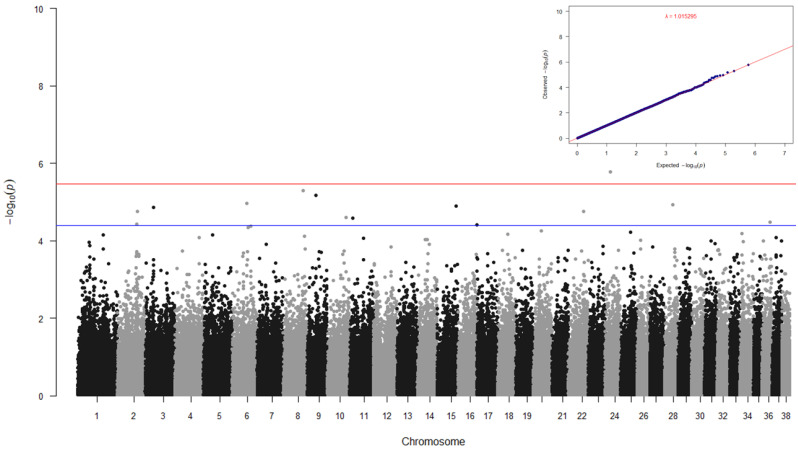
: Canine behavior plays an important role in the success of the human-dog relationship and the dog's overall welfare, making selection for behavior a vital part of any breeding program. While behaviors are complex traits determined by gene × environment interactions, genetic selection for desirable behavioral phenotypes remains possible. : No genomic association studies of dog behavior to date have been reported on a commercial breeding (CB) cohort; therefore, we utilized dogs from these facilities ( = 615 dogs). Behavioral testing followed previously validated protocols, resulting in three phenotypes/variables [social fear (SF), non-social fear (NSF), and startle response (SR)]. Dogs were genotyped on the 710 K Affymetrix Axiom CanineHD SNP array. : Inbreeding coefficients indicated that dogs from CB facilities are statistically less inbred than dogs originating from other breeding sources. Heritability estimates for behavioral phenotypes ranged from 0.042 ± 0.045 to 0.354 ± 0.111. A genome-wide association analysis identified genetic loci associated with SF, NSF, and SR; genes near many of these loci have been previously associated with behavioral phenotypes in other populations of dogs. Finally, genetic risk scores demonstrated differences between dogs that were more or less fearful in response to test stimuli, suggesting that these behaviors could be subjected to genetic improvement. : This study confirms several canine genetic behavioral loci identified in previous studies. It also demonstrates that inbreeding coefficients of dogs in CB facilities are typically lower than those in dogs originating from other breeding sources. SF and NSF were more heritable than SR. Risk allele and weighted risk scores suggest that fearful behaviors could be subjected to genetic improvement.
犬类行为在人犬关系的成功以及犬的整体福利中起着重要作用,因此行为选择成为任何育种计划的关键部分。虽然行为是由基因×环境相互作用决定的复杂性状,但对理想行为表型进行基因选择仍是可行的。:迄今为止,尚未有关于商业育种(CB)群体的犬类行为基因组关联研究报告;因此,我们利用了这些机构的犬(n = 615只犬)。行为测试遵循先前验证的方案,得出三种表型/变量[社交恐惧(SF)、非社交恐惧(NSF)和惊吓反应(SR)]。犬只在710K Affymetrix Axiom CanineHD SNP芯片上进行基因分型。:近亲繁殖系数表明,来自CB机构的犬在统计学上比来自其他育种来源的犬近亲繁殖程度更低。行为表型的遗传力估计值范围为0.042±0.045至0.354±0.111。全基因组关联分析确定了与SF、NSF和SR相关的基因座;这些基因座附近的许多基因先前已与其他犬类群体的行为表型相关联。最后,遗传风险评分显示了对测试刺激反应或多或少恐惧的犬之间的差异,这表明这些行为可以通过基因改良。:本研究证实了先前研究中确定的几个犬类遗传行为基因座。它还表明,CB机构中犬的近亲繁殖系数通常低于来自其他育种来源的犬。SF和NSF比SR更具遗传性。风险等位基因和加权风险评分表明,恐惧行为可以通过基因改良。