Razi Elahe Mirarab, Ghafari Soraya, Golalipour Mohammad Jafar
Histology Laboratory, Golestan University of Medical Sciences, Gorgan, Iran.
Department of Anatomical Sciences, Faculty of Medicine, Golestan University of Medical Sciences, Gorgan, Iran.
Basic Clin Neurosci. 2015 Jan;6(1):6-13.
Diabetes mellitus is associated with nervous system alterations in both human and animal models. This study was done to determine the effect of gestational diabetes on the Purkinje and granular cells in the cerebellum of rat offspring.
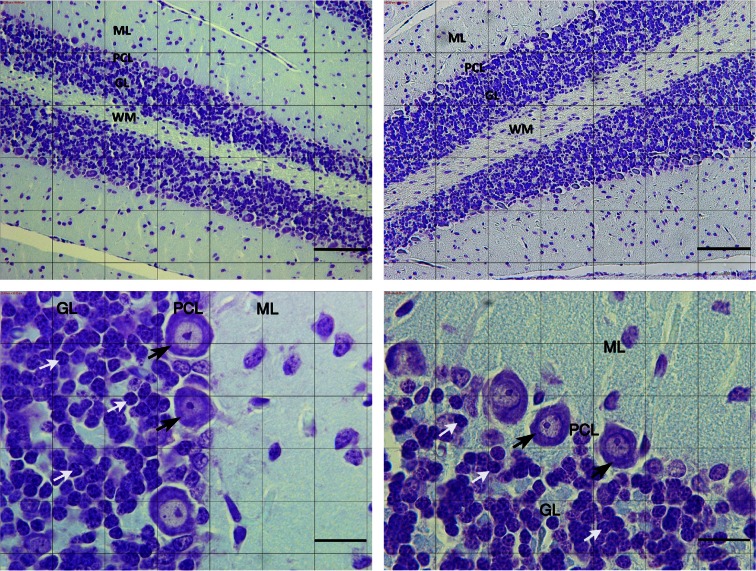
10 Wistar rats Dams were randomly allocated in control and diabetic group. The experimental group received 40 mg/kg/body weight of streptozotocin (STZ) at the first day of gestation and control groups received saline injection intraperitoneally (IP). Six male offsprings of gestational diabetic mothers and control dams, at the 21, 28 postnatal days were randomly scarified and coronal sections of cerebellum (6 micrometer) serially collected. The neurons were stained with cresyl violet.
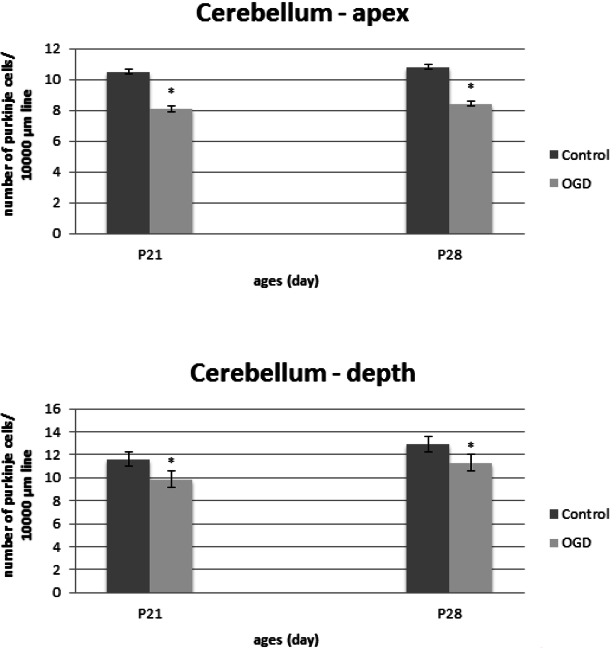
The Purkinje cells density in the apex and depth of cerebellum in P21, in the experimental group was reduced 23% and 15% in comparison with the control group (P<0.001). The granular cells density in the experimental group was reduced 19.58% and 18.3% in comparison with the controls (P<0.001). The Purkinje cells density of cerebellum in P28, in the diabetic group reduced to 22.12% and 12.62% in comparison with the control group (P<0.001). The granular cells density in the diabetic group reduced 17.14% and 16.12% in comparison with the control group (P<0.001).
The Purkinje and granular cells significantly reduced in gestational diabetes rat offspring.
糖尿病在人类和动物模型中均与神经系统改变有关。本研究旨在确定妊娠期糖尿病对大鼠后代小脑浦肯野细胞和颗粒细胞的影响。
将10只Wistar大鼠母鼠随机分为对照组和糖尿病组。实验组在妊娠第1天接受40mg/kg体重的链脲佐菌素(STZ),对照组腹腔注射生理盐水。在出生后第21天和28天,随机处死6只妊娠糖尿病母亲和对照母鼠的雄性后代,连续收集小脑冠状切片(6微米)。神经元用甲酚紫染色。
在出生后第21天,实验组小脑顶部和深部的浦肯野细胞密度与对照组相比分别降低了23%和15%(P<0.001)。实验组颗粒细胞密度与对照组相比分别降低了19.58%和18.3%(P<0.001)。在出生后第28天,糖尿病组小脑浦肯野细胞密度与对照组相比分别降至22.12%和12.62%(P<0.001)。糖尿病组颗粒细胞密度与对照组相比分别降低了17.14%和16.12%(P<0.001)。
妊娠期糖尿病大鼠后代的浦肯野细胞和颗粒细胞显著减少。