Dipartimento di Scienze Mediche e Chirurgiche Università di Bologna, Bologna, Italy.
Dipartimento dell'Apparato Digerente, Azienda Ospedaliero-Universitaria di Bologna, Bologna, Italy; Centro di Ricerca Biomedica Applicata (CRBA), Azienda Ospedaliero-Universitaria Policlinico S Orsola-Malpighi e Università di Bologna, Bologna, Italy.
J Hepatocell Carcinoma. 2015 Apr 24;2:29-38. doi: 10.2147/JHC.S77038. eCollection 2015.
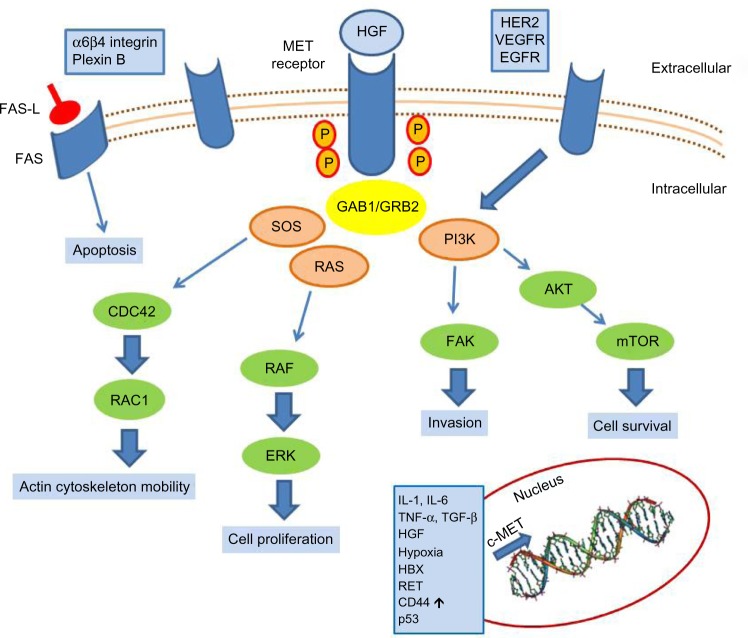
c-MET is the membrane receptor for hepatocyte growth factor (HGF), also known as scatter factor or tumor cytotoxic factor, a mitogenic growth factor for hepatocytes. HGF is mainly produced by cells of mesenchymal origin and it mainly acts on neighboring epidermal and endothelial cells, regulating epithelial growth and morphogenesis. HGF/MET signaling has been identified among the drivers of tumorigenesis in human cancers. As such, c-MET is a recognized druggable target, and against it, targeted agents are currently under clinical investigation. c-MET overexpression is a common event in a wide range of human malignancies, including gastric, lung, breast, ovary, colon, kidney, thyroid, and liver carcinomas. Despite c-MET overexpression being reported by a large majority of studies, no evidence for a c-MET oncogenic addiction exists in hepatocellular carcinoma (HCC). In particular, c-MET amplification is a rare event, accounting for 4%-5% of cases while no mutation has been identified in c-MET oncogene in HCC. Thus, the selection of patient subgroups more likely to benefit from c-MET inhibition is challenging. Notwithstanding, c-MET overexpression was reported to be associated with increased metastatic potential and poor prognosis in patients with HCC, providing a rationale for its therapeutic inhibition. Here we summarize the role of activated HGF/MET signaling in HCC, its prognostic relevance, and the implications for therapeutic approaches in HCC.
c-MET 是肝细胞生长因子 (HGF) 的膜受体,也称为分散因子或肿瘤细胞毒性因子,是一种有丝分裂生长因子,可刺激肝细胞生长。HGF 主要由间充质来源的细胞产生,主要作用于相邻的表皮细胞和内皮细胞,调节上皮细胞的生长和形态发生。HGF/MET 信号通路已被确定为人类癌症发生的驱动因素之一。因此,c-MET 是一个公认的可靶向治疗的靶点,针对它的靶向药物目前正在临床研究中。c-MET 过表达是广泛存在于多种人类恶性肿瘤中的常见事件,包括胃癌、肺癌、乳腺癌、卵巢癌、结肠癌、肾癌、甲状腺癌和肝癌。尽管大多数研究都报道了 c-MET 过表达,但在肝细胞癌 (HCC) 中并没有发现 c-MET 致癌性成瘾的证据。特别是 c-MET 扩增是一种罕见的事件,占病例的 4%-5%,而 HCC 中的 c-MET 致癌基因没有发生突变。因此,选择更有可能受益于 c-MET 抑制的患者亚组具有挑战性。尽管如此,c-MET 过表达与 HCC 患者的转移潜能增加和预后不良相关,为其治疗性抑制提供了依据。在这里,我们总结了激活的 HGF/MET 信号通路在 HCC 中的作用、其预后相关性以及对 HCC 治疗方法的影响。