EMBL Australia Node in Single Molecule Science, School of Medical Sciences, University of New South WalesSydney, NSW, Australia; ARC Centre of Excellence in Advanced Molecular Imaging, University of New South WalesSydney, NSW, Australia.
Front Cell Dev Biol. 2016 Jul 26;4:77. doi: 10.3389/fcell.2016.00077. eCollection 2016.
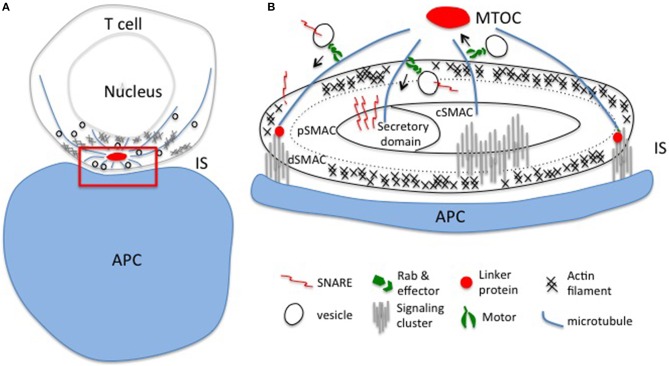
There is emerging evidence that exocytosis plays an important role in regulating T cell receptor (TCR) signaling. The trafficking molecules involved in lytic granule (LG) secretion in cytotoxic T lymphocytes (CTL) have been well-studied due to the immune disorder known as familial hemophagocytic lymphohistiocytosis (FHLH). However, the knowledge of trafficking machineries regulating the exocytosis of receptors and signaling molecules remains quite limited. In this review, we summarize the reported trafficking molecules involved in the transport of the TCR and downstream signaling molecules to the cell surface. By combining this information with the known knowledge of LG exocytosis and general exocytic trafficking machinery, we attempt to draw a more complete picture of how the TCR signaling network and exocytic trafficking matrix are interconnected to facilitate T cell activation. This also highlights how membrane compartmentalization facilitates the spatiotemporal organization of cellular responses that are essential for immune functions.
越来越多的证据表明胞吐作用在调节 T 细胞受体 (TCR) 信号转导中发挥着重要作用。由于细胞毒性 T 淋巴细胞 (CTL) 中溶酶体颗粒 (LG) 分泌的运输分子与一种称为家族性噬血细胞性淋巴组织细胞增生症 (FHLH) 的免疫紊乱有关,因此这些运输分子已得到深入研究。然而,调节受体和信号分子胞吐作用的运输机制的知识仍然相当有限。在这篇综述中,我们总结了报道的参与 TCR 和下游信号分子运输到细胞表面的运输分子。通过将这些信息与已知的 LG 胞吐作用和一般的胞吐运输机制相结合,我们试图更全面地描绘 TCR 信号网络和胞吐运输基质是如何相互连接以促进 T 细胞激活的。这也突出了膜区室化如何促进免疫功能所必需的细胞反应的时空组织。