Phung Tanya N, Huber Christian D, Lohmueller Kirk E
Interdepartmental Program in Bioinformatics, University of California, Los Angeles, Los Angeles, California, United States of America.
Department of Ecology and Evolutionary Biology, University of California, Los Angeles, Los Angeles, California, United States of America.
PLoS Genet. 2016 Aug 10;12(8):e1006199. doi: 10.1371/journal.pgen.1006199. eCollection 2016 Aug.
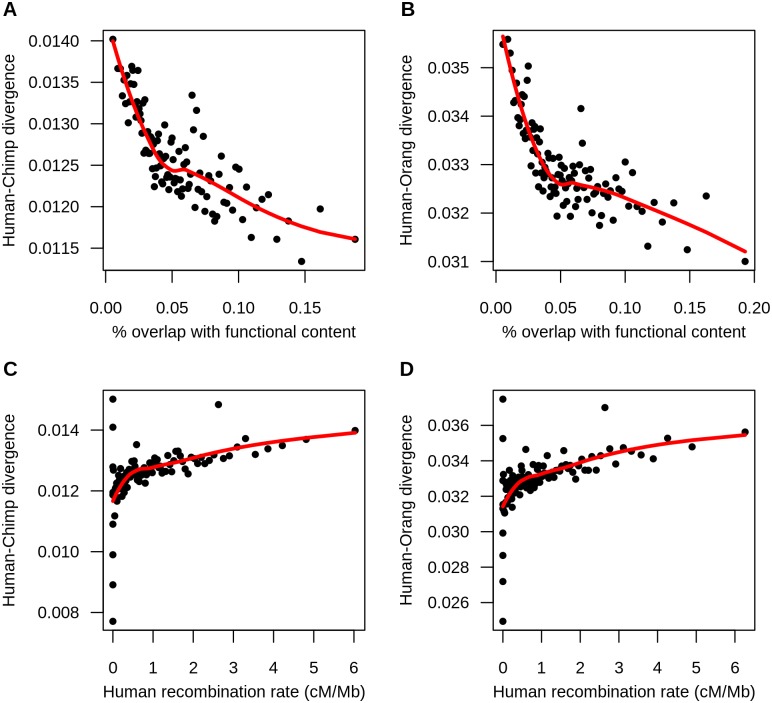
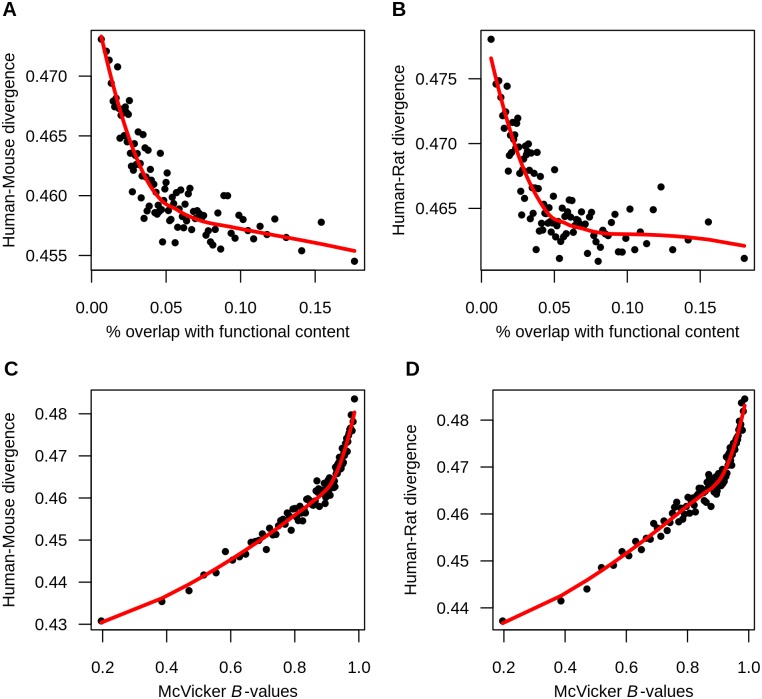
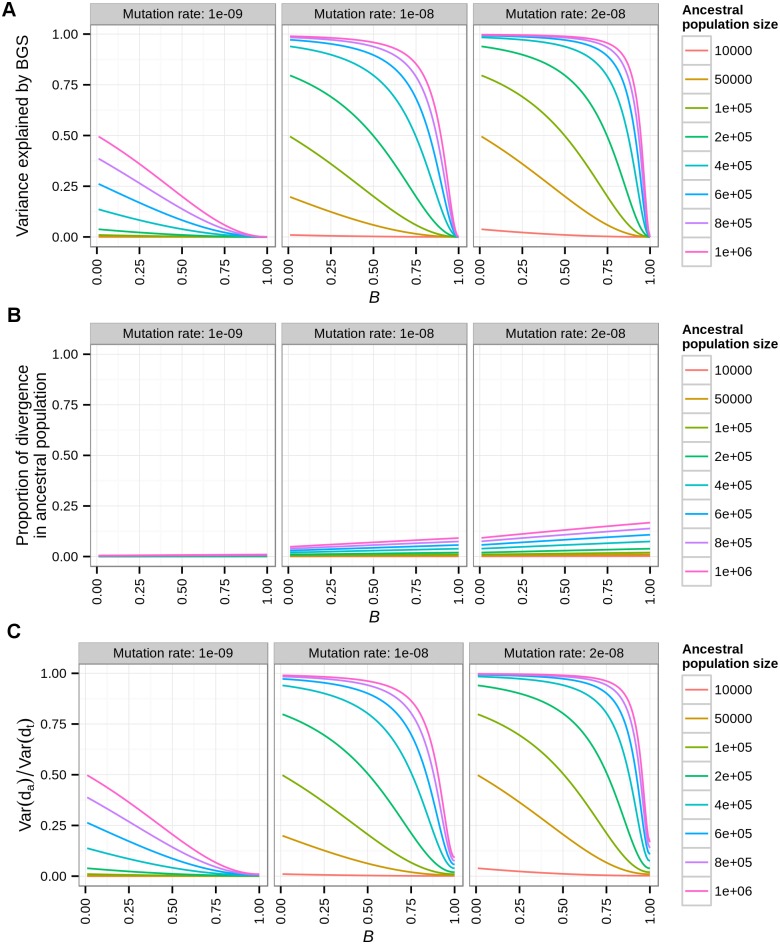
A major goal in evolutionary biology is to understand how natural selection has shaped patterns of genetic variation across genomes. Studies in a variety of species have shown that neutral genetic diversity (intra-species differences) has been reduced at sites linked to those under direct selection. However, the effect of linked selection on neutral sequence divergence (inter-species differences) remains ambiguous. While empirical studies have reported correlations between divergence and recombination, which is interpreted as evidence for natural selection reducing linked neutral divergence, theory argues otherwise, especially for species that have diverged long ago. Here we address these outstanding issues by examining whether natural selection can affect divergence between both closely and distantly related species. We show that neutral divergence between closely related species (e.g. human-primate) is negatively correlated with functional content and positively correlated with human recombination rate. We also find that neutral divergence between distantly related species (e.g. human-rodent) is negatively correlated with functional content and positively correlated with estimates of background selection from primates. These patterns persist after accounting for the confounding factors of hypermutable CpG sites, GC content, and biased gene conversion. Coalescent models indicate that even when the contribution of ancestral polymorphism to divergence is small, background selection in the ancestral population can still explain a large proportion of the variance in divergence across the genome, generating the observed correlations. Our findings reveal that, contrary to previous intuition, natural selection can indirectly affect linked neutral divergence between both closely and distantly related species. Though we cannot formally exclude the possibility that the direct effects of purifying selection drive some of these patterns, such a scenario would be possible only if more of the genome is under purifying selection than currently believed. Our work has implications for understanding the evolution of genomes and interpreting patterns of genetic variation.
进化生物学的一个主要目标是了解自然选择如何塑造了全基因组的遗传变异模式。对各种物种的研究表明,与直接选择位点相关的中性遗传多样性(种内差异)在这些位点处有所减少。然而,连锁选择对中性序列分歧(种间差异)的影响仍不明确。虽然实证研究报告了分歧与重组之间的相关性,这被解释为自然选择减少连锁中性分歧的证据,但理论上却有不同观点,尤其是对于那些很久以前就已分化的物种。在这里,我们通过研究自然选择是否会影响近缘和远缘物种之间的分歧来解决这些突出问题。我们表明,近缘物种(如人类与灵长类)之间的中性分歧与功能含量呈负相关,与人类重组率呈正相关。我们还发现,远缘物种(如人类与啮齿动物)之间的中性分歧与功能含量呈负相关,与灵长类背景选择的估计值呈正相关。在考虑了高变CpG位点、GC含量和偏向性基因转换等混杂因素后,这些模式依然存在。溯祖模型表明,即使祖先多态性对分歧的贡献很小,祖先种群中的背景选择仍能解释全基因组分歧方差的很大一部分,从而产生了观察到的相关性。我们的研究结果表明,与之前的直觉相反,自然选择可以间接影响近缘和远缘物种之间的连锁中性分歧。虽然我们不能正式排除纯化选择的直接作用驱动了其中一些模式的可能性,但只有在比目前认为的更多的基因组处于纯化选择之下时才会出现这种情况。我们的工作对于理解基因组的进化和解释遗传变异模式具有重要意义。