Fiest Kirsten M, Bernstein Charles N, Walker John R, Graff Lesley A, Hitchon Carol A, Peschken Christine A, Zarychanski Ryan, Abou-Setta Ahmed, Patten Scott B, Sareen Jitender, Bolton James, Singer Alexander, Marrie Ruth Ann
Department of Internal Medicine, Max Rady College of Medicine, Rady Faculty of Health Sciences, University of Manitoba, 820 Sherbrook Street, Winnipeg, R3A1R9, Canada.
Health Sciences Centre, 820 Sherbrook Street, Winnipeg, MB, R3A 1R9, Canada.
BMC Res Notes. 2016 Aug 12;9(1):404. doi: 10.1186/s13104-016-2204-2.
Depression and anxiety are common in inflammatory bowel disease (IBD) and can affect disease outcomes, including quality of life and success of disease treatment. Successful management of psychiatric comorbidities may improve outcomes, though the effectiveness of existing treatments in IBD is unknown.
We searched multiple online databases from inception until March 25, 2015, without restrictions on language, date, or location of publication. We included controlled clinical trials conducted in persons with IBD and depression or anxiety. Two independent reviewers reviewed all abstracts and full-text articles and extracted information including trial and participant characteristics. We also assessed the risk of bias.
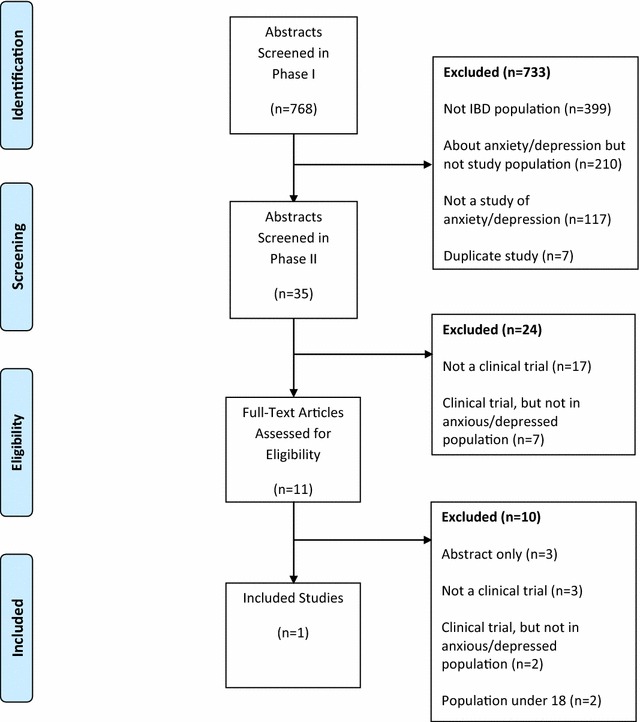
Of 768 unique abstracts, we included one trial of pharmacological anxiety treatment in IBD (48 participants), which found an improvement in anxiety symptoms (p < 0.001). There was a high risk of bias in this trial. We found no controlled clinical trials on the treatment of depression in persons with IBD and depression and no controlled clinical trials reporting on psychological interventions for anxiety or depression in IBD.
Only one trial examined an intervention for anxiety in adults with IBD and no trials studied depression in adults with IBD. The level of evidence is low because of the risk of bias and limited evidence.
抑郁症和焦虑症在炎症性肠病(IBD)中很常见,并且会影响疾病的转归,包括生活质量和疾病治疗的成功率。精神疾病共病的成功管理可能会改善转归,尽管现有治疗方法在IBD中的有效性尚不清楚。
我们检索了多个在线数据库,从建库至2015年3月25日,对语言、日期或出版地点均无限制。我们纳入了针对患有IBD且伴有抑郁或焦虑的患者进行的对照临床试验。两名独立的审阅者审阅了所有摘要和全文文章,并提取了包括试验和参与者特征在内的信息。我们还评估了偏倚风险。
在768篇独特的摘要中,我们纳入了一项针对IBD患者进行的药物性焦虑治疗试验(48名参与者),该试验发现焦虑症状有所改善(p < 0.001)。该试验存在较高的偏倚风险。我们未发现针对患有IBD且伴有抑郁的患者进行抑郁症治疗的对照临床试验,也未发现关于IBD患者焦虑或抑郁的心理干预的对照临床试验。
仅有一项试验研究了针对成年IBD患者焦虑症的干预措施,没有试验研究成年IBD患者的抑郁症。由于存在偏倚风险且证据有限,证据水平较低。