Molino Monica, Emanuel Federica, Zito Margherita, Ghislieri Chiara, Colombo Lara, Cortese Claudio G
Work and Organizational Psychology, Department of Psychology, University of Turin Turin, Italy.
Front Psychol. 2016 Jul 28;7:1133. doi: 10.3389/fpsyg.2016.01133. eCollection 2016.
Emotional labor, defined as the process of regulating feelings and expressions as part of the work role, is a major characteristic in call centers. In particular, interacting with customers, agents are required to show certain emotions that are considered acceptable by the organization, even though these emotions may be different from their true feelings. This kind of experience is defined as emotional dissonance and represents a feature of the job especially for call center inbound activities.
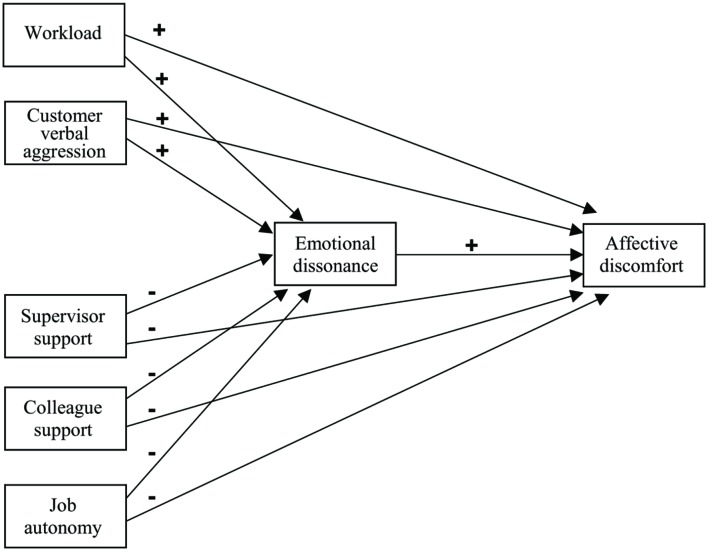
The present study was aimed at investigating whether emotional dissonance mediates the relationship between job demands (workload and customer verbal aggression) and job resources (supervisor support, colleague support, and job autonomy) on the one hand, and, on the other, affective discomfort, using the job demands-resources model as a framework. The study also observed differences between two different types of inbound activities: customer assistance service (CA) and information service.
The study involved agents of an Italian Telecommunication Company, 352 of whom worked in the CA and 179 in the information service. The hypothesized model was tested across the two groups through multi-group structural equation modeling.
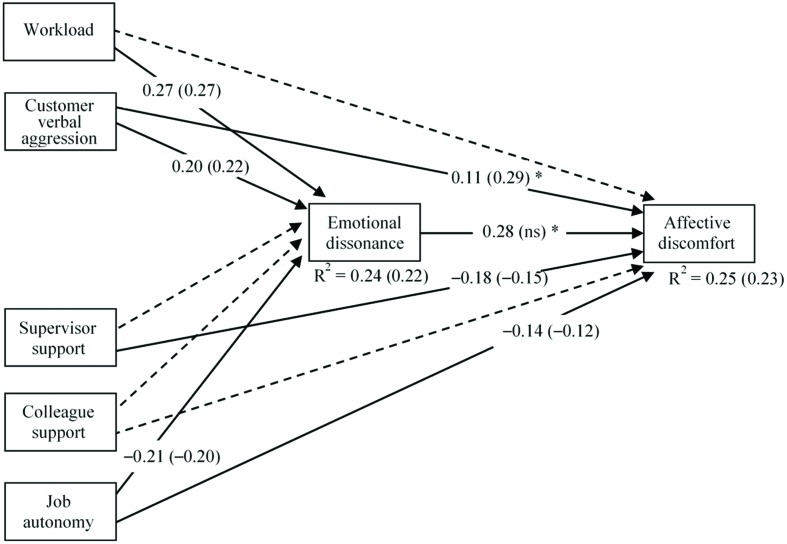
Analyses showed that CA agents experience greater customer verbal aggression and emotional dissonance than information service agents. RESULTS also showed, only for the CA group, a full mediation of emotional dissonance between workload and affective discomfort, and a partial mediation of customer verbal aggression and job autonomy, and affective discomfort.
This study's findings contributed both to the emotional labor literature, investigating the mediational role of emotional dissonance in the job demands-resources model, and to call center literature, considering differences between two specific kinds of inbound activities. Suggestions for organizations and practitioners emerged in order to identify practical implications useful both to support employees in coping with emotional labor and to promote well-being in inbound call centers. In detail, results showed the need to improve training programs in order to enhance employees' emotion regulation skills, and to introduce human resource practices aimed at clarifying emotional requirements of the job.
情绪劳动被定义为作为工作角色一部分来调节情感和表情的过程,是呼叫中心的一个主要特征。特别是在与客户互动时,客服人员需要表现出组织认为可接受的某些情绪,即使这些情绪可能与他们的真实感受不同。这种体验被定义为情绪失调,是该工作的一个特点,尤其是对于呼叫中心的呼入业务。
本研究旨在以工作需求-资源模型为框架,调查情绪失调是否一方面在工作需求(工作量和客户言语攻击)与工作资源(上级支持、同事支持和工作自主性)之间起中介作用,另一方面在情感不适方面起中介作用。该研究还观察了两种不同类型呼入业务之间的差异:客户协助服务(CA)和信息服务。
该研究涉及一家意大利电信公司的客服人员,其中352人从事客户协助服务,179人从事信息服务。通过多组结构方程模型在两组中对假设模型进行了测试。
分析表明,客户协助服务客服人员比信息服务客服人员经历更多的客户言语攻击和情绪失调。结果还表明,仅对于客户协助服务组,情绪失调在工作量与情感不适之间起完全中介作用,在客户言语攻击和工作自主性与情感不适之间起部分中介作用。
本研究结果既为情绪劳动文献做出了贡献,调查了情绪失调在工作需求-资源模型中的中介作用,也为呼叫中心文献做出了贡献,考虑了两种特定呼入业务之间的差异。为组织和从业者提出了建议,以确定有助于支持员工应对情绪劳动并促进呼入呼叫中心员工福祉的实际意义。具体而言,结果表明需要改进培训计划以提高员工的情绪调节技能,并引入旨在明确工作情感要求的人力资源实践。