Sedaka N M, Olsen C H, Yannai L E, Stutzman W E, Krause A J, Sherafat-Kazemzadeh R, Condarco T A, Brady S M, Demidowich A P, Reynolds J C, Yanovski S Z, Hubbard V S, Yanovski J A
Section on Growth and Obesity (SGO), Program in Developmental Endocrinology and Genetics (PDEGEN), Eunice Kennedy Shriver National Institute of Child Health and Human Development (NICHD), National Institutes of Health (NIH), Bethesda, MD, USA.
Biostatistics Consulting Center, Uniformed Services University of the Health Sciences, Bethesda, MD, USA.
Int J Obes (Lond). 2017 Jan;41(1):61-70. doi: 10.1038/ijo.2016.145. Epub 2016 Aug 18.
The influence of insulin and insulin resistance (IR) on children's weight and fat gain is unclear.
To evaluate insulin and IR as predictors of weight and body fat gain in children at high risk for adult obesity. We hypothesized that baseline IR would be positively associated with follow-up body mass index (BMI) and fat mass.
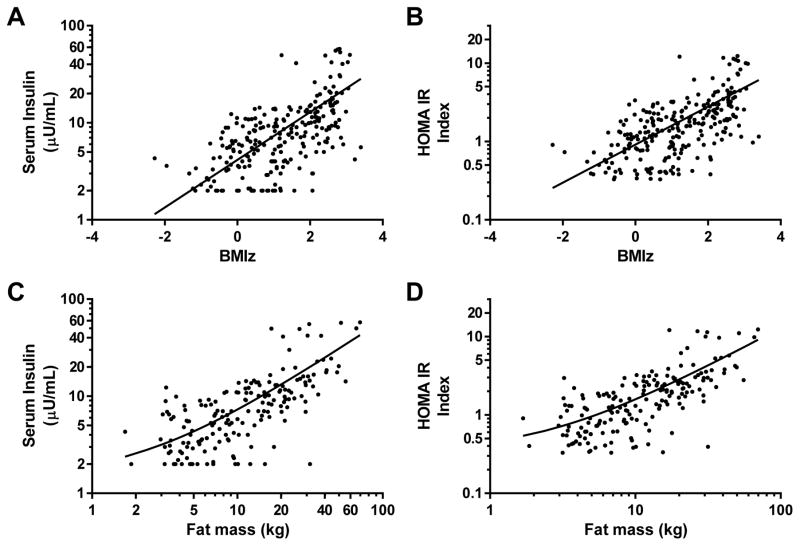
SUBJECTS/METHODS: Two hundred and forty-nine healthy African American and Caucasian children aged 6-12 years at high risk for adult obesity because of early-onset childhood overweight and/or parental overweight were followed for up to 15 years with repeated BMI and fat mass measurements. We examined baseline serum insulin and homeostasis model of assessment-IR (HOMA-IR) as predictors of follow-up BMI Z-score and fat mass by dual-energy X-ray absorptiometry in mixed model longitudinal analyses accounting for baseline body composition, pubertal stage, sociodemographic factors and follow-up interval.
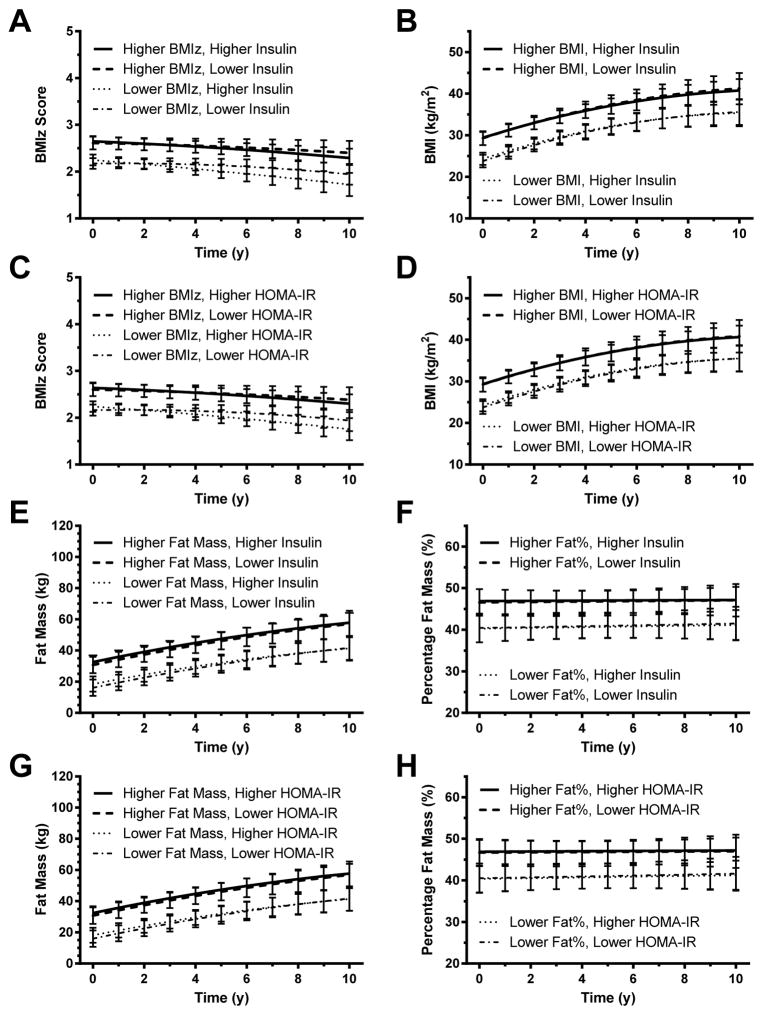
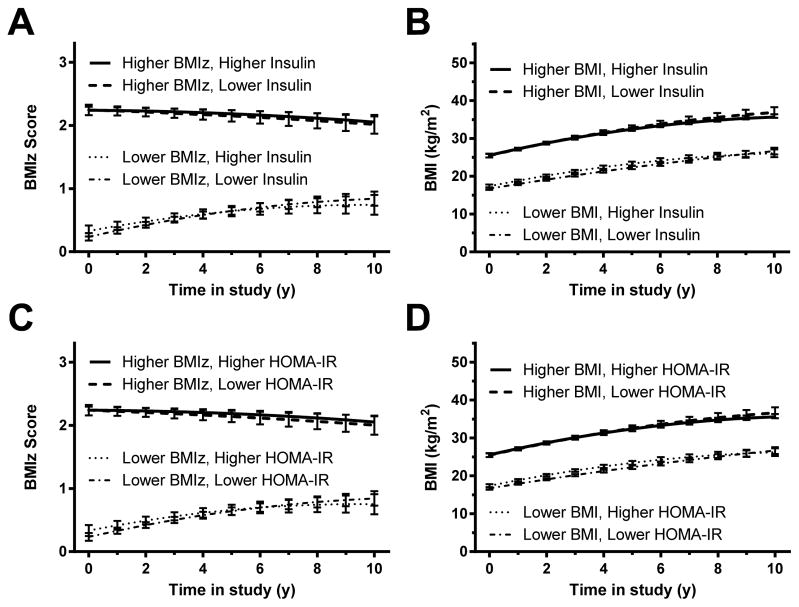
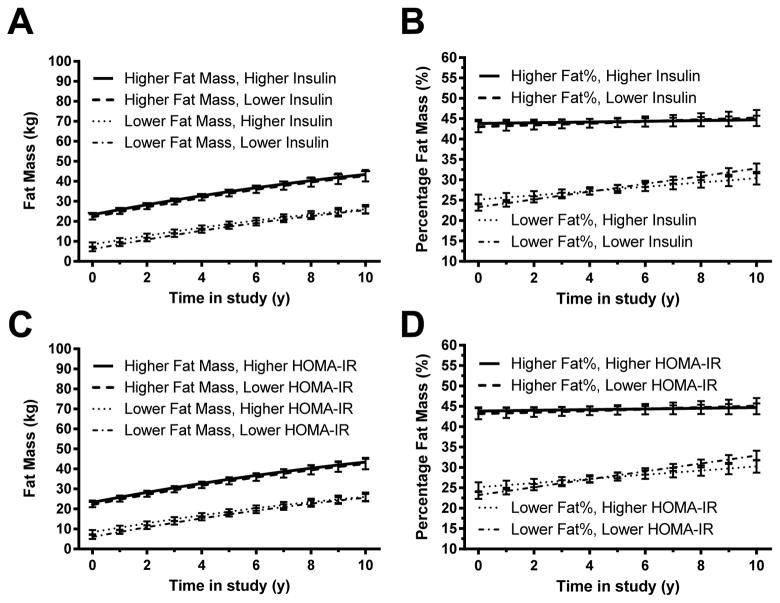
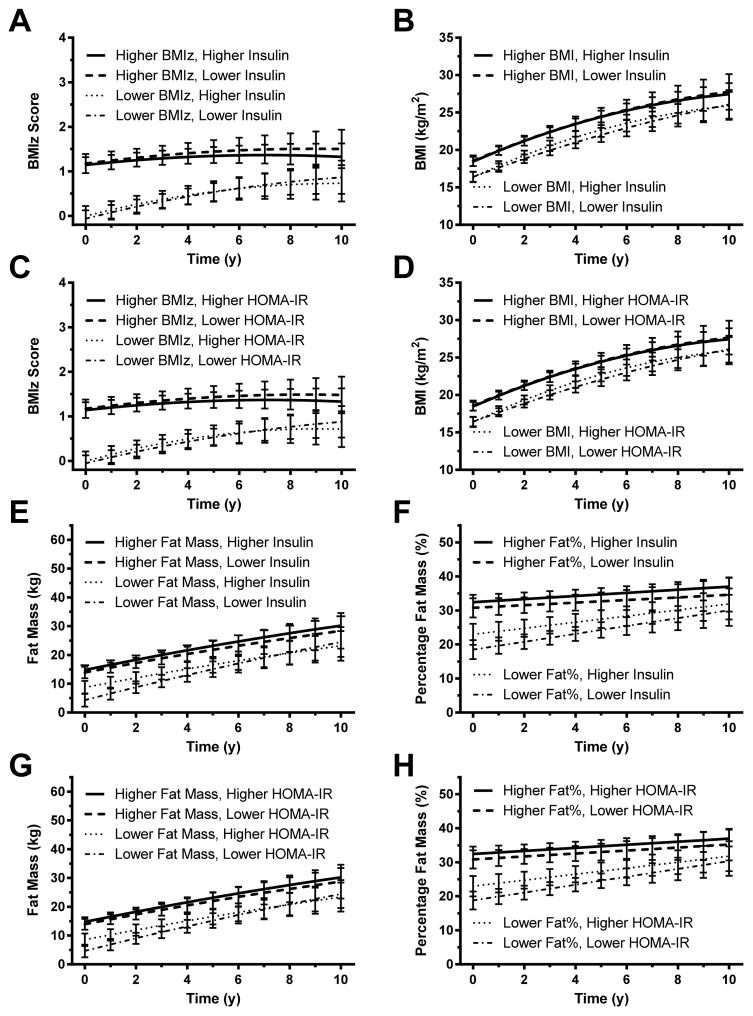
At baseline, 39% were obese (BMI⩾95th percentile for age/sex). Data from 1335 annual visits were examined. Children were followed for an average of 7.2±4.3 years, with a maximum follow-up of 15 years. After accounting for covariates, neither baseline insulin nor HOMA-IR was significantly associated with follow-up BMI (Ps>0.26), BMIz score (Ps>0.22), fat mass (Ps>0.78) or fat mass percentage (Ps>0.71). In all models, baseline BMI (P<0.0001), body fat mass (P<0.0001) and percentage of fat (P<0.001) were strong positive predictors for change in BMI and fat mass. In models restricted to children without obesity at baseline, some but not all models had significant interaction terms between body adiposity and insulinemia/HOMA-IR that suggested less gain in mass among those with greater insulin or IR. The opposite was found in some models restricted to children with obesity at baseline.
In middle childhood, BMI and fat mass, but not insulin or IR, are strong predictors of children's gains in BMI and fat mass during adolescence.
胰岛素及胰岛素抵抗(IR)对儿童体重及脂肪增加的影响尚不清楚。
评估胰岛素及IR作为成年期肥胖高危儿童体重及体脂增加预测指标的作用。我们假设基线IR与随访时的体重指数(BMI)及脂肪量呈正相关。
对象/方法:249名6至12岁的健康非裔美国人和白人儿童,因其儿童期早发超重和/或父母超重而成为成年期肥胖高危人群,对其进行长达15年的随访,重复测量BMI和脂肪量。在考虑基线身体组成、青春期阶段、社会人口学因素及随访间隔的混合模型纵向分析中,我们将基线血清胰岛素及评估胰岛素抵抗的稳态模型(HOMA-IR)作为随访BMI Z评分及通过双能X线吸收法测量的脂肪量的预测指标进行研究。
基线时,39%的儿童肥胖(BMI⩾年龄/性别的第95百分位数)。对1335次年度访视的数据进行了检查。儿童平均随访7.2±4.3年,最长随访15年。在考虑协变量后,基线胰岛素及HOMA-IR均与随访BMI(P>0.26)、BMI Z评分(P>0.22)、脂肪量(P>0.78)或脂肪量百分比(P>0.71)均无显著相关性。在所有模型中,基线BMI(P<0.0001)、身体脂肪量(P<0.0001)及脂肪百分比(P<0.001)是BMI及脂肪量变化的强阳性预测指标。在仅限于基线时无肥胖儿童的模型中,部分但并非所有模型中身体肥胖与胰岛素血症/HOMA-IR之间存在显著交互项,提示胰岛素或IR较高者体重增加较少。在一些仅限于基线时肥胖儿童的模型中发现了相反的情况。
在童年中期,BMI和脂肪量而非胰岛素或IR是儿童青春期BMI和脂肪量增加的强预测指标。