Department of Preventive Medicine, Northwestern University Feinberg School of Medicine, Chicago, IL 60611, USA.
Diabet Med. 2012 Sep;29(9):1153-8. doi: 10.1111/j.1464-5491.2012.03726.x.
To examine associations of central adiposity, serum adiponectin and clamp-derived insulin sensitivity in a single longitudinal cohort from early adolescence to young adulthood.
The cohort was examined three times at mean ages 15 years (n = 308), 19 years (n = 218) and 22 years (n = 163). Insulin sensitivity was measured with the euglycaemic hyperinsulinaemic clamp. Circulating adiponectin was measured by enzyme-linked immunosorbent assay. Computed tomography scans were used at mean age 22 to compute subcutaneous and visceral abdominal fat volume. Partial Pearson correlations and linear regression were used to examine cross-sectional associations at each examination.
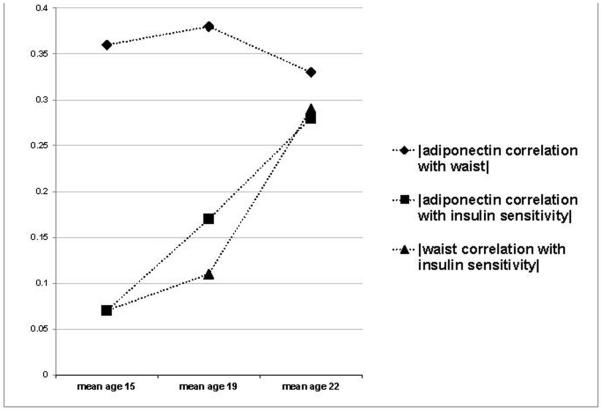
The moderate negative correlation between waist circumference and adiponectin was significant and essentially unchanged from mean age 15 (-0.32, P < 0.0001) to mean age 22 (-0.29, P < 0.002), whereas the negative correlation between waist circumference and insulin sensitivity and the positive correlation between adiponectin and insulin sensitivity increased steadily in magnitude to mean age 22 (-0.29, P = 0.0002; and 0.32, P < 0.0001, respectively). In regression models including both visceral and subcutaneous fat, only visceral fat was significantly associated with insulin sensitivity, while only subcutaneous fat was nearly significantly associated with adiponectin.
This study shows that the significant negative relationship between waist circumference and adiponectin predated the development of significant relationships between insulin sensitivity and both waist circumference and adiponectin. It also shows that adiponectin is more closely related to subcutaneous fat and insulin sensitivity is more closely related to visceral fat in young adults.
在从青少年早期到成年早期的单一纵向队列中,研究中心性肥胖、血清脂联素和钳夹衍生的胰岛素敏感性之间的关联。
该队列在平均年龄 15 岁(n = 308)、19 岁(n = 218)和 22 岁(n = 163)时进行了三次检查。使用正葡萄糖高胰岛素钳夹技术测量胰岛素敏感性。通过酶联免疫吸附试验测量循环脂联素。在平均年龄 22 岁时使用计算机断层扫描计算皮下和内脏腹部脂肪量。使用偏 Pearson 相关和线性回归来检查每次检查的横断面关联。
腰围和脂联素之间的中度负相关是显著的,并且从平均年龄 15 岁(-0.32,P < 0.0001)到平均年龄 22 岁(-0.29,P < 0.002)基本不变,而腰围和胰岛素敏感性之间的负相关和脂联素和胰岛素敏感性之间的正相关的大小稳步增加,到平均年龄 22 岁时分别为-0.29(P = 0.0002)和 0.32(P < 0.0001)。在包括内脏和皮下脂肪的回归模型中,只有内脏脂肪与胰岛素敏感性显著相关,而只有皮下脂肪与脂联素几乎显著相关。
本研究表明,腰围和脂联素之间的显著负相关关系先于胰岛素敏感性与腰围和脂联素之间的显著关系的发展。它还表明,脂联素与皮下脂肪的关系更为密切,而胰岛素敏感性与内脏脂肪的关系更为密切。