
ST段抬高型心肌梗死患者院前延迟就诊的预测因素。
Predictors of delayed pre-hospital presentation among patients with ST-segment elevation myocardial infarction.
作者信息
Albrahim Mohammed, Ahmed Amjad M, Alwakeel Abdulrahman, Hijji Faisal, Al-Mallah Mouaz H
机构信息
King Saud bin Abdulaziz University for Health Sciences, Riyadh, Saudi Arabia.
King Abdulaziz Cardiac Center, Ministry of National Guard - Health Affairs, Riyadh, Saudi Arabia.
出版信息
Qatar Med J. 2016 Jul 26;2016(1):7. doi: 10.5339/qmj.2016.7. eCollection 2016.
BACKGROUND
Early treatment of ST elevation myocardial infarction (STEMI) is essential to improve survival of these patients. However, not all patients present early enough to receive optimal treatment especially in third world countries. Social factors affecting early vs. late treatment have not been studied, particularly in the Middle East. Thus, the aim of this study was to determine the social factors associated with delayed presentation of STEMI patients.
METHODS
All patients with STEMI presenting to King Abdulaziz Cardiac Center (KACC) between October 2013 and July 2014 were approached. After obtaining consent, patients were interviewed regarding their psychosocial circumstances using a standardized questionnaire. Their medical charts were also reviewed for further clinical data. Patients were divided according to their symptom-to-door time into early ( ≤ 6h) and late (>6h) presentation and group comparisons were conducted.
RESULTS
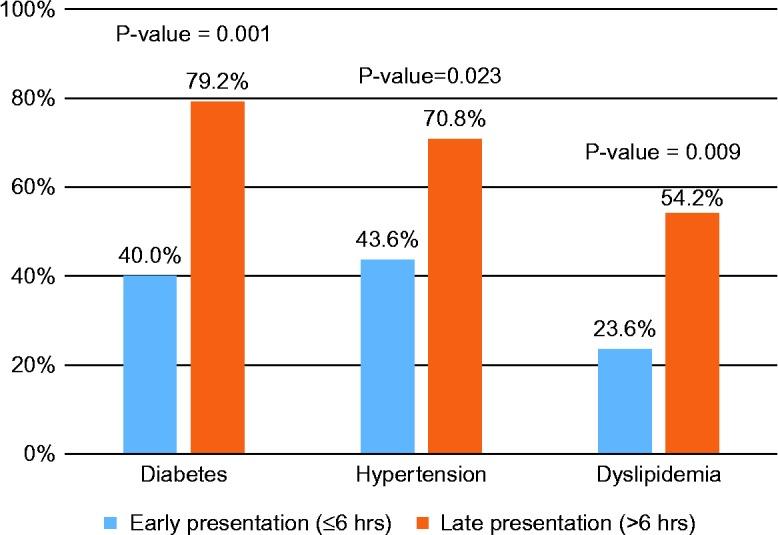
A total of 79 patients were enrolled, of which 24 patients (30%) presented late. Patients with increased symptom-to-door time had higher prevalence of diabetes (40% vs. 79.2%, p = 0.001), hypertension (43.6% vs. 70.8%, p = 0.023), and dyslipidemia (23.6% vs. 54.2%, p = 0.009). Most of the late presenters did not undergo primary coronary intervention (72.7% vs. 47.8%, P = 0.034) and had less prior information about myocardial infarction (43.6% vs. 25%, P = 0.023). Late presenters were more often illiterates and lived most often far away from the hospital. Using multivariate logistic regression; dyslipidemia was the only independent predictor for the late hospital presentation for STEMI patients.
CONCLUSION
One third of patients with STEMI present more than six hours after symptom onset; these patients have a higher prevalence of coronary risk factors and less information about STEMI. Programs should be designed to educate patients and the general public about the symptoms of STEMI and the necessary action to be taken if a heart attack is suspected.
背景
早期治疗ST段抬高型心肌梗死(STEMI)对于提高此类患者的生存率至关重要。然而,并非所有患者都能尽早就诊以接受最佳治疗,尤其是在第三世界国家。影响早期与晚期治疗的社会因素尚未得到研究,特别是在中东地区。因此,本研究的目的是确定与STEMI患者延迟就诊相关的社会因素。
方法
纳入2013年10月至2014年7月期间就诊于阿卜杜勒阿齐兹国王心脏中心(KACC)的所有STEMI患者。获得同意后,使用标准化问卷就患者的社会心理状况进行访谈。还查阅他们的病历以获取更多临床数据。根据症状出现至就诊时间将患者分为早期(≤6小时)和晚期(>6小时)就诊,并进行组间比较。
结果
共纳入79例患者,其中24例(30%)就诊延迟。症状出现至就诊时间延长的患者中,糖尿病患病率更高(40%对79.2%,p = 0.001)、高血压患病率更高(43.6%对70.8%,p = 0.023)、血脂异常患病率更高(23.6%对54.2%,p = 0.009)。大多数就诊延迟的患者未接受直接冠状动脉介入治疗(72.7%对47.8%,P = 0.034),且对心肌梗死的先前了解较少(43.6%对25%,P = 0.023)。就诊延迟的患者文盲比例更高,且大多居住在远离医院的地方。使用多因素逻辑回归分析;血脂异常是STEMI患者延迟就诊的唯一独立预测因素。
结论
三分之一的STEMI患者在症状发作后超过6小时就诊;这些患者冠状动脉危险因素的患病率更高,对STEMI的了解较少应设计相关项目,对患者和公众进行STEMI症状以及怀疑心脏病发作时应采取的必要措施的教育。
 Zotero 插件