Kraemer Susanne A, Wielgoss Sébastien, Fiegna Francesca, Velicer Gregory J
Institute of Evolutionary Biology, University of Edinburgh, King's Buildings, Edinburgh, EH9 3FL, UK.
Institute of Integrative Biology, ETH Zürich, Universitätstrasse 16, 8092, Zürich, Switzerland.
Mol Ecol. 2016 Oct;25(19):4875-88. doi: 10.1111/mec.13803. Epub 2016 Sep 23.
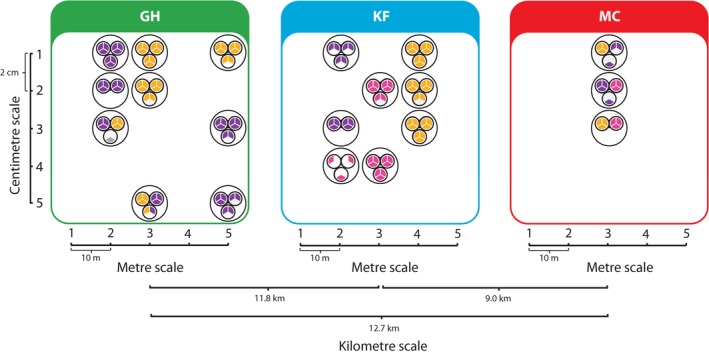
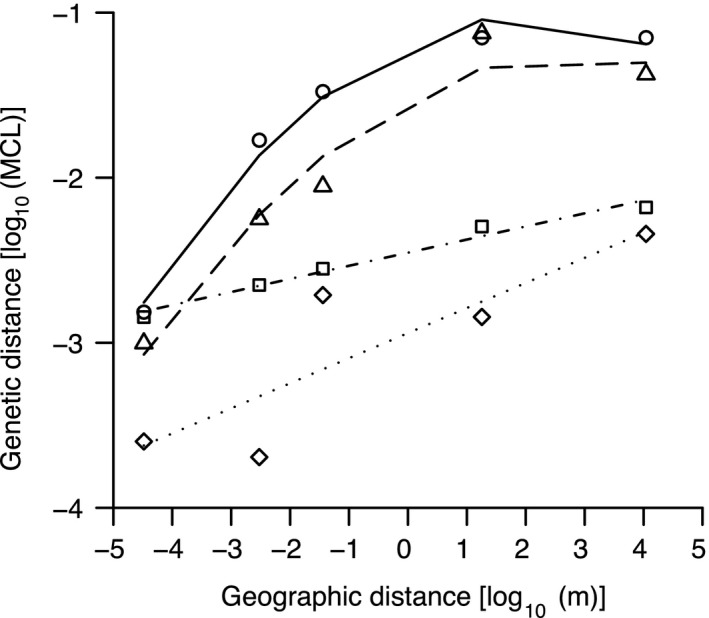
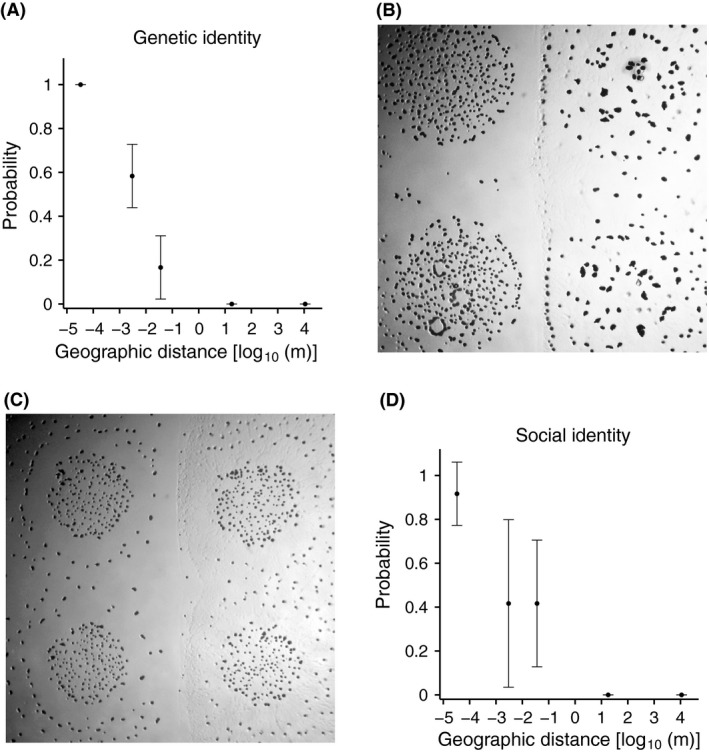
The spatial distribution of potential interactants is critical to social evolution in all cooperative organisms. Yet the biogeography of microbial kin discrimination at the scales most relevant to social interactions is poorly understood. Here we resolve the microbiogeography of social identity and genetic relatedness in local populations of the model cooperative bacterium Myxococcus xanthus at small spatial scales, across which the potential for dispersal is high. Using two criteria of relatedness-colony-merger compatibility during cooperative motility and DNA-sequence similarity at highly polymorphic loci-we find that relatedness decreases greatly with spatial distance even across the smallest scale transition. Both social relatedness and genetic relatedness are maximal within individual fruiting bodies at the micrometre scale but are much lower already across adjacent fruiting bodies at the millimetre scale. Genetic relatedness was found to be yet lower among centimetre-scale samples, whereas social allotype relatedness decreased further only at the metre scale, at and beyond which the probability of social or genetic identity among randomly sampled isolates is effectively zero. Thus, in M. xanthus, high-relatedness patches form a rich mosaic of diverse social allotypes across fruiting body neighbourhoods at the millimetre scale and beyond. Individuals that migrate even short distances across adjacent groups will frequently encounter allotypic conspecifics and territorial kin discrimination may profoundly influence the spatial dynamics of local migration. Finally, we also found that the phylogenetic scope of intraspecific biogeographic analysis can affect the detection of spatial structure, as some patterns evident in clade-specific analysis were masked by simultaneous analysis of all strains.
在所有合作生物中,潜在相互作用者的空间分布对社会进化至关重要。然而,在与社会相互作用最相关的尺度上,微生物亲缘识别的生物地理学却鲜为人知。在这里,我们解析了模式合作细菌黄色粘球菌局部种群中社会身份和遗传相关性的微生物地理学,该细菌在小空间尺度上具有很高的扩散潜力。利用两个相关性标准——合作运动过程中的菌落合并兼容性和高度多态性位点的DNA序列相似性——我们发现,即使在最小的尺度转变中,相关性也会随着空间距离大幅降低。社会相关性和遗传相关性在微米尺度的单个子实体内部都是最大的,但在毫米尺度的相邻子实体之间就已经低得多了。在厘米尺度的样本中,遗传相关性更低,而社会异型相关性仅在米尺度及以上才进一步降低,在这个尺度及以上,随机抽样分离株之间的社会或遗传身份概率实际上为零。因此,在黄色粘球菌中,高相关性斑块在毫米尺度及以上的子实体邻域形成了一个由多样社会异型组成的丰富镶嵌体。即使在相邻群体之间短距离迁移的个体也经常会遇到异型同种个体,领地亲缘识别可能会深刻影响局部迁移的空间动态。最后,我们还发现种内生物地理分析的系统发育范围会影响空间结构的检测,因为在特定分支分析中明显的一些模式在对所有菌株进行同时分析时被掩盖了。