M Barbara Angela, Dobbins Maureen, Haynes R Brian, Iorio Alfonso, Lavis John N, Levinson Anthony J
Health Information Research Unit, Department of Clinical Epidemiology and Biostatistics, McMaster University, Hamilton, ON, Canada.
JMIR Hum Factors. 2016 Aug 19;3(2):e22. doi: 10.2196/humanfactors.6208.
Evidence summaries and blogs can support evidence-informed healthy aging, by presenting high-quality health research evidence in plain language for a nonprofessional (citizen) audience.
Our objective was to explore citizens' perceptions about the usability of evidence summaries and blog posts on the Web-based McMaster Optimal Aging Portal.
Twenty-two citizens (aged 50 years and older) and informal caregivers participated in a qualitative study using a think-aloud method and semistructured interviews. Eleven interviews were conducted in person, 7 over the telephone, and 4 by Skype.
We identified themes that fell under 4 user-experience categories: (1) desirability: personal relevance, (2) understandability: language comprehension, grasping the message, dealing with uncertainty, (3) usability: volume of information, use of numbers, and (4) usefulness: intention to use, facility for sharing.
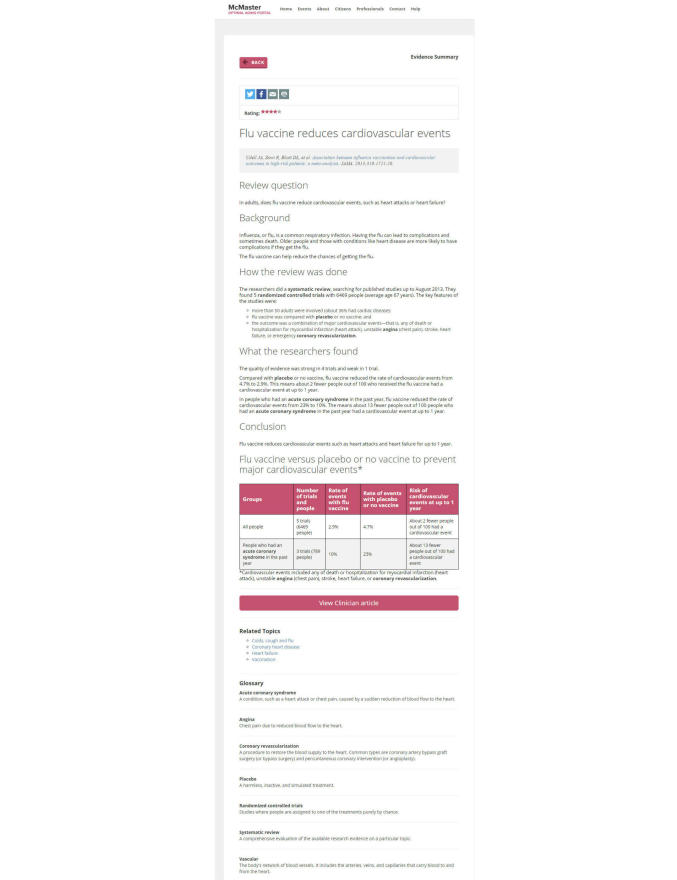
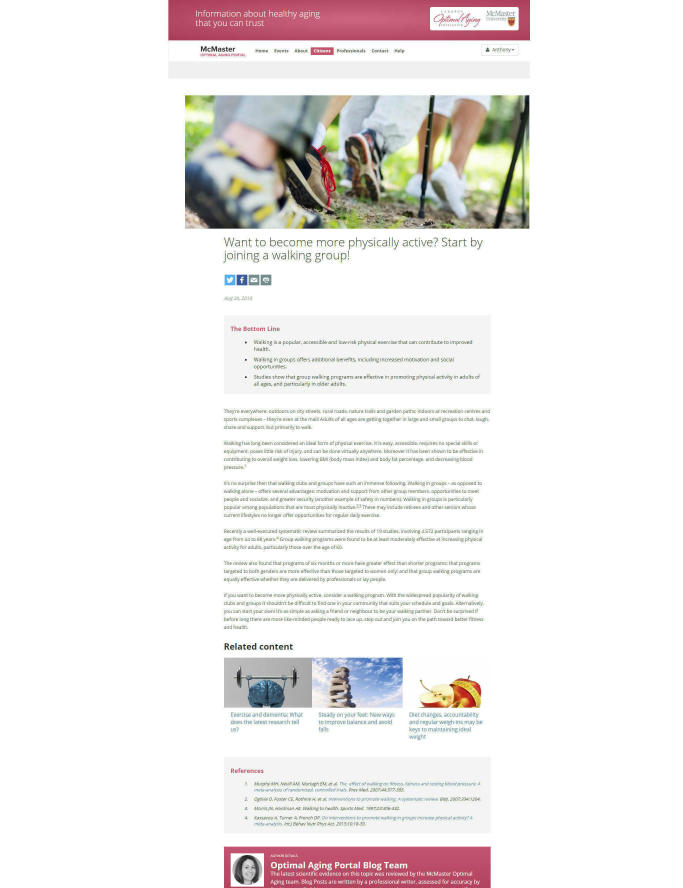
Participants recognized that high-quality evidence on aging was valuable. Their intended use of the information was influenced by how much it applied to their own health circumstances or those of a loved one. Some specific formatting features that were preferred included consistent layout, content organized by subheadings, catchy titles, numerical information summarized in a table, and inclusion of a glossary.
证据总结和博客通过以通俗易懂的语言向非专业(普通民众)受众呈现高质量的健康研究证据,能够为基于证据的健康老龄化提供支持。
我们的目的是探究民众对基于网络的麦克马斯特最佳老龄化门户网站上证据总结和博客文章可用性的看法。
22名年龄在50岁及以上的民众和非正式照护者参与了一项定性研究,采用出声思考法和半结构化访谈。11次访谈为面对面进行,7次通过电话进行,4次通过Skype进行。
我们确定了属于4个用户体验类别的主题:(1)可取性:个人相关性;(2)可理解性:语言理解、领会信息、应对不确定性;(3)可用性:信息量、数字的使用;(4)有用性:使用意图、分享便利性。
参与者认识到关于老龄化的高质量证据很有价值。他们对信息的预期使用受到信息与自身健康状况或所爱之人健康状况的相关程度的影响。一些更受青睐的具体格式特征包括布局一致、内容按副标题组织、标题吸引人、数字信息以表格形式总结以及包含术语表。