Barbara Angela M, Dobbins Maureen, Haynes R Brian, Iorio Alfonso, Lavis John N, Raina Parminder, Levinson Anthony J
Health Information Research Unit, Department of Clinical Epidemiology and Biostatistics, McMaster University, Hamilton, ON, Canada.
JMIR Hum Factors. 2016 May 11;3(1):e14. doi: 10.2196/humanfactors.4800.
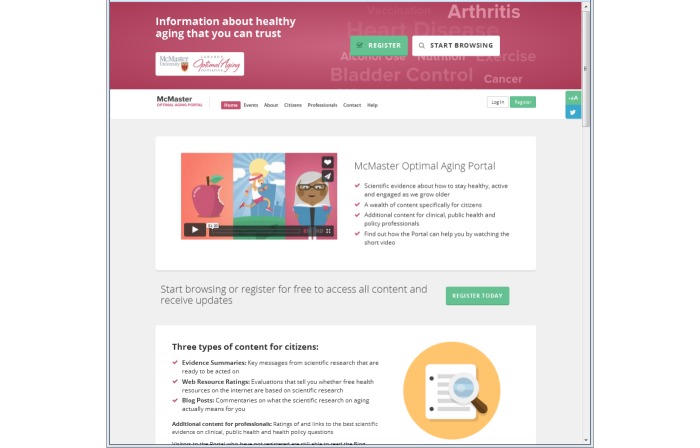
Increasingly, older adults and their informal caregivers are using the Internet to search for health-related information. There is a proliferation of health information online, but the quality of this information varies, often based on exaggerated or dramatic findings, and not easily comprehended by consumers. The McMaster Optimal Aging Portal (Portal) was developed to provide Internet users with high-quality evidence about aging and address some of these current limitations of health information posted online. The Portal includes content for health professionals coming from three best-in-class resources (MacPLUS, Health Evidence, and Health Systems Evidence) and four types of content specifically prepared for the general public (Evidence Summaries, Web Resource Ratings, Blog Posts, and Twitter messages).
Our objectives were to share the findings of the usability evaluation of the Portal with particular focus on the content features for the general public and to inform designers of health information websites and online resources for older adults about key usability themes.
Data analysis included task performance during usability testing and qualitative content analyses of both the usability sessions and interviews to identify core themes.
A total of 37 participants took part in 33 usability testing sessions and 21 focused interviews. Qualitative analysis revealed common themes regarding the Portal's strengths and challenges to usability. The strengths of the website were related to credibility, applicability, browsing function, design, and accessibility. The usability challenges included reluctance to register, process of registering, searching, terminology, and technical features.
The study reinforced the importance of including end users during the development of this unique, dynamic, evidence-based health information website. The feedback was applied to iteratively improve website usability. Our findings can be applied by designers of health-related websites.
越来越多的老年人及其非正式护理人员通过互联网搜索健康相关信息。网上健康信息大量涌现,但这些信息质量参差不齐,往往基于夸大或引人注目的研究结果,消费者难以理解。麦克马斯特最佳衰老门户网站(以下简称“门户网站”)旨在为互联网用户提供有关衰老的高质量证据,并解决当前在线发布的健康信息存在的一些局限性。该门户网站包含来自三个一流资源(MacPLUS、健康证据和卫生系统证据)的针对健康专业人员的内容,以及专门为普通大众准备的四种类型的内容(证据摘要、网络资源评级、博客文章和推特消息)。
我们的目标是分享该门户网站可用性评估的结果,特别关注面向普通大众的内容特征,并向老年人健康信息网站和在线资源的设计者通报关键的可用性主题。
数据分析包括可用性测试期间的任务表现,以及对可用性测试环节和访谈进行定性内容分析,以确定核心主题。
共有37名参与者参加了33次可用性测试环节和21次重点访谈。定性分析揭示了有关该门户网站可用性优势和挑战的共同主题。该网站的优势与可信度、适用性、浏览功能、设计和可访问性有关。可用性挑战包括不愿注册、注册流程、搜索、术语和技术特征。
该研究强化了在开发这个独特、动态、基于证据的健康信息网站时纳入最终用户的重要性。反馈意见被用于迭代改进网站的可用性。我们的研究结果可供健康相关网站的设计者参考。