Villanyi Zoltan, Collart Martine A
Faculty of Medicine, Department of Microbiology and Molecular Medicine, University of Geneva, Geneva, Switzerland.
Institute of Genetics and Genomics Geneva, Geneva, Switzerland.
Bioessays. 2016 Oct;38(10):997-1002. doi: 10.1002/bies.201600051. Epub 2016 Aug 22.
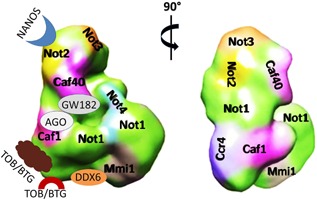
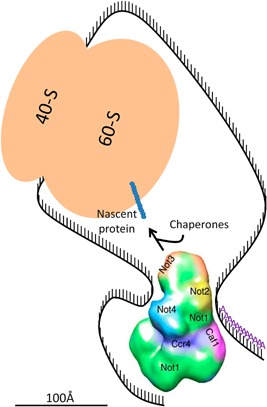
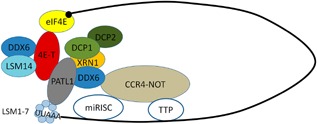
In a recent issue of Nature Communications Ukleja and co-workers reported a cryo-EM 3D reconstruction of the Ccr4-Not complex from Schizosaccharomyces pombe with an immunolocalization of the different subunits. The newly gained architectural knowledge provides cues to apprehend the functional diversity of this major eukaryotic regulator. Indeed, in the cytoplasm alone, Ccr4-Not regulates translational repression, decapping and deadenylation, and the Not module additionally plays a positive role in translation. The spatial distribution of the subunits within the structure is compatible with a model proposing that the Ccr4-Not complex interacts with the 5' and 3' ends of target mRNAs, allowing different functional modules of the complex to act at different stages of the translation process, possibly within a circular constellation of the mRNA. This work opens new avenues, and reveals important gaps in our understanding regarding structure and mode of function of the Ccr4-Not complex that need to be addressed in the future.
在最近一期的《自然·通讯》杂志上,乌克莱亚及其同事报道了粟酒裂殖酵母Ccr4-Not复合物的冷冻电镜三维重建结果以及不同亚基的免疫定位情况。新获得的结构知识为理解这一主要真核生物调节因子的功能多样性提供了线索。实际上,仅在细胞质中,Ccr4-Not就调节翻译抑制、脱帽和去腺苷酸化,并且Not模块在翻译中还发挥着积极作用。该结构中亚基的空间分布与一个模型相符,该模型提出Ccr4-Not复合物与靶标mRNA的5'和3'末端相互作用,使复合物的不同功能模块能够在翻译过程的不同阶段发挥作用,可能是在mRNA的环状结构中。这项工作开辟了新途径,并揭示了我们在理解Ccr4-Not复合物的结构和功能模式方面存在的重要差距,这些差距需要在未来加以解决。