Sakai Mio, Illies Till, Jerusel Nadine, Tateishi Souichirou, Uchikoshi Masato, Fiehler Jens, Watanabe Yoshiyuki, Nakanishi Katsuyuki, Tomiyama Noriyuki
Department of Diagnostic Radiology, Osaka Medical Center for Cancer and Cardiovascular Diseases, 1-3-3 Nakamichi, Higashinari-ku, Osaka 537-8511 Japan.
Department of Diagnostic and Interventional Neuroradiology, University Medical Center Hamburg-Eppendorf, Hamburg, Germany.
Springerplus. 2016 Aug 8;5(1):1282. doi: 10.1186/s40064-016-2953-3. eCollection 2016.
Information of tumor vascular architecture and hemodynamics is important in treating patients with head and neck tumors (HNTs). The purpose of this study is to investigate the feasibility of non-contrast-enhanced four-dimensional magnetic resonance angiography (non-CE 4DMRA) using arterial spin labeling for anatomical and hemodynamic evaluation of vascularity of head and neck tumors.
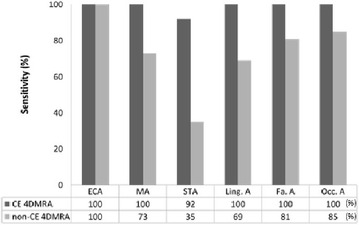
Non-CE 4DMRA images of 15 patients with HNTs were compared with those of contrast-enhanced 4DMRA (CE 4DMRA) by two independent observers. For qualitative evaluation, overall image quality, visualization of arterial branches and main arterial tumor feeders were assessed. For hemodynamic evaluation, signal-intensity-over-time curves within the tumors were compared. The sensitivity of non-CE 4DMRA for the identification of arterial branches and the main arterial tumor feeders was 75 and 20 %, respectively (interobserver agreement, κ = 0.56 and 0.54, respectively), while that of CE 4DMRA was 99 and 95 %, respectively (interobserver agreement, κ = 0.62 and 0.70, respectively). All three arterial/hypervascularized tumors determined on CE 4DMRA showed distinct signal-intensity-over-time curve pattern on non-CE 4DMRA, with distinct peak and wash out phases. Other tumors showed no wash out on non-CE 4DMRA.
Use of non-CE 4DMRA for the anatomical and hemodynamic evaluation of vascularity of head and neck tumors is feasible, although the technique needs to be improved.
肿瘤血管结构和血流动力学信息对于头颈部肿瘤(HNT)患者的治疗至关重要。本研究的目的是探讨使用动脉自旋标记的非增强四维磁共振血管造影(non-CE 4DMRA)对头颈部肿瘤血管进行解剖和血流动力学评估的可行性。
15名头颈部肿瘤患者的non-CE 4DMRA图像由两名独立观察者与增强四维磁共振血管造影(CE 4DMRA)图像进行比较。对于定性评估,评估整体图像质量、动脉分支和主要肿瘤供血动脉的可视化情况。对于血流动力学评估,比较肿瘤内的信号强度随时间变化曲线。non-CE 4DMRA识别动脉分支和主要肿瘤供血动脉的敏感性分别为75%和20%(观察者间一致性,κ分别为0.56和0.54),而CE 4DMRA的敏感性分别为99%和95%(观察者间一致性,κ分别为0.62和0.70)。在CE 4DMRA上确定的所有三个动脉/高血管化肿瘤在non-CE 4DMRA上均显示出明显的信号强度随时间变化曲线模式,具有明显的峰值和洗脱期。其他肿瘤在non-CE 4DMRA上未显示洗脱。
使用non-CE 4DMRA对头颈部肿瘤血管进行解剖和血流动力学评估是可行的,尽管该技术需要改进。