Ramsbottom Simon A, Pownall Mary E
Institute of Genetic Medicine, International Centre for Life, Newcastle University, NE1 3BZ Newcastle upon Tyne, UK.
Biology Department, University of York, YO10 5YW York, UK.
J Dev Biol. 2016 Jul 20;4(3):23. doi: 10.3390/jdb4030023.
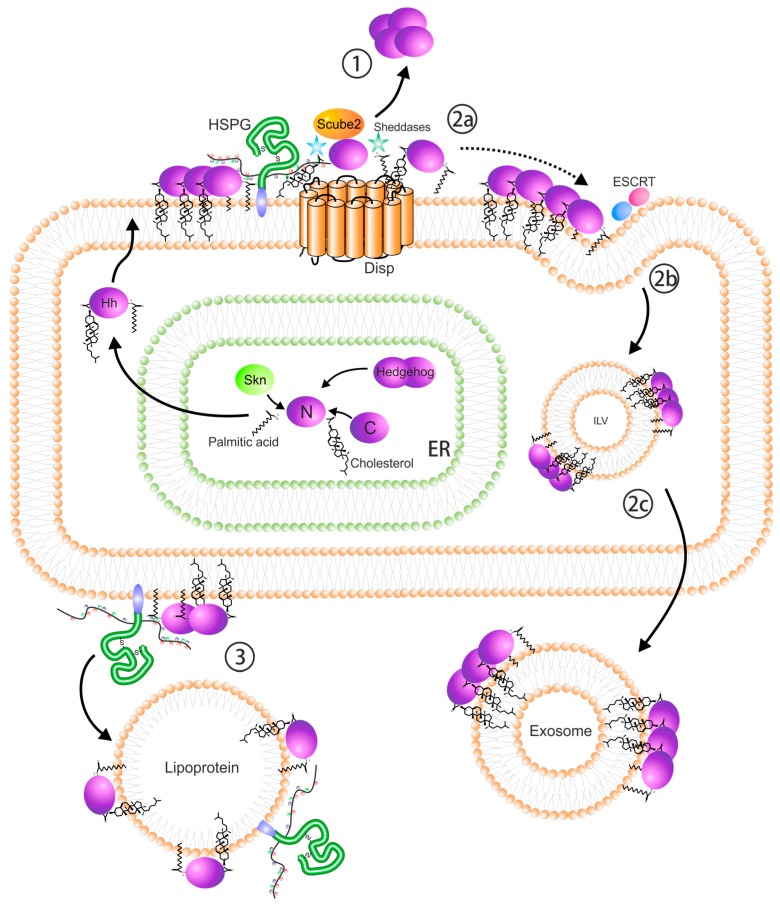
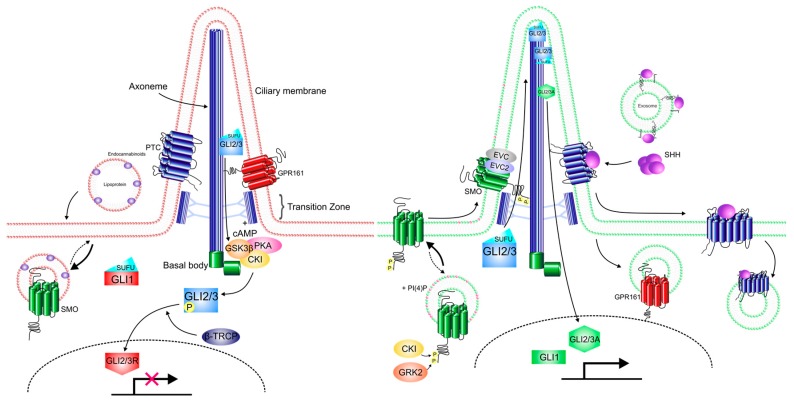
The hedgehog (Hh) signalling pathway is conserved throughout metazoans and plays an important regulatory role in both embryonic development and adult homeostasis. Many levels of regulation exist that control the release, reception, and interpretation of the hedgehog signal. The fatty nature of the Shh ligand means that it tends to associate tightly with the cell membrane, and yet it is known to act as a morphogen that diffuses to elicit pattern formation. Heparan sulfate proteoglycans (HSPGs) play a major role in the regulation of Hh distribution outside the cell. Inside the cell, the primary cilium provides an important hub for processing the Hh signal in vertebrates. This review will summarise the current understanding of how the Hh pathway is regulated from ligand production, release, and diffusion, through to signal reception and intracellular transduction.
刺猬信号通路在整个后生动物中高度保守,在胚胎发育和成年期稳态中均发挥重要的调节作用。存在多种调控水平来控制刺猬信号的释放、接收和解读。音猬因子(Shh)配体的脂类性质意味着它倾向于与细胞膜紧密结合,但已知它作为一种形态发生素可扩散以引发模式形成。硫酸乙酰肝素蛋白聚糖(HSPGs)在细胞外刺猬信号分布的调节中起主要作用。在细胞内,初级纤毛是脊椎动物处理刺猬信号的重要枢纽。本综述将总结目前对于刺猬信号通路如何从配体产生、释放和扩散,直至信号接收和细胞内转导进行调控的理解。