
广泛分布的瓢虫整个分布范围内的遗传多样性与结构:聚焦于表型分化的后缘种群。
Genetic diversity and structuring across the range of a widely distributed ladybird: focus on rear-edge populations phenotypically divergent.
作者信息
Lecompte Émilie, Bouanani Mohand-Ameziane, Magro Alexandra, Crouau-Roy Brigitte
机构信息
Université Toulouse 3 UPS, UMR 5174 EDB (Laboratoire Évolution & Diversité Biologique) CNRS, ENFA F-31062 Toulouse France.
出版信息
Ecol Evol. 2016 Jul 13;6(15):5517-29. doi: 10.1002/ece3.2288. eCollection 2016 Aug.
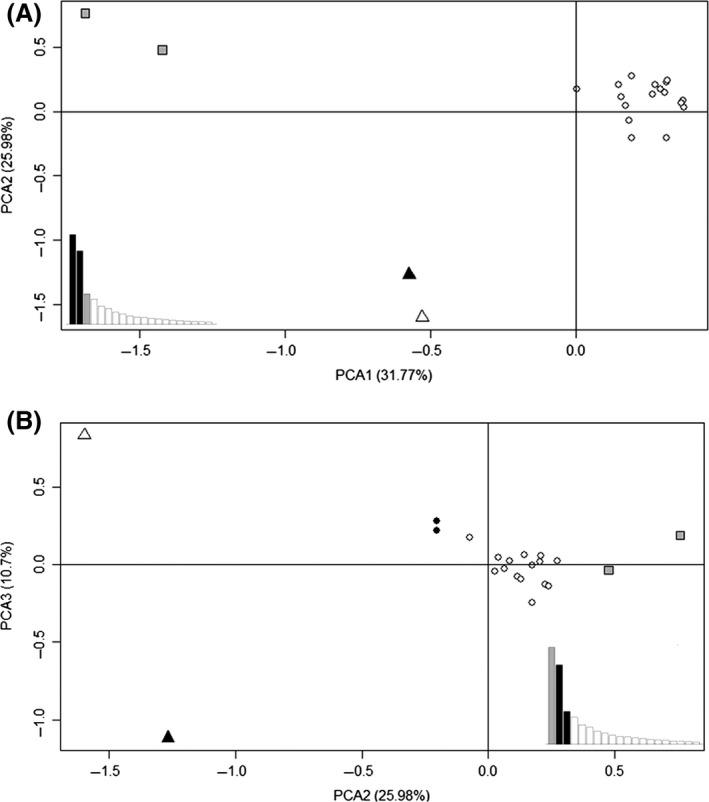
Population genetics and phenotypic structures are often predicted to vary along the geographic range of a species. This phenomenon would be accentuated for species with large range areas, with discontinuities and marginal populations. We herein compare the genetic patterns of central populations of Coccinella septempunctata L. with those of two phenotypically differentiated populations considered as rear-edge populations and subspecies based on phenotype (Algeria and Japan). According to the central-marginal model and expected characteristics of rear-edge populations, we hypothesize that these rear-edge populations have (1) a reduced genetic diversity, resulting from their relative isolation over long periods of time, (2) a higher population genetic differentiation, explained by low contemporary gene flow levels, and (3) a relationship between genetic diversity characteristics and phenotypes, due to historical isolation and/or local adaptation. Based on genotyping of 28 populations for 18 microsatellite markers, several levels of regional genetic diversity and differentiation are observed between and within populations, according to their localization: low within-population genetic diversity and higher genetic differentiation of rear-edge populations. The genetic structuring clearly dissociates the Algerian and Eastern Asia populations from the others. Geographical patterns of genetic diversity and differentiation support the hypothesis of the central-marginal model. The pattern observed is in agreement with the phenotypic structure across species range. A clear genetic break between populations of Algeria, the Eastern Asia, and the remaining populations is a dominant feature of the data. Differential local adaptations, absence of gene flow between marginal and central populations, and/or incapacity to mate after colonization, have contributed to their distinct genotypic and phenotypic characteristics.
种群遗传学和表型结构通常被预测会沿着物种的地理分布范围发生变化。对于分布范围广、存在间断分布和边缘种群的物种,这种现象会更加明显。我们在此比较了七星瓢虫中心种群与两个基于表型被视为后缘种群和亚种的表型分化种群(阿尔及利亚和日本)的遗传模式。根据中心-边缘模型和后缘种群的预期特征,我们假设这些后缘种群具有:(1)遗传多样性降低,这是由于它们长期相对隔离所致;(2)种群遗传分化更高,这可以用当代低基因流水平来解释;(3)由于历史隔离和/或局部适应,遗传多样性特征与表型之间存在关联。基于对28个种群的18个微卫星标记进行基因分型,根据种群的地理位置,在种群间和种群内观察到了几个区域遗传多样性和分化水平:后缘种群的种群内遗传多样性低,遗传分化高。遗传结构明显将阿尔及利亚和东亚种群与其他种群区分开来。遗传多样性和分化的地理模式支持了中心-边缘模型的假设。观察到的模式与物种分布范围内的表型结构一致。阿尔及利亚、东亚种群与其余种群之间明显的遗传间断是数据的一个主要特征。不同的局部适应、边缘种群和中心种群之间缺乏基因流,以及/或者定殖后无法交配,导致了它们独特的基因型和表型特征。



 Zotero 插件