Eyres Isobel, Duvaux Ludovic, Gharbi Karim, Tucker Rachel, Hopkins David, Simon Jean-Christophe, Ferrari Julia, Smadja Carole M, Butlin Roger K
Department of Animal and Plant Sciences, University of Sheffield, Western Bank, Alfred Denny Building, Sheffield, S10 2TN, UK.
Edinburgh Genomics, Ashworth Laboratories, University of Edinburgh, EH9 3JT, Edinburgh, UK.
Mol Ecol. 2017 Jan;26(1):43-58. doi: 10.1111/mec.13818. Epub 2016 Sep 15.
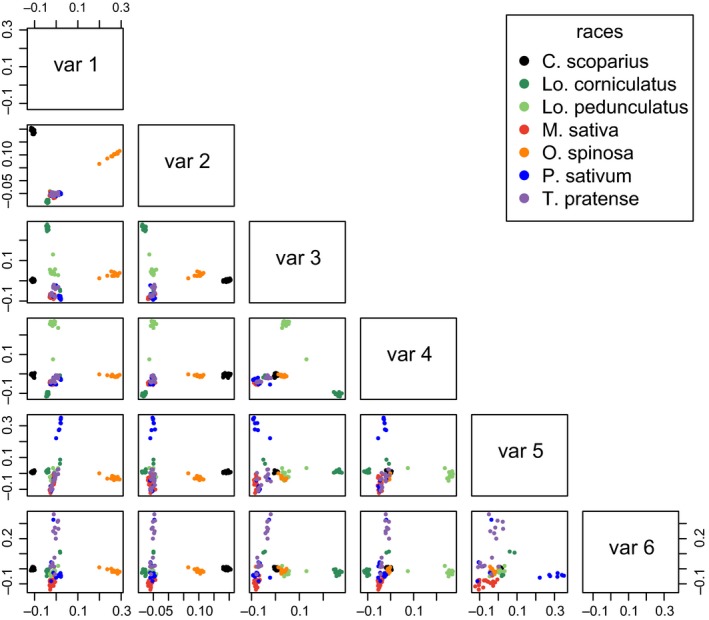
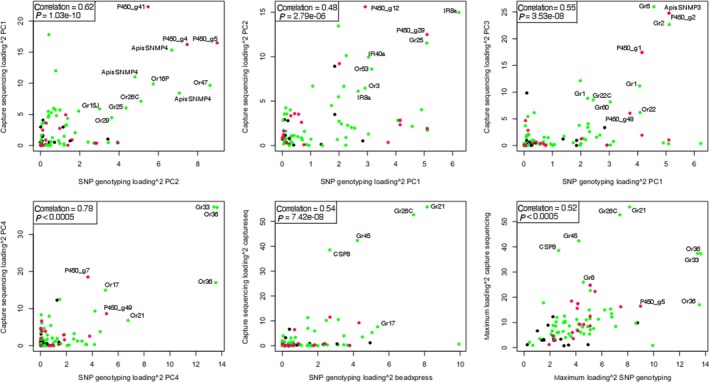
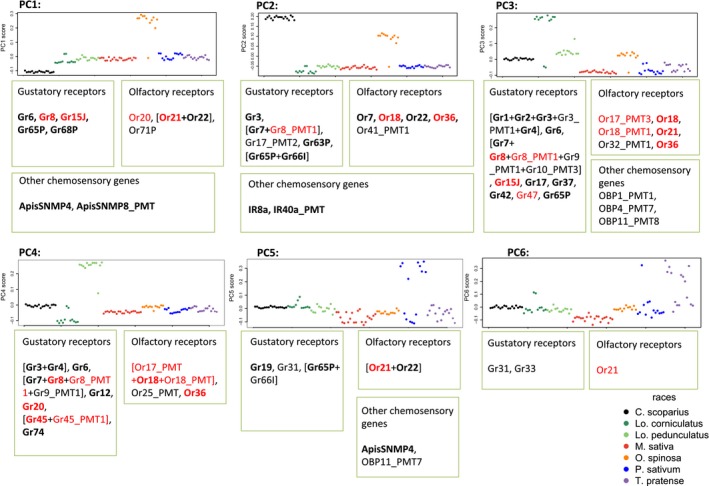
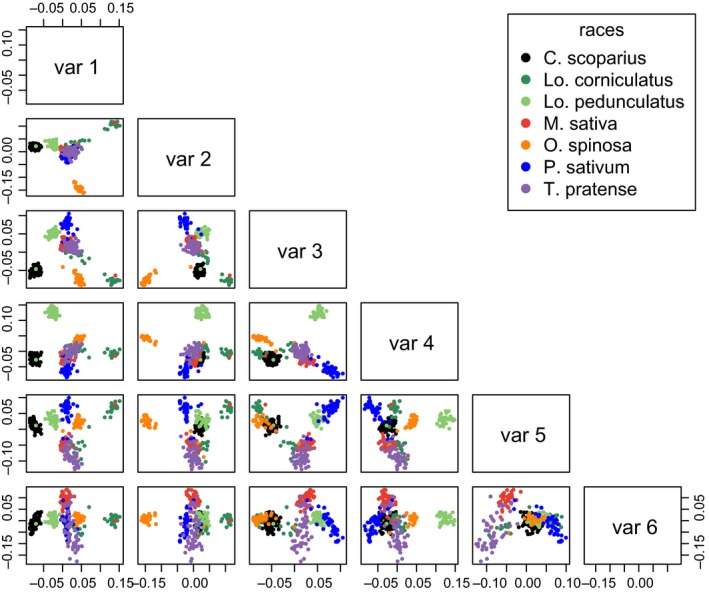
Host-associated races of phytophagous insects provide a model for understanding how adaptation to a new environment can lead to reproductive isolation and speciation, ultimately enabling us to connect barriers to gene flow to adaptive causes of divergence. The pea aphid (Acyrthosiphon pisum) comprises host races specializing on legume species and provides a unique system for examining the early stages of diversification along a gradient of genetic and associated adaptive divergence. As host choice produces assortative mating, understanding the underlying mechanisms of choice will contribute directly to understanding of speciation. As host choice in the pea aphid is likely mediated by smell and taste, we use capture sequencing and SNP genotyping to test for the role of chemosensory genes in the divergence between eight host plant species across the continuum of differentiation and sampled at multiple locations across western Europe. We show high differentiation of chemosensory loci relative to control loci in a broad set of pea aphid races and localities, using a model-free approach based on principal component analysis. Olfactory and gustatory receptors form the majority of highly differentiated genes and include loci that were already identified as outliers in a previous study focusing on the three most closely related host races. Consistent indications that chemosensory genes may be good candidates for local adaptation and barriers to gene flow in the pea aphid open the way to further investigations aiming to understand their impact on gene flow and to determine their precise functions in response to host plant metabolites.
植食性昆虫的寄主相关种群为理解适应新环境如何导致生殖隔离和物种形成提供了一个模型,最终使我们能够将基因流动的障碍与分化的适应性原因联系起来。豌豆蚜(Acyrthosiphon pisum)包括专门以豆科植物为寄主的寄主种群,为沿着遗传和相关适应性分化梯度研究多样化的早期阶段提供了一个独特的系统。由于寄主选择导致选型交配,了解选择的潜在机制将直接有助于对物种形成的理解。由于豌豆蚜的寄主选择可能由嗅觉和味觉介导,我们使用捕获测序和单核苷酸多态性基因分型来测试化学感应基因在跨越分化连续体的八种寄主植物物种之间的分化中所起的作用,并在西欧多个地点进行采样。我们使用基于主成分分析的无模型方法,在广泛的豌豆蚜种群和地点中展示了化学感应位点相对于对照位点的高度分化。嗅觉和味觉受体构成了高度分化基因的大部分,并且包括在先前一项针对三个关系最密切的寄主种群的研究中已被确定为异常值的位点。有一致迹象表明,化学感应基因可能是豌豆蚜局部适应和基因流动障碍的良好候选者,这为进一步研究开辟了道路,旨在了解它们对基因流动的影响,并确定它们在响应寄主植物代谢产物时的确切功能。