Blaazer C Joséphine H, Villacis-Perez Ernesto A, Chafi Rachid, Van Leeuwen Thomas, Kant Merijn R, Schimmel Bernardus C J
Department of Evolutionary and Population Biology, Institute for Biodiversity and Ecosystem Dynamics, University of Amsterdam, Amsterdam, Netherlands.
Department of Plants and Crops, Faculty of Bioscience Engineering, Ghent University, Ghent, Belgium.
Front Plant Sci. 2018 Jul 30;9:1057. doi: 10.3389/fpls.2018.01057. eCollection 2018.
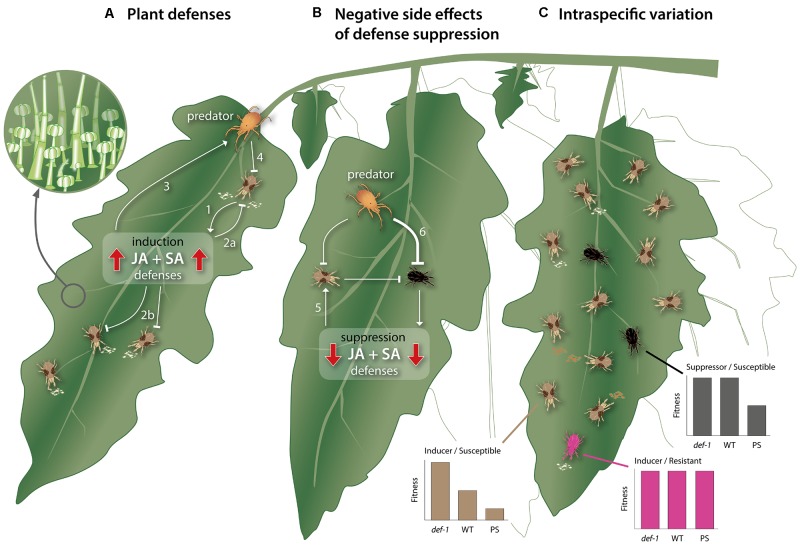
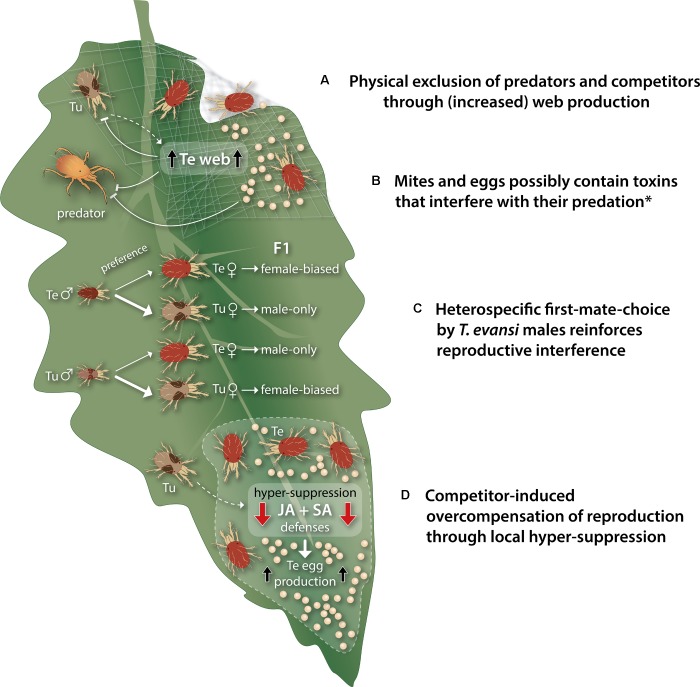
Plants have evolved numerous defensive traits that enable them to resist herbivores. In turn, this resistance has selected for herbivores that can cope with defenses by either avoiding, resisting or suppressing them. Several species of herbivorous mites, such as the spider mites and , were found to maximize their performance by suppressing inducible plant defenses. At first glimpse it seems obvious why such a trait will be favored by natural selection. However, defense suppression appeared to readily backfire since mites that do so also make their host plant more suitable for competitors and their offspring more attractive for natural enemies. This, together with the fact that spider mites are infamous for their ability to resist (plant) toxins directly, justifies the question as to why traits that allow mites to suppress defenses nonetheless seem to be relatively common? We argue that this trait may facilitate generalist herbivores, like , to colonize new host species. While specific detoxification mechanisms may, on average, be suitable only on a narrow range of similar hosts, defense suppression may be more broadly effective, provided it operates by targeting conserved plant signaling components. If so, resistance and suppression may be under frequency-dependent selection and be maintained as a polymorphism in generalist mite populations. In that case, the defense suppression trait may be under rapid positive selection in subpopulations that have recently colonized a new host but may erode in relatively isolated populations in which host-specific detoxification mechanisms emerge. Although there is empirical evidence to support these scenarios, it contradicts the observation that several of the mite species found to suppress plant defenses actually are relatively specialized. We argue that in these cases buffering traits may enable such mites to mitigate the negative side effects of suppression in natural communities and thus shield this trait from natural selection.
植物进化出了许多防御特性,使其能够抵御食草动物。反过来,这种抗性又促使食草动物进化出应对防御的能力,要么避开、抵抗,要么抑制这些防御。人们发现,几种植食性螨类,如叶螨和,通过抑制植物的诱导防御来最大化自身的生存能力。乍一看,这样的特性为何会受到自然选择的青睐似乎很明显。然而,防御抑制似乎很容易产生适得其反的效果,因为这样做的螨类也会使它们的寄主植物更适合竞争者,且它们的后代对天敌更具吸引力。再加上叶螨以其直接抵抗(植物)毒素的能力而臭名昭著,这就引发了一个问题:为什么能让螨类抑制防御的特性看起来仍然相对普遍?我们认为,这种特性可能有助于像这样的广食性食草动物定殖新的寄主物种。虽然特定的解毒机制平均而言可能只适用于范围狭窄的相似寄主,但防御抑制可能具有更广泛的效果,前提是它通过靶向保守的植物信号成分来发挥作用。如果是这样,抗性和抑制可能受到频率依赖选择,并在广食性螨类种群中作为一种多态性得以维持。在这种情况下,防御抑制特性在最近定殖新寄主的亚种群中可能会受到快速的正选择,但在出现寄主特异性解毒机制的相对孤立的种群中可能会逐渐消失。尽管有实证证据支持这些设想,但这与以下观察结果相矛盾:发现能抑制植物防御的几种螨类实际上相对特化。我们认为,在这些情况下,缓冲特性可能使这些螨类能够减轻自然群落中抑制作用的负面影响,从而使这种特性免受自然选择的影响。