• 文献检索
  • 文档翻译
  • 深度研究
  • 学术资讯
  • Suppr Zotero 插件Zotero 插件
  • 邀请有礼
  • 套餐&价格
  • 历史记录
应用&插件
Suppr Zotero 插件Zotero 插件浏览器插件Mac 客户端Windows 客户端微信小程序
定价
高级版会员购买积分包购买API积分包
服务
文献检索文档翻译深度研究API 文档MCP 服务
关于我们
关于 Suppr公司介绍联系我们用户协议隐私条款
关注我们

Suppr 超能文献

核心技术专利:CN118964589B侵权必究
粤ICP备2023148730 号-1Suppr @ 2026

文献检索

告别复杂PubMed语法,用中文像聊天一样搜索,搜遍4000万医学文献。AI智能推荐,让科研检索更轻松。

立即免费搜索

文件翻译

保留排版,准确专业,支持PDF/Word/PPT等文件格式,支持 12+语言互译。

免费翻译文档

深度研究

AI帮你快速写综述,25分钟生成高质量综述,智能提取关键信息,辅助科研写作。

立即免费体验

高迁移率族蛋白B1(HMGB1)和凝血酶介导血脑屏障功能障碍,作为神经炎症和阿尔茨海默病向神经退行性变发展的生物标志物。

HMGB1 and thrombin mediate the blood-brain barrier dysfunction acting as biomarkers of neuroinflammation and progression to neurodegeneration in Alzheimer's disease.

作者信息

Festoff Barry W, Sajja Ravi K, van Dreden Patrick, Cucullo Luca

机构信息

pHLOGISTIX LLC, 4220 Shawnee Mission Parkway, Fairway, KS, 66205, USA.

Department of Neurology, University of Kansas Medical Center, 3901 Rainbow Blvd, Kansas City, KS, 66160, USA.

出版信息

J Neuroinflammation. 2016 Aug 24;13(1):194. doi: 10.1186/s12974-016-0670-z.

DOI:10.1186/s12974-016-0670-z
PMID:27553758
原文链接:https://pmc.ncbi.nlm.nih.gov/articles/PMC4995775/
Abstract

BACKGROUND

The blood-brain barrier (BBB) dysfunction represents an early feature of Alzheimer's disease (AD) that precedes the hallmarks of amyloid beta (amyloid β) plaque deposition and neuronal neurofibrillary tangle (NFT) formation. A damaged BBB correlates directly with neuroinflammation involving microglial activation and reactive astrogliosis, which is associated with increased expression and/or release of high-mobility group box protein 1 (HMGB1) and thrombin. However, the link between the presence of these molecules, BBB damage, and progression to neurodegeneration in AD is still elusive. Therefore, we aimed to profile and validate non-invasive clinical biomarkers of BBB dysfunction and neuroinflammation to assess the progression to neurodegeneration in mild cognitive impairment (MCI) and AD patients.

METHODS

We determined the serum levels of various proinflammatory damage-associated molecules in aged control subjects and patients with MCI or AD using validated ELISA kits. We then assessed the specific and direct effects of such molecules on BBB integrity in vitro using human primary brain microvascular endothelial cells or a cell line.

RESULTS

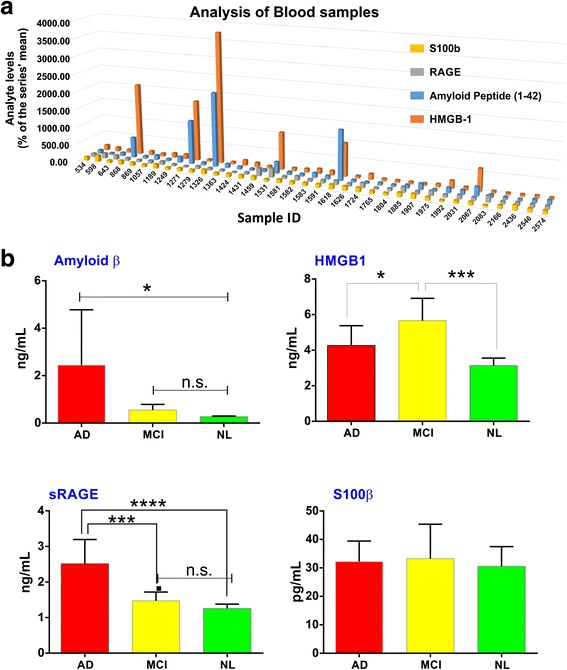
We observed a significant increase in serum HMGB1 and soluble receptor for advanced glycation end products (sRAGE) that correlated well with amyloid beta levels in AD patients (vs. control subjects). Interestingly, serum HMGB1 levels were significantly elevated in MCI patients compared to controls or AD patients. In addition, as a marker of BBB damage, soluble thrombomodulin (sTM) antigen, and activity were significantly (and distinctly) increased in MCI and AD patients. Direct in vitro BBB integrity assessment further revealed a significant and concentration-dependent increase in paracellular permeability to dextrans by HMGB1 or α-thrombin, possibly through disruption of zona occludins-1 bands. Pre-treatment with anti-HMGB1 monoclonal antibody blocked HMGB1 effects and leaving BBB integrity intact.

CONCLUSIONS

Our current studies indicate that thrombin and HMGB1 are causal proximate proinflammatory mediators of BBB dysfunction, while sTM levels may indicate BBB endothelial damage; HMGB1 and sRAGE might serve as clinical biomarkers for progression and/or therapeutic efficacy along the AD spectrum.

摘要

背景

血脑屏障(BBB)功能障碍是阿尔茨海默病(AD)的早期特征,早于淀粉样β蛋白(Aβ)斑块沉积和神经元神经原纤维缠结(NFT)形成等标志性病变。受损的血脑屏障与涉及小胶质细胞活化和反应性星形胶质细胞增生的神经炎症直接相关,这与高迁移率族蛋白B1(HMGB1)和凝血酶的表达增加和/或释放有关。然而,这些分子的存在、血脑屏障损伤与AD中神经退行性变进展之间的联系仍不明确。因此,我们旨在分析和验证血脑屏障功能障碍和神经炎症的非侵入性临床生物标志物,以评估轻度认知障碍(MCI)和AD患者神经退行性变的进展情况。

方法

我们使用经过验证的酶联免疫吸附测定(ELISA)试剂盒,测定了老年对照受试者以及MCI或AD患者血清中各种促炎损伤相关分子的水平。然后,我们使用人原代脑微血管内皮细胞或细胞系,在体外评估了这些分子对血脑屏障完整性的特异性和直接影响。

结果

我们观察到AD患者(与对照受试者相比)血清HMGB1和晚期糖基化终产物可溶性受体(sRAGE)显著增加,且与Aβ水平密切相关。有趣的是,与对照组或AD患者相比,MCI患者血清HMGB1水平显著升高。此外,作为血脑屏障损伤的标志物,可溶性血栓调节蛋白(sTM)抗原和活性在MCI和AD患者中显著(且明显)增加。体外血脑屏障完整性的直接评估进一步显示,HMGB1或α-凝血酶可使葡聚糖的细胞旁通透性显著且呈浓度依赖性增加,这可能是通过破坏紧密连接蛋白-1带实现的。用抗HMGB1单克隆抗体预处理可阻断HMGB1的作用并保持血脑屏障完整性。

结论

我们目前的研究表明,凝血酶和HMGB1是血脑屏障功能障碍的直接促炎介质,而sTM水平可能表明血脑屏障内皮损伤;HMGB1和sRAGE可能作为AD谱系中疾病进展和/或治疗效果的临床生物标志物。
https://cdn.ncbi.nlm.nih.gov/pmc/blobs/66bf/4995775/e88d851f37ab/12974_2016_670_Fig5_HTML.jpg
https://cdn.ncbi.nlm.nih.gov/pmc/blobs/66bf/4995775/e660f879ad21/12974_2016_670_Fig1_HTML.jpg
https://cdn.ncbi.nlm.nih.gov/pmc/blobs/66bf/4995775/17ea8a2caa07/12974_2016_670_Fig2_HTML.jpg
https://cdn.ncbi.nlm.nih.gov/pmc/blobs/66bf/4995775/6b485ff11487/12974_2016_670_Fig3_HTML.jpg
https://cdn.ncbi.nlm.nih.gov/pmc/blobs/66bf/4995775/7acb76955183/12974_2016_670_Fig4_HTML.jpg
https://cdn.ncbi.nlm.nih.gov/pmc/blobs/66bf/4995775/e88d851f37ab/12974_2016_670_Fig5_HTML.jpg
https://cdn.ncbi.nlm.nih.gov/pmc/blobs/66bf/4995775/e660f879ad21/12974_2016_670_Fig1_HTML.jpg
https://cdn.ncbi.nlm.nih.gov/pmc/blobs/66bf/4995775/17ea8a2caa07/12974_2016_670_Fig2_HTML.jpg
https://cdn.ncbi.nlm.nih.gov/pmc/blobs/66bf/4995775/6b485ff11487/12974_2016_670_Fig3_HTML.jpg
https://cdn.ncbi.nlm.nih.gov/pmc/blobs/66bf/4995775/7acb76955183/12974_2016_670_Fig4_HTML.jpg
https://cdn.ncbi.nlm.nih.gov/pmc/blobs/66bf/4995775/e88d851f37ab/12974_2016_670_Fig5_HTML.jpg

相似文献

1
HMGB1 and thrombin mediate the blood-brain barrier dysfunction acting as biomarkers of neuroinflammation and progression to neurodegeneration in Alzheimer's disease.高迁移率族蛋白B1(HMGB1)和凝血酶介导血脑屏障功能障碍,作为神经炎症和阿尔茨海默病向神经退行性变发展的生物标志物。
J Neuroinflammation. 2016 Aug 24;13(1):194. doi: 10.1186/s12974-016-0670-z.
2
Assessing blood-brain barrier dysfunction and its association with Alzheimer's pathology, cognitive impairment and neuroinflammation.评估血脑屏障功能障碍及其与阿尔茨海默病病理、认知障碍和神经炎症的关联。
Alzheimers Res Ther. 2024 Jul 31;16(1):172. doi: 10.1186/s13195-024-01529-1.
3
Blood-Brain Barrier Dysfunction and the Pathogenesis of Alzheimer's Disease.血脑屏障功能障碍与阿尔茨海默病发病机制。
Int J Mol Sci. 2017 Sep 13;18(9):1965. doi: 10.3390/ijms18091965.
4
The Relationship between Markers of Inflammation and Degeneration in the Central Nervous System and the Blood-Brain Barrier Impairment in Alzheimer's Disease.阿尔茨海默病中中枢神经系统炎症与退变标志物和血脑屏障损伤之间的关系
J Alzheimers Dis. 2017;59(3):903-912. doi: 10.3233/JAD-170220.
5
Anti-RAGE antibody attenuates isoflurane-induced cognitive dysfunction in aged rats.抗晚期糖基化终末产物受体抗体可减轻异氟烷诱导的老年大鼠认知功能障碍。
Behav Brain Res. 2017 Mar 30;322(Pt A):167-176. doi: 10.1016/j.bbr.2017.01.012. Epub 2017 Jan 20.
6
Blood-Brain Barrier Breakdown in Relationship to Alzheimer and Vascular Disease.血脑屏障与阿尔茨海默病和血管疾病的关系。
Ann Neurol. 2021 Aug;90(2):227-238. doi: 10.1002/ana.26134. Epub 2021 Jun 5.
7
Anti-high mobility group box-1 monoclonal antibody protects the blood-brain barrier from ischemia-induced disruption in rats.抗高迁移率族蛋白 B1 单克隆抗体保护血脑屏障免受缺血性损伤。
Stroke. 2011 May;42(5):1420-8. doi: 10.1161/STROKEAHA.110.598334. Epub 2011 Apr 7.
8
Proximate Mediators of Microvascular Dysfunction at the Blood-Brain Barrier: Neuroinflammatory Pathways to Neurodegeneration.血脑屏障微血管功能障碍的近期介质:神经炎症途径导致神经退行性变。
Biomed Res Int. 2017;2017:1549194. doi: 10.1155/2017/1549194. Epub 2017 Aug 14.
9
Electroacupuncture Improves Blood-Brain Barrier and Hippocampal Neuroinflammation in SAMP8 Mice by Inhibiting HMGB1/TLR4 and RAGE/NADPH Signaling Pathways.电针通过抑制HMGB1/TLR4和RAGE/NADPH信号通路改善SAMP8小鼠的血脑屏障和海马神经炎症
Chin J Integr Med. 2023 May;29(5):448-458. doi: 10.1007/s11655-023-3592-5. Epub 2023 Jan 7.
10
Plasma neuronal exosomes serve as biomarkers of cognitive impairment in HIV infection and Alzheimer's disease.血浆神经元外泌体可作为 HIV 感染和阿尔茨海默病认知障碍的生物标志物。
J Neurovirol. 2019 Oct;25(5):702-709. doi: 10.1007/s13365-018-0695-4. Epub 2019 Jan 4.

引用本文的文献

1
Increased Synapse Elimination by Inflammatory Cells Contributes to Long-lasting Post-Stroke Memory Dysfunction in Old Mice.炎症细胞导致的突触消除增加促成老年小鼠中风后长期记忆功能障碍。
bioRxiv. 2025 Jun 15:2025.06.13.659591. doi: 10.1101/2025.06.13.659591.
2
"Silent messengers of chaos: unveiling the dual threat of immune infiltrates in Japanese encephalitis virus neuroinflammatory storm".沉默的混乱使者:揭示日本脑炎病毒神经炎症风暴中免疫浸润的双重威胁
Virol J. 2025 May 31;22(1):173. doi: 10.1186/s12985-025-02805-8.
3
Adjunctive Sedation with Dexmedetomidine for the Prevention of Severe Inflammation and Septic Encephalopathy: A Pilot Randomized Controlled Study.

本文引用的文献

1
Anti-high mobility group box 1 antibody exerts neuroprotection in a rat model of Parkinson's disease.抗高迁移率族蛋白 B1 抗体在帕金森病大鼠模型中发挥神经保护作用。
Exp Neurol. 2016 Jan;275 Pt 1:220-31. doi: 10.1016/j.expneurol.2015.11.003. Epub 2015 Nov 10.
2
The blood-brain barrier endothelium: a target for pro-inflammatory cytokines.血脑屏障内皮细胞:促炎细胞因子的作用靶点。
Biochem Soc Trans. 2015 Aug;43(4):702-6. doi: 10.1042/BST20140319. Epub 2015 Aug 3.
3
Role of high-mobility group box-1 protein in disruption of vascular barriers and regulation of leukocyte-endothelial interactions.
右美托咪定辅助镇静预防严重炎症和脓毒症脑病:一项前瞻性随机对照研究。
Crit Care Med. 2025 Jul 1;53(7):e1377-e1388. doi: 10.1097/CCM.0000000000006655. Epub 2025 Mar 31.
4
Annexin A1, calreticulin and high mobility group box 1 are elevated in secondary progressive multiple sclerosis: Does immunogenic cell death occur in multiple sclerosis?膜联蛋白A1、钙网蛋白和高迁移率族蛋白B1在继发进展型多发性硬化症中升高:多发性硬化症中是否发生免疫原性细胞死亡?
Bioimpacts. 2024 Sep 8;15:30264. doi: 10.34172/bi.30264. eCollection 2025.
5
Seizures in brain tumors: pathogenesis, risk factors and management (Review).脑肿瘤中的癫痫发作:发病机制、危险因素与管理(综述)
Int J Mol Med. 2025 May;55(5). doi: 10.3892/ijmm.2025.5523. Epub 2025 Mar 21.
6
Changes in the pH value of the human brain in Alzheimer's disease pathology correlated with CD68-positive microglia: a community-based autopsy study in Beijing, China.阿尔茨海默病病理学中人类大脑pH值变化与CD68阳性小胶质细胞的相关性:中国北京一项基于社区的尸检研究
Mol Brain. 2025 Feb 10;18(1):10. doi: 10.1186/s13041-025-01180-3.
7
High mobility group box 1 (HMGB1) mediates nicotine-induced podocyte injury.高迁移率族蛋白B1(HMGB1)介导尼古丁诱导的足细胞损伤。
Front Pharmacol. 2025 Jan 7;15:1540639. doi: 10.3389/fphar.2024.1540639. eCollection 2024.
8
Role of Oxidative Stress in Blood-Brain Barrier Disruption and Neurodegenerative Diseases.氧化应激在血脑屏障破坏和神经退行性疾病中的作用
Antioxidants (Basel). 2024 Nov 28;13(12):1462. doi: 10.3390/antiox13121462.
9
More than microglia: myeloid cells and biomarkers in neurodegeneration.不止小胶质细胞:神经退行性变中的髓样细胞与生物标志物
Front Neurosci. 2024 Oct 31;18:1499458. doi: 10.3389/fnins.2024.1499458. eCollection 2024.
10
Blood-brain barrier disruption: a culprit of cognitive decline?血脑屏障破坏:认知衰退的罪魁祸首?
Fluids Barriers CNS. 2024 Aug 7;21(1):63. doi: 10.1186/s12987-024-00563-3.
高迁移率族蛋白盒1在破坏血管屏障及调节白细胞与内皮细胞相互作用中的作用
J Recept Signal Transduct Res. 2015;35(4):340-5. doi: 10.3109/10799893.2014.984309. Epub 2014 Nov 19.
4
The dynamic blood-brain barrier.动态血脑屏障。
FEBS J. 2015 Nov;282(21):4067-79. doi: 10.1111/febs.13412. Epub 2015 Sep 8.
5
Immune attack: the role of inflammation in Alzheimer disease.免疫攻击:炎症在阿尔茨海默病中的作用。
Nat Rev Neurosci. 2015 Jun;16(6):358-72. doi: 10.1038/nrn3880.
6
Amyloid β: one of three danger-associated molecules that are secondary inducers of the proinflammatory cytokines that mediate Alzheimer's disease.淀粉样β蛋白:三种与危险相关分子之一,是介导阿尔茨海默病的促炎细胞因子的次要诱导物。
Br J Pharmacol. 2015 Aug;172(15):3714-27. doi: 10.1111/bph.13181. Epub 2015 Jun 29.
7
Altered Nrf2 signaling mediates hypoglycemia-induced blood-brain barrier endothelial dysfunction in vitro.改变的Nrf2信号传导在体外介导低血糖诱导的血脑屏障内皮功能障碍。
PLoS One. 2015 Mar 25;10(3):e0122358. doi: 10.1371/journal.pone.0122358. eCollection 2015.
8
Alzheimer's disease drug-development pipeline: few candidates, frequent failures.阿尔茨海默病药物研发管线:候选药物寥寥,失败频频。
Alzheimers Res Ther. 2014 Jul 3;6(4):37. doi: 10.1186/alzrt269. eCollection 2014.
9
Disruption of blood-brain barrier in Alzheimer disease pathogenesis.阿尔茨海默病发病机制中血脑屏障的破坏
Tissue Barriers. 2013 Apr 1;1(2):e23993. doi: 10.4161/tisb.23993.
10
The neurovascular unit - concept review.神经血管单位——概念综述。
Acta Physiol (Oxf). 2014 Apr;210(4):790-8. doi: 10.1111/apha.12250.