Chen Xiao-Long, Chen Xin-Zu, Wang Yi-Gao, He Du, Lu Zheng-Hao, Liu Kai, Zhang Wei-Han, Wang Wei, Li Chang-Chun, Xue Lian, Zhao Lin-Yong, Yang Kun, Liu Jian-Ping, Zhou Zong-Guang, Hu Jian-Kun, Mo Xian-Ming
Department of Gastrointestinal Surgery, West China Hospital, Sichuan University, Chengdu 610041, China.
Laboratory of Gastric Cancer, State Key Laboratory of Biotherapy/Collaborative Innovation Center of Biotherapy and Cancer Center, West China Hospital, Sichuan University, Chengdu 610041, China.
Oncotarget. 2016 Sep 20;7(38):62049-62069. doi: 10.18632/oncotarget.11384.
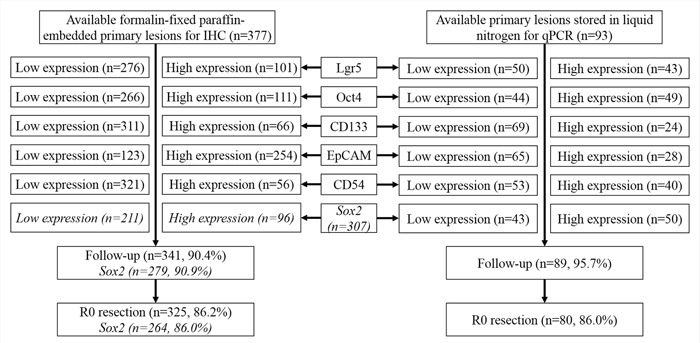
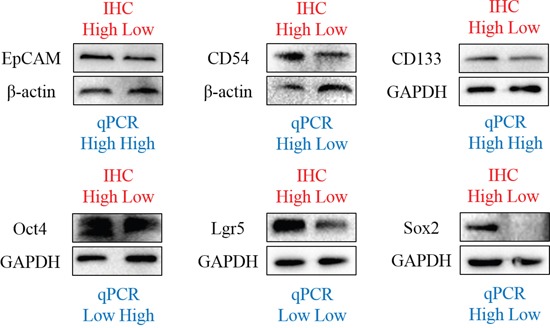
Cancer stem cells (CSCs) are thought as the source of tumor maintaining and many CSCs markers have been identified. Regarding the heterogeneity in gastric cancer (GC), TNM stage is not enough to accurately predict the prognosis. The aim of this study was to investigate the clinical significance of CSCs markers (Lgr5, Oct4, CD133, EpCAM, CD54 and Sox2) and establish a new model based on these markers to accurately predict prognosis of GC. We retrospectively enrolled 377 GC tissues from January 2006 to October 2012 to perform immunohistochemistry (IHC), and 93 pairs of GC tissues and corresponding adjacent normal gastric tissues to perform quantitative PCR (qPCR) from December 2011 to October 2012. The clinicopathological and follow-up characteristics were collected. In IHC, Oct4, CD133 and EpCAM were independently related to tumor progression, while Sox2 were associated with well or moderate differentiation (all p<0.05). Cox regression showed that Oct4-EpCAM was an independently prognostic factor, indicating that double low expression of Oct4-EpCAM group had significantly better prognosis than control group (p=0.035). Regarding qPCR, CD133 was an independent prognostic factor, showing that the prognosis of patients with CD133 high expression was significantly worse than that of patients with CD133 low expression (p<0.001). The prognostic prediction accuracy of nomogram based on Oct4-EpCAM expression in IHC was significantly better than TNM stage alone (p=0.003). Low expressions of Oct4-EpCAM in IHC and CD133 in qPCR were favorable prognostic factors in GC. The nomogram based on Oct4-EpCAM was valuable in prognostic prediction of GC patients.
癌症干细胞(CSCs)被认为是肿瘤维持的来源,并且已经鉴定出许多CSCs标志物。考虑到胃癌(GC)的异质性,TNM分期不足以准确预测预后。本研究的目的是探讨CSCs标志物(Lgr5、Oct4、CD133、EpCAM、CD54和Sox2)的临床意义,并基于这些标志物建立一个新模型以准确预测GC的预后。我们回顾性纳入了2006年1月至2012年10月的377例GC组织进行免疫组织化学(IHC)检测,并于2011年12月至2012年10月纳入93对GC组织及相应的癌旁正常胃组织进行定量PCR(qPCR)检测。收集临床病理和随访特征。在IHC中,Oct4、CD133和EpCAM与肿瘤进展独立相关,而Sox2与高分化或中分化相关(所有p<0.05)。Cox回归显示Oct4-EpCAM是一个独立的预后因素,表明Oct4-EpCAM双低表达组的预后明显优于对照组(p=0.035)。在qPCR方面,CD133是一个独立的预后因素,表明CD133高表达患者的预后明显差于CD133低表达患者(p<0.001)。基于IHC中Oct4-EpCAM表达的列线图的预后预测准确性明显优于单独的TNM分期(p=0.003)。IHC中Oct4-EpCAM低表达和qPCR中CD133低表达是GC的有利预后因素。基于Oct4-EpCAM的列线图在GC患者的预后预测中具有重要价值。