Zhang Xiaowei, Hua Ruixi, Wang Xiaofeng, Huang Mingzhu, Gan Lu, Wu Zhenhua, Zhang Jiejun, Wang Hongqiang, Cheng Yufan, Li Jin, Guo Weijian
Department of Medical Oncology, Fudan University Shanghai Cancer Center, Shanghai, China.
Department of Oncology, Shanghai Medical College, Fudan University, Cancer Hospital of Fudan University, Shanghai, China.
Oncotarget. 2016 Mar 1;7(9):9815-31. doi: 10.18632/oncotarget.6890.
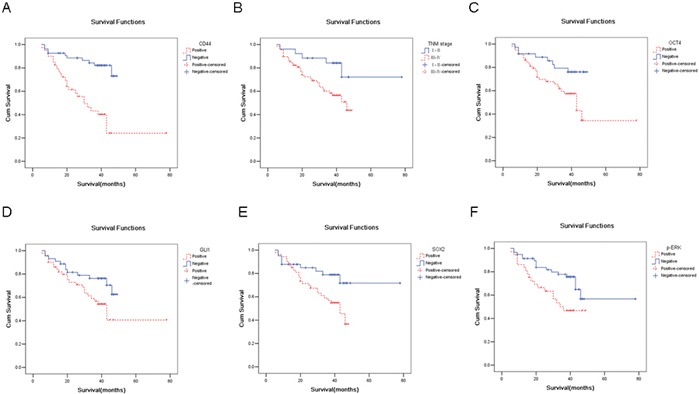
The existence of gastric cancer stem cells (CSCs) has not been definitively proven and specific cell surface markers for identifying gastric CSCs have largely not been identified. Our research aimed to isolate potential gastric CSCs and clarify their clinical significance, while defining markers for GCSC identification and verification. Here, we report that spheroid cells possess stem cell-like properties, and overexpress certain stem cell markers. CD133 or CD44-positive cells also exhibit properties of CSCs. The expression of Oct4, Sox2, Gli1, CD44, CD133, p-AKT, and p-ERK was significantly higher in metastatic lesions compared to that in primary lesions. Elevated expression of some of these proteins was correlated with a more aggressive phenotype and poorer prognosis, including Oct4, Sox2, Gli1, CD44, and p-ERK. Multivariate Cox proportional hazards model analysis showed that only CD44 is an independent factor. Knockdown of CD44 down-regulated the stem cell-like properties, which was accompanied by the down-regulation of p-ERK and Oct4. Oct4 overexpression could reverse the decreased CSCs properties induced by CD44 knockdown. Taken together, our research revealed that spheroid cell culture, and CD133 or CD44-labeled FACS methods can be used to isolate gastric CSCs. Some CSC markers have clinical significance in predicting the prognosis. CD44 is an independent prognostic factor and maintains the properties of CSCs in CD44-p-ERK-Oct4 positive feedback loop.
胃癌干细胞(CSCs)的存在尚未得到明确证实,用于识别胃癌干细胞的特异性细胞表面标志物在很大程度上也未被确定。我们的研究旨在分离潜在的胃癌干细胞并阐明其临床意义,同时确定用于胃癌干细胞识别和验证的标志物。在此,我们报告球形细胞具有干细胞样特性,并过度表达某些干细胞标志物。CD133或CD44阳性细胞也表现出癌症干细胞的特性。与原发性病变相比,转移性病变中Oct4、Sox2、Gli1、CD44、CD133、p-AKT和p-ERK的表达明显更高。其中一些蛋白质的表达升高与更具侵袭性的表型和更差的预后相关,包括Oct4、Sox2、Gli1、CD44和p-ERK。多变量Cox比例风险模型分析表明,只有CD44是一个独立因素。敲低CD44可下调干细胞样特性,同时伴有p-ERK和Oct4的下调。Oct4的过表达可逆转由CD44敲低诱导的癌症干细胞特性的降低。综上所述,我们的研究表明,球形细胞培养以及CD133或CD44标记的荧光激活细胞分选(FACS)方法可用于分离胃癌干细胞。一些癌症干细胞标志物在预测预后方面具有临床意义。CD44是一个独立的预后因素,并在CD44-p-ERK-Oct4正反馈回路中维持癌症干细胞的特性。