Kim Jin-Bae, Joung Hyun Jun, Lee Jung Myung, Woo Jong Shin, Kim Woo-Shik, Kim Kwon Sam, Lee Kyung Hye, Kim Weon
Division of Cardiology, Department of Internal Medicine, Kyung Hee University Hospital, Kyung Hee University, Seoul, Hoegi-dong 1, Dongdaemun-gu, Seoul, 130-701, Republic of Korea.
Trials. 2016 Aug 24;17(1):422. doi: 10.1186/s13063-016-1541-8.
Atrial fibrillation (AF) is known to be associated with several pathophysiological mechanisms including endothelial dysfunction of the heart and arterial vessels. Recent evidence suggests that new oral anticoagulant (NOAC) treatment may improve endothelial function and the inflammatory process involved in atherosclerosis in AF patients. This study is designed to determine the efficacy of NOAC therapy in the prevention of endothelial dysfunction and the progression of atherosclerosis of AF subjects.
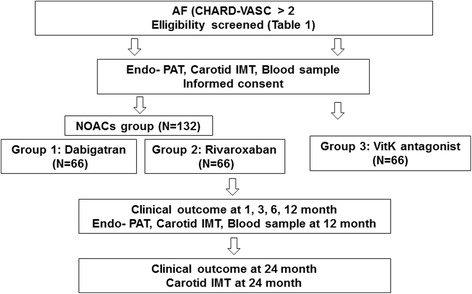
METHOD/DESIGN: AF patients with a CHA2DS2-VASc score >2 and no previous history of overt coronary disease, severe peripheral arterial disease (PAD) or major stroke will be registered and randomly assigned either to the NOAC group (dabigatran or rivaroxaban) or the warfarin group in this prospective, randomized, 2-year follow-up study. Reactive hyperemia peripheral arterial tonometry (RH-PAT) measurements reflecting endothelial function will be conducted using the Endo-PAT2000 device. Left and right carotid intima-media thickness (IMT) will be measured at baseline, 12 months, and 24 months. The primary endpoint is defined as change in Reactive Hyperemia Index (RHI) at 12 months. Secondary endpoints included changes in the right and left maximum IMT of the common carotid artery (CCA) and internal carotid artery (ICA), the mean IMT of the CCA and ICA at 24 months, and 24-month cardiovascular events including cardiac death, stroke, acute myocardial infarction (AMI), overall cause of death, withdrawal of drug, or bleeding events.
This is the first study to evaluate the efficacy of NOAC therapy for the prevention of endothelial dysfunction and progression of atherosclerosis in AF subjects. These findings are expected to expand the knowledge of NOAC pleotropic action in AF patients.
ClinicalTrials.gov: NCT02544932 , registered on 7 September 2015.
已知心房颤动(AF)与多种病理生理机制相关,包括心脏和动脉血管的内皮功能障碍。最近的证据表明,新型口服抗凝剂(NOAC)治疗可能改善房颤患者的内皮功能以及动脉粥样硬化所涉及的炎症过程。本研究旨在确定NOAC治疗在预防房颤患者内皮功能障碍和动脉粥样硬化进展方面的疗效。
方法/设计:在这项前瞻性、随机、为期2年的随访研究中,将纳入CHA2DS2-VASc评分>2且既往无明显冠心病、严重外周动脉疾病(PAD)或重大卒中病史的房颤患者,并随机分为NOAC组(达比加群或利伐沙班)或华法林组。将使用Endo-PAT2000设备进行反映内皮功能的反应性充血外周动脉张力测定(RH-PAT)测量。在基线、12个月和24个月时测量左右颈动脉内膜中层厚度(IMT)。主要终点定义为12个月时反应性充血指数(RHI)的变化。次要终点包括左右颈总动脉(CCA)和颈内动脉(ICA)最大IMT的变化、24个月时CCA和ICA的平均IMT,以及24个月时的心血管事件,包括心源性死亡、卒中、急性心肌梗死(AMI)、全因死亡、药物撤药或出血事件。
这是第一项评估NOAC治疗预防房颤患者内皮功能障碍和动脉粥样硬化进展疗效的研究。这些发现有望扩展对NOAC在房颤患者中多效作用的认识。
ClinicalTrials.gov:NCT02544932,于2015年9月7日注册。