Hintersteiner Beate, Lingg Nico, Zhang Peiqing, Woen Susanto, Hoi Kong Meng, Stranner Stefan, Wiederkum Susanne, Mutschlechner Oliver, Schuster Manfred, Loibner Hans, Jungbauer Alois
a Department of Biotechnology , University of Natural Resources and Life Sciences, Vienna , Vienna , Austria.
b Bioprocessing Technology Institute, Agency for Science, Technology and Research (A*STAR) , Centros , Singapore.
MAbs. 2016 Nov/Dec;8(8):1548-1560. doi: 10.1080/19420862.2016.1225642. Epub 2016 Aug 25.
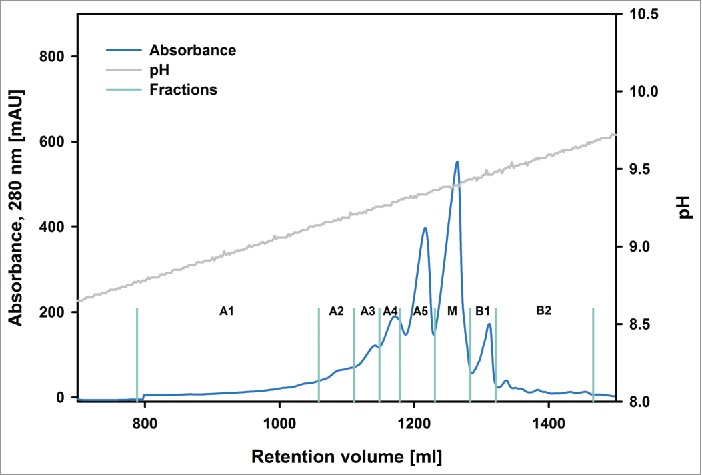
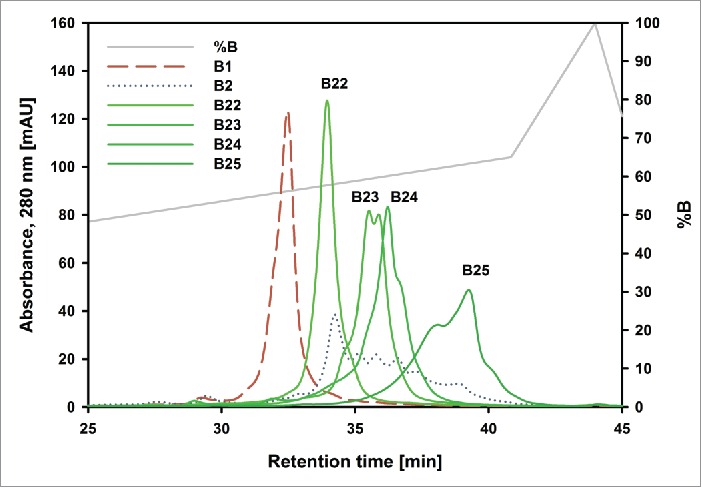
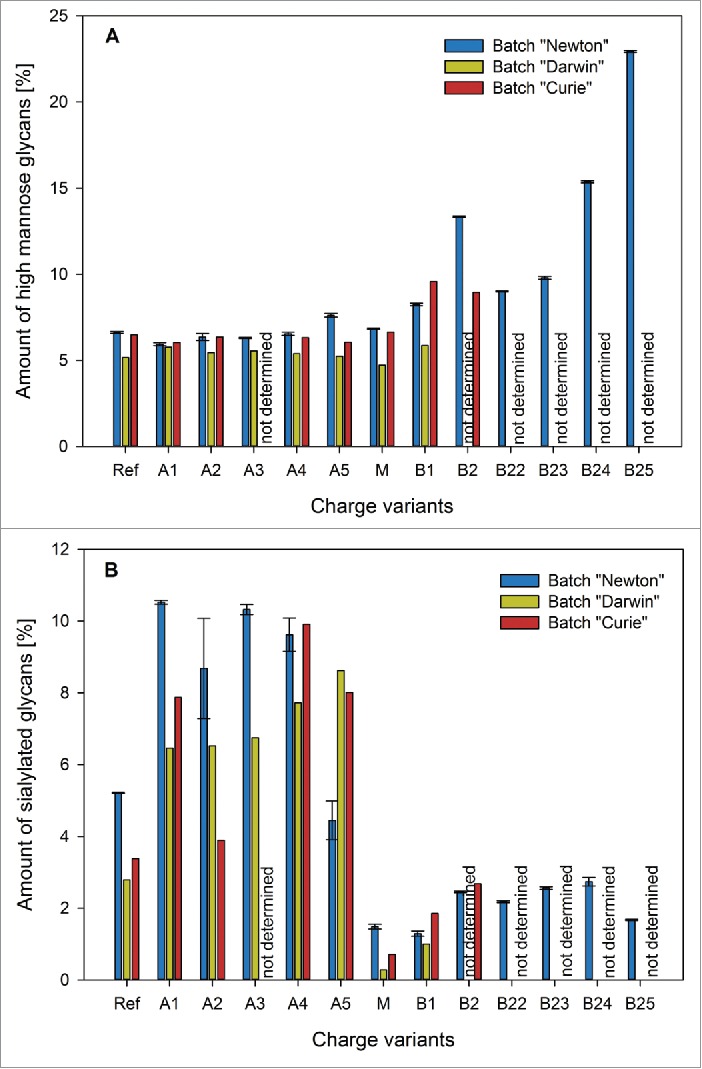
We identified active isoforms of the chimeric anti-GD2 antibody, ch14.18, a recombinant antibody produced in Chinese hamster ovary cells, which is already used in clinical trials. We separated the antibody by high resolution ion-exchange chromatography with linear pH gradient elution into acidic, main and basic charge variants on a preparative scale yielding enough material for an in-depth study of the sources and the effects of microheterogeneity. The binding affinity of the charge variants toward the antigen and various cell surface receptors was studied by Biacore. Effector functions were evaluated using cellular assays for antibody-dependent cell-mediated cytotoxicity and complement-dependent cytotoxicity. Basic charge variants showed increased binding to cell surface receptor FcγRIIIa, which plays a major role in regulating effector functions. Furthermore, increased binding of the basic fractions to the neonatal receptor was observed. As this receptor mediates the prolonged half-life of IgG in human serum, this data may well hint at an increased serum half-life of these basic variants compared to their more acidic counterparts. Different glycoform patterns, C-terminal lysine clipping and N-terminal pyroglutamate formation were identified as the main structural sources for the observed isoform pattern. Potential differences in structural stability between individual charge variant fractions by nano differential scanning calorimetry could not been detected. Our in-vitro data suggests that the connection between microheterogeneity and the biological activity of recombinant antibody therapeutics deserves more attention than commonly accepted.
我们鉴定了嵌合抗GD2抗体ch14.18的活性异构体,该抗体是在中国仓鼠卵巢细胞中产生的重组抗体,已用于临床试验。我们通过高分辨率离子交换色谱法,采用线性pH梯度洗脱,在制备规模上分离出该抗体的酸性、主要和碱性电荷变体,从而获得足够的材料用于深入研究微观不均一性的来源及其影响。通过Biacore研究了电荷变体对抗原和各种细胞表面受体的结合亲和力。使用细胞分析方法评估了抗体依赖性细胞介导的细胞毒性和补体依赖性细胞毒性的效应功能。碱性电荷变体显示出与细胞表面受体FcγRIIIa的结合增加,该受体在调节效应功能中起主要作用。此外,还观察到碱性组分与新生儿受体的结合增加。由于该受体介导IgG在人血清中的半衰期延长,这些数据很可能暗示这些碱性变体与其酸性更强的对应物相比,血清半衰期增加。不同的糖型模式、C末端赖氨酸截短和N末端焦谷氨酸形成被确定为观察到的异构体模式的主要结构来源。通过纳米差示扫描量热法未检测到各个电荷变体组分之间结构稳定性的潜在差异。我们的体外数据表明,微观不均一性与重组抗体治疗药物的生物活性之间的联系值得比通常认为的更多关注。