Ahmed Fahad W, Rider Rachel, Glanville Michael, Narayanan Kilimangalam, Razvi Salman, Weaver Jolanta U
Department of Diabetes, Queen Elizabeth Hospital, Gateshead, UK.
Institute of Cellular Medicine, Newcastle University, Framlington Place, Newcastle, NE2 4HH, UK.
Cardiovasc Diabetol. 2016 Aug 26;15(1):116. doi: 10.1186/s12933-016-0413-6.
Type 1 diabetes is associated with increased cardiovascular disease (CVD). Decreased endothelial progenitor cells (EPCs) number plays a pivotal role in reduced endothelial repair and development of CVD. We aimed to determine if cardioprotective effect of metformin is mediated by increasing circulating endothelial progenitor cells (cEPCs), pro-angiogenic cells (PACs) and decreasing circulating endothelial cells (cECs) count whilst maintaining unchanged glycemic control.
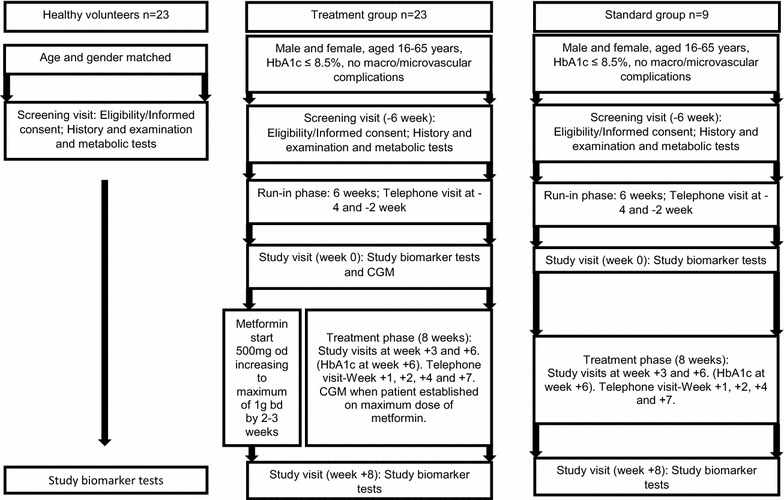
This study was an open label and parallel standard treatment study. Twenty-three type 1 diabetes patients without overt CVD were treated with metformin for 8 weeks (treatment group-TG). They were matched with nine type 1 diabetes patients on standard treatment (SG) and 23 age- and sex-matched healthy volunteers (HC). Insulin dose was adjusted to keep unchanged glycaemic control. cEPCs and cECs counts were determined by flow cytometry using surface markers CD45(dim)CD34(+)VEGFR-2(+) and CD45(dim)CD133(-)CD34(+)CD144(+) respectively. Peripheral blood mononuclear cells were cultured to assess changes in PACs number, function and colony forming units (CFU-Hill's colonies).
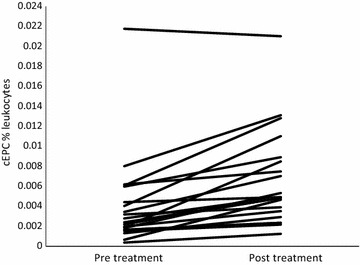
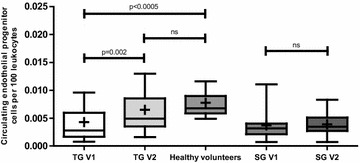
At baseline TG had lower cEPCs, PACs, CFU-Hills' colonies and PACs adhesion versus HC (p < 0.001-all variables) and higher cECs versus HC (p = 0.03). Metformin improved cEPCs, PACs, CFU-Hill's colonies number, cECs and PACs adhesion (p < 0.05-all variables) to levels seen in HC whilst HbA1c (one-way ANOVA p = 0.78) and glucose variability (average glucose, blood glucose standard deviation, mean amplitude of glycaemic excursion, continuous overall net glycaemic action and area under curve) remained unchanged. No changes were seen in any variables in SG. There was an inverse correlation between CFU-Hill's colonies with cECs.
Metformin has potential cardio-protective effect through improving cEPCs, CFU-Hill's colonies, cECs, PACs count and function independently of hypoglycaemic effect. This finding needs to be confirmed by long term cardiovascular outcome studies in type 1 diabetes. Trial registration ISRCTN26092132.
1型糖尿病与心血管疾病(CVD)风险增加相关。内皮祖细胞(EPCs)数量减少在血管内皮修复能力降低及CVD发展过程中起关键作用。我们旨在确定二甲双胍的心脏保护作用是否通过增加循环内皮祖细胞(cEPCs)、促血管生成细胞(PACs)数量及减少循环内皮细胞(cECs)数量来介导,同时维持血糖控制不变。
本研究为开放标签、平行标准治疗研究。23例无明显CVD的1型糖尿病患者接受二甲双胍治疗8周(治疗组-TG)。他们与9例接受标准治疗的1型糖尿病患者(SG)及23例年龄和性别匹配的健康志愿者(HC)进行匹配。调整胰岛素剂量以维持血糖控制不变。分别使用表面标志物CD45(dim)CD34(+)VEGFR-2(+)和CD45(dim)CD133(-)CD34(+)CD144(+)通过流式细胞术测定cEPCs和cECs数量。培养外周血单个核细胞以评估PACs数量、功能及集落形成单位(CFU-Hill集落)的变化。
基线时,与HC相比,TG的cEPCs、PACs、CFU-Hill集落及PACs黏附较低(所有变量p<0.001),cECs高于HC(p = 0.03)。二甲双胍改善了cEPCs、PACs数量、CFU-Hill集落数量、cECs及PACs黏附(所有变量p<0.05),使其达到HC中的水平,而糖化血红蛋白(单因素方差分析p = 0.78)及血糖变异性(平均血糖、血糖标准差、血糖波动平均幅度、连续总体净血糖作用及曲线下面积)保持不变。SG组的任何变量均无变化。CFU-Hill集落与cECs之间呈负相关。
二甲双胍具有潜在的心脏保护作用,可通过改善cEPCs、CFU-Hill集落、cECs数量及PACs数量和功能来实现,且独立于降糖作用。这一发现需要通过1型糖尿病长期心血管结局研究来证实。试验注册号:ISRCTN26092132。