Docherty James R, Steinhoff Martin, Lorton Dianne, Detmar Michael, Schäfer Gregor, Holmes Anna, Di Nardo Anna
Department of Physiology, Royal College of Surgeons in Ireland, Dublin, Ireland.
Department of Dermatology and Charles Institute for Translational Dermatology, University College Dublin, Dublin, Ireland.
Adv Ther. 2016 Nov;33(11):1885-1895. doi: 10.1007/s12325-016-0404-8. Epub 2016 Aug 25.
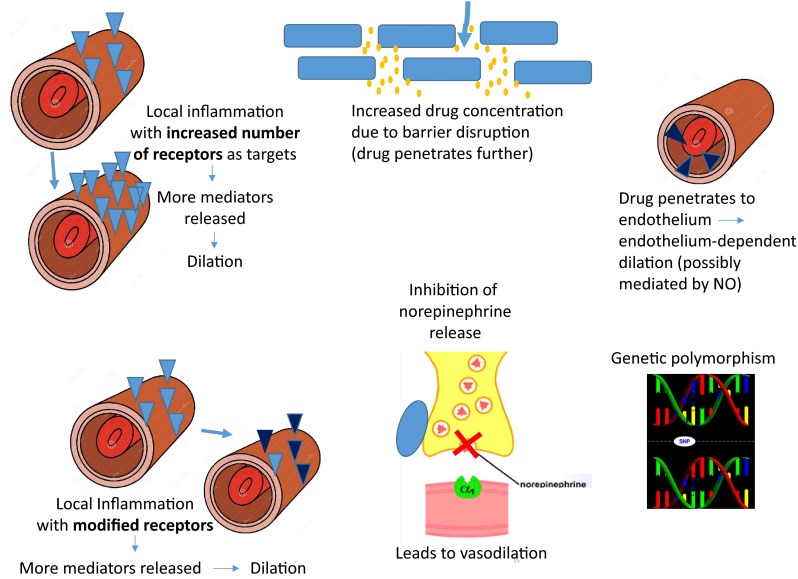
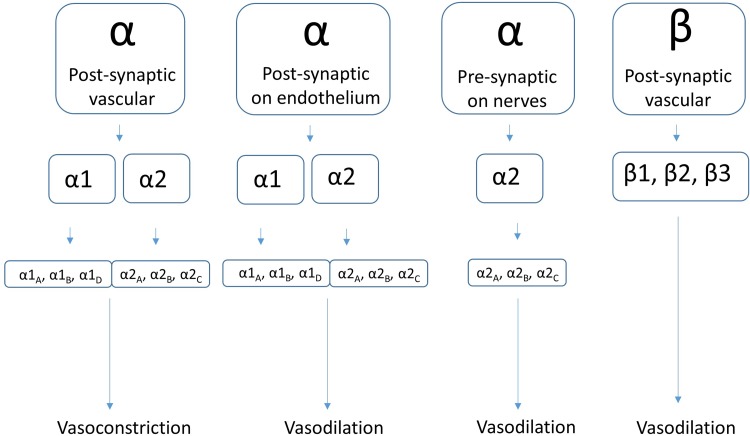
Rosacea is a chronic inflammatory disease with transient and non-transient redness as key characteristics. Brimonidine is a selective α2-adrenergic receptor (AR) agonist approved for persistent facial erythema of rosacea based on significant efficacy and good safety data. The majority of patients treated with brimonidine report a benefit; however, there have been sporadic reports of worsening erythema after the initial response. A group of dermatologists, receptor physiology, and neuroimmunology scientists met to explore potential mechanisms contributing to side effects as well as differences in efficacy. We propose the following could contribute to erythema after application: (1) local inflammation and perivascular inflammatory cells with abnormally functioning ARs may lead to vasodilatation; (2) abnormal saturation and cells expressing different AR subtypes with varying ligand affinity; (3) barrier dysfunction and increased skin concentrations of brimonidine with increased actions at endothelial and presynaptic receptors, resulting in increased vasodilation; and (4) genetic predisposition and receptor polymorphism(s) leading to different smooth muscle responses. Approximately 80% of patients treated with brimonidine experience a significant improvement without erythema worsening as an adverse event. Attention to optimizing skin barrier function, setting patient expectations, and strategies to minimize potential problems may possibly reduce further the number of patients who experience side effects.
Galderma International S.A.S., Paris, France.
酒渣鼻是一种慢性炎症性疾病,其主要特征为短暂性和非短暂性红斑。溴莫尼定是一种选择性α2肾上腺素能受体(AR)激动剂,基于显著的疗效和良好的安全性数据,被批准用于治疗酒渣鼻的持续性面部红斑。大多数接受溴莫尼定治疗的患者报告有疗效;然而,也有零星报道称,在初始反应后红斑会加重。一组皮肤科医生、受体生理学和神经免疫学科学家会面,探讨导致副作用以及疗效差异的潜在机制。我们提出以下因素可能导致用药后出现红斑:(1)局部炎症和血管周围炎症细胞以及功能异常的ARs可能导致血管扩张;(2)异常饱和以及表达具有不同配体亲和力的不同AR亚型的细胞;(3)屏障功能障碍以及溴莫尼定在皮肤中的浓度增加,在内皮和突触前受体上的作用增强,导致血管扩张增加;(4)遗传易感性和受体多态性导致不同的平滑肌反应。大约80%接受溴莫尼定治疗的患者有显著改善,且红斑没有作为不良事件加重。关注优化皮肤屏障功能、设定患者期望以及尽量减少潜在问题的策略,可能会进一步减少出现副作用的患者数量。
法国巴黎高德美公司。